THE CLASSIC COLLECTION✦The Disappearing EyeCLASSIC FREE BOOKS
The Disappearing Eye
Fergus Hume
THE CLASSIC COLLECTION · 1905
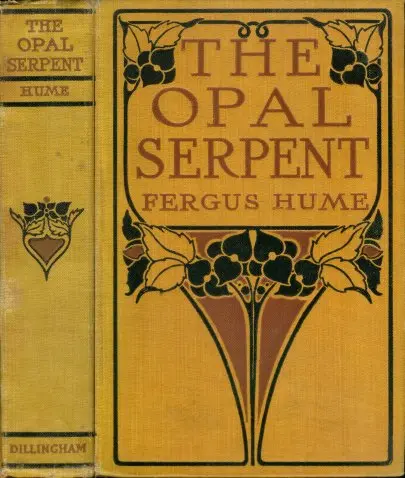
"The Opal Serpent" by Fergus Hume is a novel written in the early 20th century. The story centers on Paul Beecot, a young aspiring writer who leaves his oppressive home life behind to seek fame and fortune in London. As he navigates the city's literary scene, Paul's affections become entwined with Sylvia Norman, the daughter of a mysterious pawnbroker, Aaron Norman, who harbors secrets related to a peculiar brooch Paul wishes to sell. At the start of the novel, we meet Paul Beecot, who has just made the bold decision to leave his unsupportive family to pursue his writerly ambitions in London. His contentious relationship with his father hints at deeper family dynamics, particularly surrounding aspirations and control. As Paul explores the world of literature, he encounters Sylvia, and their mutual attraction unfolds against a backdrop of intrigue involving a jeweled serpent brooch owned by Sylvia's father. The opening establishes a sense of foreboding with Aaron Norman's peculiar behavior towards the brooch, suggesting that the story will explore themes of ambition, love, and the darker undercurrents of identity.
Introduction adapted from the source catalogue; source summaries may be automatically generated.
Free to read · English · 89,033 words · No account needed
MAKE TIME FOR A GOOD BOOK
On by default. Untick to stop anonymous reading totals. Each page counts after 10 seconds in view. How this works.
Anonymous counting is on unless you have switched it off.
The dinner was delightful, well cooked, daintily served, and leisurely eaten. A red-shaded lamp threw a rosy light on the white cloth, the glittering crystal and bright silver. The number of diners was less than the Muses, and more than the Graces, and everyone laid himself or herself out to make things bright. And again Maud Krill may be mentioned as an exception. She ate well and held her tongue, merely smiling heavily when addressed. Paul, glancing at her serene face across the rosy-hued table, wondered if she really was as calm as she looked, and if she really lacked the brain power her mother seemed to possess.
"I am glad to see you here, Beecot," said Hay, smiling.
"I am very glad to be here," said Paul, adapting himself to circumstances, "especially in such pleasant company."
"You don't go out much," said Lord George.
"No, I am a poor author who has yet to win his spurs."
"I thought of being an author myself," said the young man, "but it was such a fag to think about things."
"You want your material supplied to you perhaps," put in Mrs. Krill in a
calm, contemptuous way.
"Oh, no! If I wrote stories like the author johnnies I'd rake up my family history. There's lots of fun there."
"Your family mightn't like it," giggled Miss Qian. "I know lots of things about my own people which would read delightfully if Mr. Beecot set them down, but then--" she shrugged her dainty shoulders, "oh, dear me, what a row there would be!"
"I suppose there is a skeleton in every cupboard," said Hay, suavely, and quite ignoring the shady tenant in his own.
"There's a whole dozen cupboards with skeletons to match in my family," said the young lord. "Why, I had an aunt, Lady Rachel Sandal, who was murdered over twenty years ago. Now," he said, looking triumphantly round the table, "which of you can say there's a murder in your family--eh, ladies and gentlemen?"
Paul glanced sideways at Mrs. Krill, wondering what she would say, and wondering also how it was that Lord George did not know she was the widow of the murdered Lemuel Krill, whose name had been so widely advertised. But Hay spoke before anyone could make a remark. "What an unpleasant subject," he said, with a pretended shudder, "let us talk of less melodramatic things."
"Oh, why," said Mrs. Krill, using her fan. "I rather like to hear about
murders."
Your reading position is saved on this browser. Take it to another device with a library code. Reading pages adapt to text, rather than matching a printed edition.
Fergus Hume

Fergus Hume

Fergus Hume
Fergus Hume
BEHIND THE BOOK
This eBook is for the use of anyone anywhere in the United States and most other parts of the world at no cost and with almost no restrictions whatsoever. You may copy it, give it away or re-use it under the terms of the Project Gutenberg License included with this eBook or online at www.gutenberg.org. If you are not located in the United States, you will have to check the laws of the country where you are located before using this eBook. Read the source licence.
The original source file, including credits and licence, is retained by this library. Request an original-format copy at no charge. Please include the book title and Project Gutenberg identifier #24769.
KEEP YOUR CURIOSITY GOING
Coulson Kernahan

Maurice Baring
Frances Wright
Cécile Tormay

Frederic Jesup Stimson

W. H. P. (William Henry Pope) Jarvis