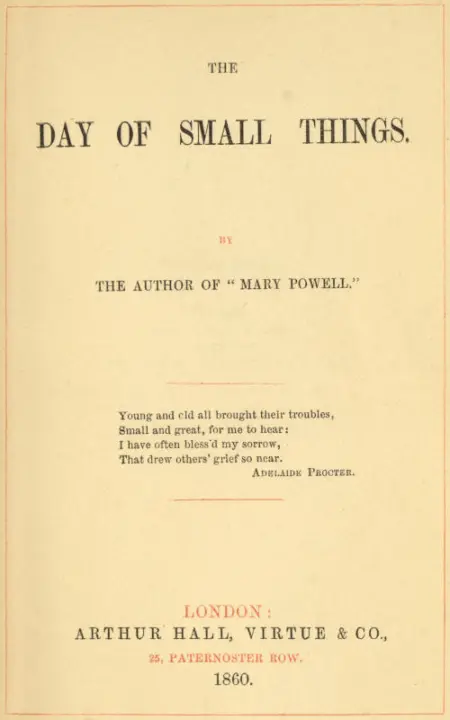
The Day of Small Things
Anne Manning
THE CLASSIC COLLECTION · 1855
"The Old Chelsea Bun-House: A Tale of the Last Century" by Anne Manning is a historical novel likely written in the mid-19th century. The story is set in a previous century, focusing on the life of Lady Betty Spadille, a once-celebrated lady of quality who now faces the silent struggles of aging and neglect amidst the bustling social scene of her youth. The narrative likely unfolds through the perspectives of characters such as Patty, the narrator, and Mrs. Gatty, Lady Betty's maid, exploring themes of social class, identity, and the contrast between frivolity and the harsh realities of life. At the start of the tale, we are introduced to Lady Betty Spadille, who reminisces about her glamorous past as a toast of society but now feels overshadowed by her decline into mediocrity. While enjoying a lavish outing at the bun-house, she exhibits the remnants of her former vivacity, yet her interactions are tinged with an air of desperation for attention and validation. Accompanying her are a group of spirited gentlemen and servants, each characterized by their social standing and manners. Amidst the festivities, the narrative shifts focus to Mrs. Gatty, whose humble background and longing for home highlight the contrasts in class and the emotional depth underlying the seemingly frivolous revelry around her. The opening invites readers to delve into a world of nostalgia and societal critique, marking the beginning of a story that balances humor and poignant observations about human nature and the passage of time.
Introduction adapted from the source catalogue; source summaries may be automatically generated.
Free to read · English · 53,141 words · No account needed
MAKE TIME FOR A GOOD BOOK
On by default. Untick to stop anonymous reading totals. Each page counts after 10 seconds in view. How this works.
Anonymous counting is on unless you have switched it off.
The Bed and Night-Clothes were soon prepared; and as I helped Mrs. Gatty to undress, I could not help noting, that though her Gown was of the plainest black Stuff, her under Garments were beautifully Fine, and fitted to a Nicety; which corroborated what she had said of her being a young Woman of good Condition. "You must not alarm yourself, Mrs. Gatty," said I; "you will very likely be quite well to-morrow."
"Don't call me Mrs. Gatty," says she. "Call me Gertrude, which is my proper Name, and it will put me in Mind of Home."
"Well, then, Mrs. Gertrude," said I.
"Not Mrs. at all, I entreat of you," said she, "plain, simple
Gertrude."
"Simple Gertrude, you may be," said I, "but plain Gertrude, you
certainly are not."
She smiled faintly, and said, "Ah, you are very Kind, and mean kindly; but the finest Compliment in the World is of little Value to me, compared with a Word of Kindness: and yours only pleases me so far as Kindness is expressed in it. And now, dear Mrs. Patty, let down the Curtain, and make the Chamber as dark as you can, and I will try to sleep; for my Head aches to Distraction, and there is Nothing you can do for me."
When I went down Stairs, I found my Mother mentioning Gatty's Case to Dr. Elwes, who frequently stepped in to smoak a quiet Pipe under our Elms. He immediately went up Stairs to see her; and was guarded in pronouncing whether she had a Fever, a Chill, a Surfeit, or what; but said Time would disclose, and he would see her again in the Morning. Meanwhile, she was to be kept Cool and Quiet; and he would write a Prescription for a Composing Draught; which accordingly he did.
"And now, with respect to Supper," said I, when he was gone. "Dear me! who has thought, all this Time, of Mr. Fenwick?"
No one had remembered him; so I immediately carried up his Whey and Buns, smote to the Heart at his having been so entirely overlooked. When I went in, he was still sitting at the Casement. He said, "Well, Leah!" with a gentle Smile, which assured me that he had heard and remembered what had passed at Lady Betty's Table.
"Dear Sir," said I, "I am quite sorry you should have been so long forgotten. We have had such a noisy Party this Afternoon."
"Rather tumultuous certainly," said he; "they helped to amuse me, and it was not my Fault that I heard every Word they said."
"How loudly High-Bred People laugh and talk, Sir!" said I.
Your reading position is saved on this browser. Take it to another device with a library code. Reading pages adapt to text, rather than matching a printed edition.
BEHIND THE BOOK
This eBook is for the use of anyone anywhere in the United States and most other parts of the world at no cost and with almost no restrictions whatsoever. You may copy it, give it away or re-use it under the terms of the Project Gutenberg License included with this eBook or online at www.gutenberg.org. If you are not located in the United States, you will have to check the laws of the country where you are located before using this eBook. Read the source licence.
The original source file, including credits and licence, is retained by this library. Request an original-format copy at no charge. Please include the book title and Project Gutenberg identifier #51829.
KEEP YOUR CURIOSITY GOING
Cécile Tormay

Moritz Busch
Coulson Kernahan
John L. Ransom

Maurice Baring
Frances Wright