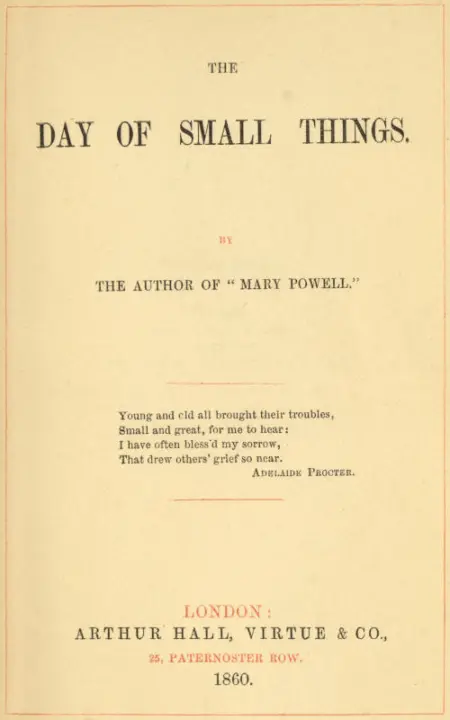
The Day of Small Things
Anne Manning
THE CLASSIC COLLECTION · 1855
"The Old Chelsea Bun-House: A Tale of the Last Century" by Anne Manning is a historical novel likely written in the mid-19th century. The story is set in a previous century, focusing on the life of Lady Betty Spadille, a once-celebrated lady of quality who now faces the silent struggles of aging and neglect amidst the bustling social scene of her youth. The narrative likely unfolds through the perspectives of characters such as Patty, the narrator, and Mrs. Gatty, Lady Betty's maid, exploring themes of social class, identity, and the contrast between frivolity and the harsh realities of life. At the start of the tale, we are introduced to Lady Betty Spadille, who reminisces about her glamorous past as a toast of society but now feels overshadowed by her decline into mediocrity. While enjoying a lavish outing at the bun-house, she exhibits the remnants of her former vivacity, yet her interactions are tinged with an air of desperation for attention and validation. Accompanying her are a group of spirited gentlemen and servants, each characterized by their social standing and manners. Amidst the festivities, the narrative shifts focus to Mrs. Gatty, whose humble background and longing for home highlight the contrasts in class and the emotional depth underlying the seemingly frivolous revelry around her. The opening invites readers to delve into a world of nostalgia and societal critique, marking the beginning of a story that balances humor and poignant observations about human nature and the passage of time.
Introduction adapted from the source catalogue; source summaries may be automatically generated.
Free to read · English · 53,141 words · No account needed
MAKE TIME FOR A GOOD BOOK
On by default. Untick to stop anonymous reading totals. Each page counts after 10 seconds in view. How this works.
Anonymous counting is on unless you have switched it off.
"Well, Prue," said he briskly, "I gave Patty a Treat last Night, so
now it's your Turn."
"You did give Patty a Treat, indeed, my Lad," says my Father
ironically.
"I'm glad she found it so, Uncle," says he, quite cheerfully, "so, To-Night, Prudence, I'll take you to the Play."
"I don't know that I want to go," says Prudence.
"Oh! very well, then I'll take Patty."
"Thank you, Tom," said I, "but I don't quite approve of Theatrical
Amusements."
"You don't? Oh my Goodness!--And do you disapprove of them, Prue?"
"No, not I," said Prue, "I think Patty more nice than wise."
"Oh, then, come along like a good Girl, and let's go together."
"But, Tom," says my Father, "I shall put a Spoke in that Wheel, unless you promise you won't forsake her as you did Patty last Night."
"I'll promise you a Dozen Times, Uncle, if you think that will make
it more secure."
"No, if you promise once in earnest, that will do."
"I do promise."
"But, Tom," put in my dear Mother, "I share Patty's Objections to the Play-House, and I think two such young Heads as you and Prue are hardly to be trusted there. In short, I would rather she did not go."
Prue pouted a little on this--My Father began to chafe.
"Fiddlesticks, my Dear," says he, "you and I often went to a Play together when we were young, and why shouldn't they?"
"Why, my Dear, as I am no longer young, I see Things in a different
Light."
"It may not be a truer Light, though, Mrs. Honeywood, and you can't expect young Folks to see Things differently from what you yourself did when you were young. Tut, tut! let the Girl go, and say no more about it."
"But, Mr. Honeywood...."
"But, Madam!" (very loud and angry,) "haven't I said it should be so, and have I a Right to be minded?"
Here my Mother turned pale and trembled, which I never could bear to see; and I was going to urge Prue and Tom, in a low Voice, to give up their Treat rather than foment a Family Quarrel, when I was called into the Shop, which prevented my knowing how the Matter ended. Presently Tom went through the Shop, out of the House; and the next Time I could look into the Parlour, it was empty.
Your reading position is saved on this browser. Take it to another device with a library code. Reading pages adapt to text, rather than matching a printed edition.
BEHIND THE BOOK
This eBook is for the use of anyone anywhere in the United States and most other parts of the world at no cost and with almost no restrictions whatsoever. You may copy it, give it away or re-use it under the terms of the Project Gutenberg License included with this eBook or online at www.gutenberg.org. If you are not located in the United States, you will have to check the laws of the country where you are located before using this eBook. Read the source licence.
The original source file, including credits and licence, is retained by this library. Request an original-format copy at no charge. Please include the book title and Project Gutenberg identifier #51829.
KEEP YOUR CURIOSITY GOING
Cécile Tormay

Moritz Busch
Coulson Kernahan
John L. Ransom

Maurice Baring
Frances Wright