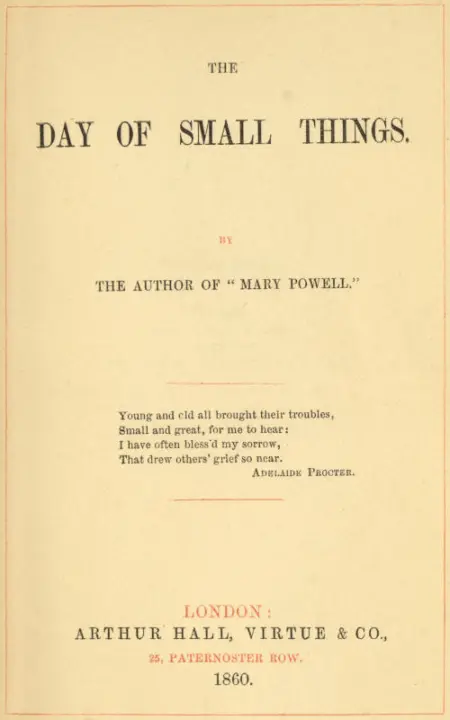
The Day of Small Things
Anne Manning
THE CLASSIC COLLECTION · 1855
"The Old Chelsea Bun-House: A Tale of the Last Century" by Anne Manning is a historical novel likely written in the mid-19th century. The story is set in a previous century, focusing on the life of Lady Betty Spadille, a once-celebrated lady of quality who now faces the silent struggles of aging and neglect amidst the bustling social scene of her youth. The narrative likely unfolds through the perspectives of characters such as Patty, the narrator, and Mrs. Gatty, Lady Betty's maid, exploring themes of social class, identity, and the contrast between frivolity and the harsh realities of life. At the start of the tale, we are introduced to Lady Betty Spadille, who reminisces about her glamorous past as a toast of society but now feels overshadowed by her decline into mediocrity. While enjoying a lavish outing at the bun-house, she exhibits the remnants of her former vivacity, yet her interactions are tinged with an air of desperation for attention and validation. Accompanying her are a group of spirited gentlemen and servants, each characterized by their social standing and manners. Amidst the festivities, the narrative shifts focus to Mrs. Gatty, whose humble background and longing for home highlight the contrasts in class and the emotional depth underlying the seemingly frivolous revelry around her. The opening invites readers to delve into a world of nostalgia and societal critique, marking the beginning of a story that balances humor and poignant observations about human nature and the passage of time.
Introduction adapted from the source catalogue; source summaries may be automatically generated.
Free to read · English · 53,141 words · No account needed
MAKE TIME FOR A GOOD BOOK
On by default. Untick to stop anonymous reading totals. Each page counts after 10 seconds in view. How this works.
Anonymous counting is on unless you have switched it off.
and Gatty frowns at her. Mr. Fenwick, perceiving some By-Play going on, stops to ask if they have Anything to say. Prudence hangs her Head over her Work, colours a little, and says, "No, Sir."
"I believe," says Mr. Fenwick, glancing over the Leaves, "I had better modernize the old Style a little, that you may follow it better."
We all thanked him, except Prudence, who said she liked it best as it
was.
"Why? Did she understand it?"
"No."
"Then why did she like it?"
"Because she did." This Answer made Mr. Fenwick laugh; but I must say I thought it very stupid. However, he went on, till within a few Verses of the End; when my Father walked in.
Mr. Fenwick, laying down the Book with that Cheerfulness and
Self-Possession which so well became him, took the first Word, and
said--
"Good Evening, Mr. Honeywood! Here am I, you see, reading to your good Wife and Daughters, and trying to prepare myself for Duty on a larger Scale."
"Sir, you do us honour," says my Father, quite civilly; "your Company must be an Honour to us at any Time, whenever you please to bestow it on us. Pray go on."
"Oh, we can wait a little While," says Mr. Fenwick. "Pray, is there
any News stirring?"
"There's a Whale in the Thames," says my Father.
"Indeed!" cried we all.
"And there's an Eye-lash in my Eye," continues he; "pray, Mrs. Honeywood, come and take it out."
While my Mother was thus engaged, we chatted among ourselves. "What will you have, Father?" said I. "Shall I make you some Tea?"
"No, I'd rather you put on Supper half an Hour, and let me have Something broiled, and some mulled Wine and Toast."
When I returned from giving Orders, I found my Father established in his Arm-Chair, my Mother returned to her Snipping, Prue and Gatty embroidering different Corners of the same Apron, and Mr. Fenwick ready to resume his Reading. The Poem was soon finished, and when we had talked it over a little, he asked us what he should read next. I said I thought he had better not do too much at first, and Supper would soon be ready. He said, "Oh, he was just getting into the Humour of it, and there was Plenty of Time to read some short Piece before Supper." So then my Mother said she thought a Paper of the Tatler would be just long enough; and mentioned a favourite Number that she had not read for a good While--that charming Piece[1] beginning,--"There are several Persons who have many Pleasures and Entertainments in their Possession which they do not enjoy;" and proceeding to give such a touching Picture of domestic Felicity. Mr. Fenwick read it with such Feeling that we were all delighted with it; and it seemed to me that even my Father, who sat quite silent, with his Back to us, was moved by it, for I noticed his breathing very hard,--his only Way of expressing strong Feeling. "Ah!" thought I to myself, "if Mr. Fenwick were to read to us in this nice Way every Evening, and my Father were to grow fond of it and of him, and get into the Way of coming Home early, instead of sipping Spirits and Water with Don Saltero, how happy we should be!"
Your reading position is saved on this browser. Take it to another device with a library code. Reading pages adapt to text, rather than matching a printed edition.
BEHIND THE BOOK
This eBook is for the use of anyone anywhere in the United States and most other parts of the world at no cost and with almost no restrictions whatsoever. You may copy it, give it away or re-use it under the terms of the Project Gutenberg License included with this eBook or online at www.gutenberg.org. If you are not located in the United States, you will have to check the laws of the country where you are located before using this eBook. Read the source licence.
The original source file, including credits and licence, is retained by this library. Request an original-format copy at no charge. Please include the book title and Project Gutenberg identifier #51829.
KEEP YOUR CURIOSITY GOING
Cécile Tormay

Moritz Busch
Coulson Kernahan
John L. Ransom

Maurice Baring
Frances Wright