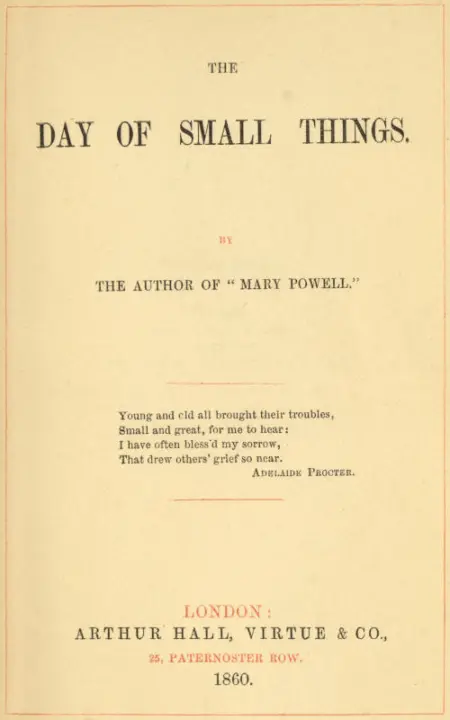
The Day of Small Things
Anne Manning
THE CLASSIC COLLECTION · 1855
"The Old Chelsea Bun-House: A Tale of the Last Century" by Anne Manning is a historical novel likely written in the mid-19th century. The story is set in a previous century, focusing on the life of Lady Betty Spadille, a once-celebrated lady of quality who now faces the silent struggles of aging and neglect amidst the bustling social scene of her youth. The narrative likely unfolds through the perspectives of characters such as Patty, the narrator, and Mrs. Gatty, Lady Betty's maid, exploring themes of social class, identity, and the contrast between frivolity and the harsh realities of life. At the start of the tale, we are introduced to Lady Betty Spadille, who reminisces about her glamorous past as a toast of society but now feels overshadowed by her decline into mediocrity. While enjoying a lavish outing at the bun-house, she exhibits the remnants of her former vivacity, yet her interactions are tinged with an air of desperation for attention and validation. Accompanying her are a group of spirited gentlemen and servants, each characterized by their social standing and manners. Amidst the festivities, the narrative shifts focus to Mrs. Gatty, whose humble background and longing for home highlight the contrasts in class and the emotional depth underlying the seemingly frivolous revelry around her. The opening invites readers to delve into a world of nostalgia and societal critique, marking the beginning of a story that balances humor and poignant observations about human nature and the passage of time.
Introduction adapted from the source catalogue; source summaries may be automatically generated.
Free to read · English · 53,141 words · No account needed
MAKE TIME FOR A GOOD BOOK
On by default. Untick to stop anonymous reading totals. Each page counts after 10 seconds in view. How this works.
Anonymous counting is on unless you have switched it off.
"Sir," said I, "allow me to say that you did not know where the Gift of that Speech lay last Night. My Father had presented my Mother with a Group of Porcelain Figures, representing the Five Senses, which she, in her Care for them, had put away."
"Was that all?" cried he, his Countenance immediately changing. "Oh, I see!--aye, aye--How absurd my Blunder was! Upon my Word, Ma'am, I beg your Pardon for having been so unmannerly. Shocking! shameful!"
Here we came upon Mr. Fenwick, who finding himself exposed to a chill Current of Air under the Elms, had got under the Shelter of the House, where my Father had set up a pretty enough rustical Seat, just outside of our Dairy Wire-Lattice. Hence it came to pass that I, being presently engaged in seeing the Afternoon Milk brought in, heard a good deal of what passed between the two Gentlemen, whether I would or no.
"I've secured Dodsley's Ear," says Mr. Caryl, cheerfully, "so that I fancy I have but to speak a Word to secure your Piece a Place in his Collection. Nothing remains to be done but for you to attend to a little Revision in the first Place, before you submit it to his critical Eye. What say you?"
"Say? That I am infinitely obliged."
"'Let my future Life,' &c.--hey? We'll suppose that all spoken. Well, here is your Manuscript; I've just scored through what I think had better be altered and left out. You are not doubtful of my Judgment, I suppose?"
"Surely not--Just allow me to see."--
"Look here,--and here--those had better come out. Here again....
What's 'Phoebus' Mane?'"
"Phoebus' Wain."
"Oh, I see. That's your bad writing; Hand-writing, of course, I mean. Here again, 'thwarting Thunder.'"
"That's Miltonic."
"Is it?"
"'And heal the Harms of thwarting Thunder blue.'"
"Hum! Well then, it strikes me, that Milton having said so once, you had better not say it again."
"Very well, I will not."
"Then, this about Truth. It's very bad--will never do. I was obliged to skip it in reading to Dodsley."
"But why?"
"Why? Why, because it isn't the Thing!--won't go down, Sir! You carry it out too far, farther than Anybody goes; it's so much Clap-Trap, and spoils what's real."
"But it is not Clap-Trap. It says no more than I mean and feel! No, no; I'll give up verbal Points to your better Taste, but in Matters of Principle, I cannot alter."
Your reading position is saved on this browser. Take it to another device with a library code. Reading pages adapt to text, rather than matching a printed edition.
BEHIND THE BOOK
This eBook is for the use of anyone anywhere in the United States and most other parts of the world at no cost and with almost no restrictions whatsoever. You may copy it, give it away or re-use it under the terms of the Project Gutenberg License included with this eBook or online at www.gutenberg.org. If you are not located in the United States, you will have to check the laws of the country where you are located before using this eBook. Read the source licence.
The original source file, including credits and licence, is retained by this library. Request an original-format copy at no charge. Please include the book title and Project Gutenberg identifier #51829.
KEEP YOUR CURIOSITY GOING
Cécile Tormay

Moritz Busch
Coulson Kernahan
John L. Ransom

Maurice Baring
Frances Wright