Hours with the Ghosts or, Nineteenth Century Witchcraft Illustrated Investigations into the Phenomena of Spiritualism and Theosophy
Henry Ridgely Evans
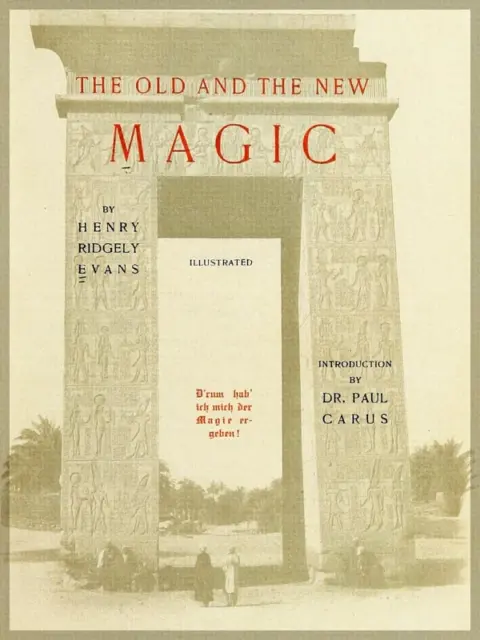
THE CLASSIC COLLECTION · 1906
"The Old and the New Magic" by Henry Ridgely Evans is a historical account written in the early 20th century. The book explores the evolution of magic from its ancient origins to modern performances, discussing various magicians and techniques throughout history. The main focus is likely on contrasting "old magic," associated with mysticism and superstition, with "new magic," which incorporates scientific principles and psychological illusions. At the start of the text, the author presents an introduction by Dr. Paul Carus, outlining the significance of magic as an art form while emphasizing the divide between its old and new iterations. Carus delves into the historical roots of magic, tracing its etymology and historical context, suggesting that magic has always been intertwined with religion and superstition. He begins to illustrate how ancient practices and beliefs have transformed into the modern magic tricks we recognize today, setting the stage for a detailed examination of notable figures and performances in magic’s rich history.
Introduction adapted from the source catalogue; source summaries may be automatically generated.
Free to read · English · 112,881 words · No account needed
MAKE TIME FOR A GOOD BOOK
On by default. Untick to stop anonymous reading totals. Each page counts after 10 seconds in view. How this works.
Anonymous counting is on unless you have switched it off.
Spirit writing, Cagliostro’s, 54; Herrmann’s, 219.
Stage, Houdin’s, 138.
Stodare, Colonel, and Sphinx illusion, 320, 324, 325.
Svengalis, silent second sight, 194–198.
Swing, magic, xx–xxiii.
Sword trick, xxiii, xxiv.
Tabarin, Trewey’s, 341, 342.
Tables, conjuring, 18, 138.
Talrich’s decapitè parlant, 325, 326.
Tarsus, temple of, illusions, 2.
Tavern of the dead. See Cabaret du Néant.
Temple doors. See Doors, temple.
Ten-Ichi, thumb-tying trick, 27.
Theurgists, deceptions of, 2.
Thibetan mail, 219, 220.
Thompson, Alfred, and Sphinx illusion, 320–322.
Thumb-tying trick, Pinetti’s, 27; Ten Ichi’s, 27.
Thurston, Howard, tricks and illusions of, 278.
Tobin, Thomas, inventor of Sphinx illusion, 318.
Trewey, shadowgraphy, 333–338; Tabarin, 341, 342.
Trick table, Houdin’s, 137, 138.
Trunk trick, 249.
“Vanity Fair” illusion, 233, 234.
Ventriloquism, Blitz, 178–180; Comte, 160, 161.
Watch trick, De Grisy’s, 19–21; Fakir of Ava’s, 241–243;
Herrmann’s, 229, 230.
Whist playing automaton. See “Psycho.”
Wine and milk trick, 12.
Wise little Turk, Pinetti’s, 26.
Wyman, second sight, 203.
Yoge’s lamp, Kellar’s, 237, 238.
“Yud,” mystery of, 266–267.
Zancigs, second sight, 199, 200.
Zöllner’s illusion, xix.
Original spelling and grammar have been generally retained, with some exceptions noted below. Original printed page numbers are shown like this: {52}. Original small caps are now uppercase. Italics look like this. Illustrations have been moved from within paragraphs of text to nearby locations between paragraphs. Footnotes have been relabeled 1–29, and moved from within paragraphs to nearby locations between paragraphs. Several missing full stops were inserted, commonly at the end of a line of text. The transcriber produced the cover image and hereby assigns it to the public domain. Original page images are available from archive.org—search for “cu31924029935743”.
Page 26. Changed “in unison with the head, head,” to “in unison with
the head,”.
Page 140. Right double quotation mark removed after “six spectators.”.
Page 141. “inedequate” to “inadequate”.
Page 146. Right single quotation mark inserted after “impression of
Cagliostro’s seal.”.
Page 162. “(London, March, 1846):” to “(London, March, 1846).”.
Page 219. “Hermann” to “Herrmann”.
Page 226. “secene” to “scene”.
Page 229. Right single quotation mark inserted after “order of the
Medjidie.”
Page 257. “Apparenty” to “Apparently”.
Page 263. “Fortuntely” to “Fortunately”.
Page 316. Removed right double quotation mark from ‘magic are
over.” ’.
Page 327. “wierd” to “weird”.
Page 348. “unintiated” to “uninitiated”.
Page 350. Changed “Shadowgraphy, Trewey’s, 33–338” to “Shadowgraphy, Trewey’s, 333–338”.
Page 351. Added page reference “2” for entry “Tarsus”.
End of Project Gutenberg's The Old and the New Magic, by Henry Ridgely Evans
Your reading position is saved on this browser. Take it to another device with a library code. Reading pages adapt to text, rather than matching a printed edition.
BEHIND THE BOOK
This eBook is for the use of anyone anywhere in the United States and most other parts of the world at no cost and with almost no restrictions whatsoever. You may copy it, give it away or re-use it under the terms of the Project Gutenberg License included with this eBook or online at www.gutenberg.org. If you are not located in the United States, you will have to check the laws of the country where you are located before using this eBook. Read the source licence.
The original source file, including credits and licence, is retained by this library. Request an original-format copy at no charge. Please include the book title and Project Gutenberg identifier #57077.
KEEP YOUR CURIOSITY GOING
Cécile Tormay

Moritz Busch
John L. Ransom
Frances Wright
Cécile Tormay

Mabel Potter Daggett