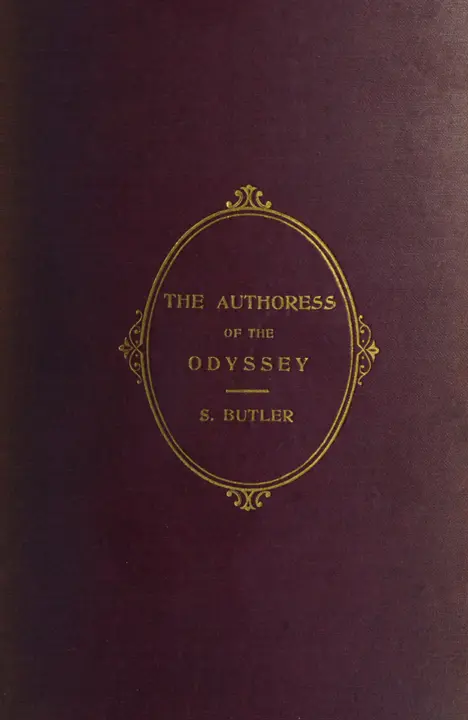
The Authoress of the Odyssey Where and when she wrote, who she was, the use she made of the Iliad, and how the poem grew under her hands
Samuel Butler
THE CLASSIC COLLECTION · 1907
"The Note-Books of Samuel Butler" by Samuel Butler is a collection of personal reflections and observations arranged and edited by Henry Festing Jones, likely written in the late 19th century. This compilation captures Butler's contemplations on a vast array of subjects, including philosophy, literature, evolution, and the complexities of life itself, reflecting the nuanced perspectives of a thinker whose work interrogated societal norms and personal identity. The opening of this work introduces readers to the origins and purpose behind Butler's note-keeping habit, revealing that he began documenting his thoughts early in life to capture fleeting insights and reflections. These notes served not only as a repository of his ideas but also as a means of shaping his literary voice by forcing him to articulate his thoughts clearly. The preface elaborates on the diverse topics covered in his notes—ranging from his childhood experiences and reflections on morality to inquiries into evolution and the nature of human existence—setting the stage for the rich tapestry of philosophical musings that follow.
Introduction adapted from the source catalogue; source summaries may be automatically generated.
Free to read · English · 142,917 words · No account needed
MAKE TIME FOR A GOOD BOOK
On by default. Untick to stop anonymous reading totals. Each page counts after 10 seconds in view. How this works.
Anonymous counting is on unless you have switched it off.
EARLY in his life Samuel Butler began to carry a note-book and to write down in it anything he wanted to remember; it might be something he heard some one say, more commonly it was something he said himself. In one of these notes he gives a reason for making them:
“One’s thoughts fly so fast that one must shoot them; it is no use trying to put salt on their tails.”
So he bagged as many as he could hit and preserved them, re-written on loose sheets of paper which constituted a sort of museum stored with the wise, beautiful, and strange creatures that were continually winging their way across the field of his vision. As he became a more expert marksman his collection increased and his museum grew so crowded that he wanted a catalogue. In 1874 he started an index, and this led to his reconsidering the notes, destroying those that he remembered having used in his published books and re-writing the remainder. The re-writing shortened some but it lengthened others and suggested so many new ones that the index was soon of little use and there seemed to be no finality about it (“Making Notes,” pp. 100–1 post). In 1891 he attached the problem afresh and made it a rule to spend an hour every morning re-editing his notes and keeping his index up to date. At his death, in 1902, he left five bound volumes, with the contents dated and indexed, about 225 pages of closely written sermon paper to each volume, and more than enough unbound and unindexed sheets to made a sixth volume of equal size.
In accordance with his own advice to a young writer (p. 363 post), he wrote the notes in copying ink and kept a pressed copy with me as a precaution against fire; but during his lifetime, unless he wanted to refer to something while he was in my chambers, I never looked at them. After his death I took them down and went through them. I knew in a general way what I should find, but I was not prepared for such a multitude and variety of thoughts, reflections, conversations, incidents. There are entries about his early life at Langar, Handel, school days at Shrewsbury, Cambridge, Christianity, literature, New Zealand, sheep-farming, philosophy, painting, money, evolution, morality, Italy, speculation, photography, music, natural history, archæology, botany, religion, book-keeping, psychology, metaphysics, the Iliad, the Odyssey, Sicily, architecture, ethics, the Sonnets of Shakespeare. I thought of publishing the books just as they stand, but too many of the entries are of no general interest and too many are of a kind that must wait if they are ever to be published. In addition to these objections the confusion is very great. One would look in the earlier volumes for entries about New Zealand and evolution and in the later ones for entries about the Odyssey and the Sonnets, but there is no attempt at arrangement and anywhere one may come upon something about Handel, or a philosophical reflection, between a note giving the name of the best hotel in an Italian town and another about Harry Nicholls and Herbert Campbell as the Babes in the Wood in the pantomime at the Grecian Theatre. This confusion has a charm, but it is a charm that would not, I fear, survive in print and, personally, I find that it makes the books distracting for continuous reading. Moreover they were not intended to be published as they stand (“Preface to Vol. II,” p. 215 post), they were intended for his own private use as a quarry from which to take material for his writing, and it is remarkable that in practice he scarcely ever used them in this way (“These Notes,” p. 261 post). When he had written and re-written a note and spoken it and repeated it in conversation, it became so much a part of him that, if he wanted to introduce it in a book, it was less trouble to re-state it again from memory than to search through his “precious indexes” for it and copy it (“Gadshill and Trapani,” p. 194, “At Piora,” p. 272 post). But he could not have re-stated a note from memory if he had not learnt it by writing it, so that it may be said that he did use the notes for his books, though not precisely in the way he originally intended. And the constant re-writing and re-considering were useful also by forcing him to settle exactly what he thought and to state it as clearly and tersely as possible. In this way the making of the notes must have had an influence on the formation of his style—though here again he had no such idea in his mind when writing them (“Style,” pp. 186–7 post)
Your reading position is saved on this browser. Take it to another device with a library code. Reading pages adapt to text, rather than matching a printed edition.
Samuel Butler
Samuel Butler
Samuel Butler
Samuel Butler
BEHIND THE BOOK
This eBook is for the use of anyone anywhere in the United States and most other parts of the world at no cost and with almost no restrictions whatsoever. You may copy it, give it away or re-use it under the terms of the Project Gutenberg License included with this eBook or online at www.gutenberg.org. If you are not located in the United States, you will have to check the laws of the country where you are located before using this eBook. Read the source licence.
The original source file, including credits and licence, is retained by this library. Request an original-format copy at no charge. Please include the book title and Project Gutenberg identifier #6173.
KEEP YOUR CURIOSITY GOING

David Patterson (Spirit) Hatch

David Patterson (Spirit) Hatch

David Patterson (Spirit) Hatch
Coulson Kernahan

Ralph Waldo Emerson

Maurice Baring