THE CLASSIC COLLECTION✦My diaries, being a personal narrative of events 1888-1914, Part 2 (1900-1914)CLASSIC FREE BOOKS
My diaries, being a personal narrative of events 1888-1914, Part 2 (1900-1914)
Wilfrid Scawen Blunt
THE CLASSIC COLLECTION · 1915
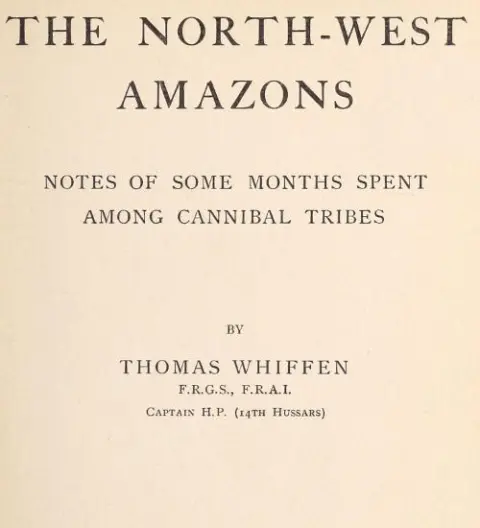
"The North-West Amazons: Notes of some months spent among cannibal tribes" by Thomas Whiffen is a historical account written in the early 20th century. The work details the author's months spent exploring the remote regions near the upper Amazon River, specifically focusing on the cannibal tribes and their cultures. Whiffen shares his observations of the tribes' customs, daily life, and interactions with nature, providing readers with an ethnographic glimpse into a largely untouched world. At the start of the narrative, Whiffen recounts his motivations for embarking on this journey following a period of unemployment due to ill health. He reflects on previous travel experiences and the influence of Dr. Alfred Russel Wallace's writings, which inspired him to explore the Amazon. Arriving in Manaos, he quickly realizes the challenges of accessing the interior and securing a reliable party, and the narrative unfolds with his detailed accounts of the difficulties faced in navigating the forest, river routes, and the dynamics with local tribes. The opening section sets the stage for an immersive exploration of the Amazonian wilderness and the indigenous peoples residing there, capturing both the allure and the difficulties of his expedition.
Introduction adapted from the source catalogue; source summaries may be automatically generated.
Free to read · English · 110,454 words · No account needed
MAKE TIME FOR A GOOD BOOK
On by default. Untick to stop anonymous reading totals. Each page counts after 10 seconds in view. How this works.
Anonymous counting is on unless you have switched it off.
[209] Spruce relates that a Guahibo told him, “With a chew of caapi and a pinch of niopo … one feels so good! No hunger--no thirst--no tired!” (Spruce, ii. 428).
[210] Mimosa acaciodes (Bentham). “A species of Inga” (Bates, i. 331). The seeds of Acacia Niopo (Humbolt). Piptadenia peregrina (L.) (Bentham and Spruce, ii. 427).
[211] The Guahibo use no quicklime (Spruce, ii. 426).
[212] This is curious, but I can advance no reason.
[213] Or “a bit of the leg-bone of the jaguar, closed at one end with pitch” (Spruce, ii. 427).
[214] And by the natives on the upper Orinoco (Spruce, ii. 423).
[215] “Two feet long and as thick as the wrist” (Spruce, ii. 420). It “is smoked in the ordinary way”. A long cigar is also smoked on the Equatorial Pacific coast, but “held in the mouth at the lighted end” (ibid. p. 436). This is common amongst negroes.
[216] Like the eyes of a cocoanut--to allow passage to the budding
rootlets.
[217] Spruce, ii. 413-55.
[218] Bates, ii. 288.
[219] Also called curari, ourali, worara, woorari, urari, ervadura. “A powerful South American arrow-poison occurring in commerce as a blackish extract, somewhat resinoid in appearance,” used for tetanus, hydrophobia, epilepsy (Dict. Mat. Med.).
[220] Strychnos castelmoeana and Cocculus toxicoferus (Hardenburg, p.
136).
[221] “Many ingredients are used, such as several kinds of barks, roots, peppers (Capsicum), ants, and the poison-fangs of snakes” (im Thurn, p. 311).
[222] Crevaux gives a long description of the preparation of this poison
(Crevaux, pp. 268-337).
[223] According to Bates, salt is considered to be an antidote for this
poison (Bates, i. 247).
[224] Bates, ii. 200. This agrees with Darwin, Descent of Man, i. 128.
[225] Dr. Galt considered “that there is no more fertile race than the pure-blooded Indian of the Marañon” (Orton, p. 465).
[226] Menstruation has been known to commence in England at the age of eleven, generally in cases of well-nourished blondes, and in exceptional cases even earlier. It has been known to occur at nine years, but this was induced by a severe accident. This is unknown among the forest people. I made out the age of puberty to be not less than fifteen for girls, and eighteen for boys, among the tribes I was with.
[227] Cf. Thomson, The Fijians, pp. 179-80; Codrington, The
Melanesians, p. 228, etc.
[228] Tapir flesh is undoubtedly rich, and over-indulgence would have evil effects upon any woman independent of other conditions, for equally it would upset a man.
[229] A tribe in British Guiana, the Macusi, carry this idea even further, and impose such restriction on a man before his actual marriage (im Thurn, p. 222). I have never met with this.
Your reading position is saved on this browser. Take it to another device with a library code. Reading pages adapt to text, rather than matching a printed edition.
BEHIND THE BOOK
This eBook is for the use of anyone anywhere in the United States and most other parts of the world at no cost and with almost no restrictions whatsoever. You may copy it, give it away or re-use it under the terms of the Project Gutenberg License included with this eBook or online at www.gutenberg.org. If you are not located in the United States, you will have to check the laws of the country where you are located before using this eBook. Read the source licence.
The original source file, including credits and licence, is retained by this library. Request an original-format copy at no charge. Please include the book title and Project Gutenberg identifier #55540.
KEEP YOUR CURIOSITY GOING
Wilfrid Scawen Blunt
Wilfrid Scawen Blunt

E. W. (Edgar Watson) Howe
Cécile Tormay

Moritz Busch
John L. Ransom