THE CLASSIC COLLECTION✦My diaries, being a personal narrative of events 1888-1914, Part 2 (1900-1914)CLASSIC FREE BOOKS
My diaries, being a personal narrative of events 1888-1914, Part 2 (1900-1914)
Wilfrid Scawen Blunt
THE CLASSIC COLLECTION · 1915
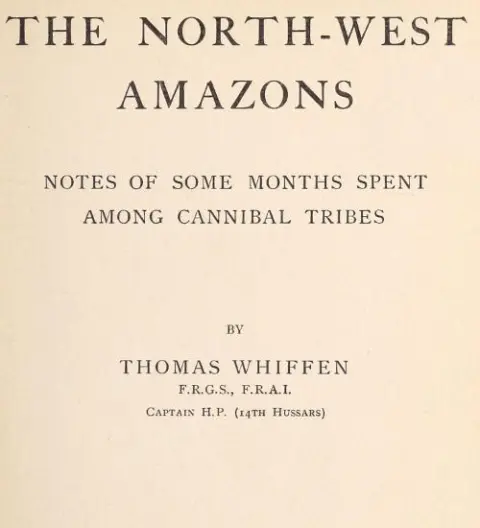
"The North-West Amazons: Notes of some months spent among cannibal tribes" by Thomas Whiffen is a historical account written in the early 20th century. The work details the author's months spent exploring the remote regions near the upper Amazon River, specifically focusing on the cannibal tribes and their cultures. Whiffen shares his observations of the tribes' customs, daily life, and interactions with nature, providing readers with an ethnographic glimpse into a largely untouched world. At the start of the narrative, Whiffen recounts his motivations for embarking on this journey following a period of unemployment due to ill health. He reflects on previous travel experiences and the influence of Dr. Alfred Russel Wallace's writings, which inspired him to explore the Amazon. Arriving in Manaos, he quickly realizes the challenges of accessing the interior and securing a reliable party, and the narrative unfolds with his detailed accounts of the difficulties faced in navigating the forest, river routes, and the dynamics with local tribes. The opening section sets the stage for an immersive exploration of the Amazonian wilderness and the indigenous peoples residing there, capturing both the allure and the difficulties of his expedition.
Introduction adapted from the source catalogue; source summaries may be automatically generated.
Free to read · English · 110,454 words · No account needed
MAKE TIME FOR A GOOD BOOK
On by default. Untick to stop anonymous reading totals. Each page counts after 10 seconds in view. How this works.
Anonymous counting is on unless you have switched it off.
[189] The ashes of the drum tree (Cecropia peltata) “are saline and antiseptic” (Spruce, ii. 447). “A kind of flour which has a saline taste” is extracted from the fruits of the Inaja palm (Maximiliana regia), and the Jara palm (Leopoldinia major), and the Caruru, a species of Lacis (Wallace, p. 340). Cuaruru is given by Spruce as a native name for Pogostemon sp.; when this is burnt the ashes give salt (Spruce, ii. 520).
[190] Cf. Torres Straits, “The chief meal of the day is taken at night, soon after sundown; the remains are eaten in the morning,” iv. 131.
[191] This is probably the puruma (Puruma Cecropiaefolia Martius) mentioned by Bates (Bates, ii. 217).
[192] Yerba Luisa (Simson, p. 61).
[193] This may be Mimusops sp. (Sapotacae) or Callophora sp. (Aponcynaccae) (Spruce, i. 50, 224; ii. 520). Bates, i. 69; Spruce, i. 51; Orton, pp. 288, 500, 581.
[194] Caapi is known as aya-huasca, the drink of Huasca, the greatest king of the Inca, to the Zaparo and other tribes farther west (Spruce, ii. 424).
[195] Spruce, ii. 419-21.
[196] Banisteria Caapi (Spruce, ii. 414).
[197] Haemadictyon amazonicum (ibid. p. 415). This is only added by
the Uaupes tribes.
[198] Both Manihot utilissima and Manihot Aypi (Spruce, ii. 414).
[199] Cf. Tylor, pp. 179-80.
[200] Paullinia cupana (Spruce, i. 180).
[201] Guarana, “pro panacea peregrinantum habetur” (von Martius), is made from the roasted seeds. It is “almost identical in its elements with theine and caffeine” (Spruce, i. 181). It is cultivated on the Negro as an article of trade. According to Bates it is made from the seeds of a climbing plant (Paullinia sorbilis) (Bates, ii. 134).
[202] Coca Erythroxylon.
[203] Spix and von Martius, p. 153.
[204] Joyce, p. 97.
[205] Markham, Peruvian Bark, p. 151.
[206] According to Bates the leaves of the candelabrum tree (Cecropia palmata) are used (Bates, ii. 211-12). Spruce has the imbauba or drum tree (Cecropia peltata) (Spruce, ii. 447). Markham gives the quinoa plant (Markham, op. cit. p. 151).
[207] Re effects. Spruce notes that it had little effect on him (Spruce, ii. 448). One of my companions though “at first affected … with slight nausea … soon became accustomed to it, and found it very useful on many occasions” (Hardenburg, p. 137-8). This is interesting in relation to my own continued intolerance. “In Peru its excessive use is said to seriously injure the coats of the stomach” (Spruce, ii. 448). At Ega it was regarded as a vice only to be indulged in secretly (Bates, ii. 211). Markham, on the other hand, considers it “the least injurious, and the most soothing and invigorating” narcotic (Markham, op. cit. p. 152). He even recommends it as a preventative of loss of breath to Alpine climbers (ibid. p. 153). With this I cannot concur.
[208] See Appendix for this and other notes.
Your reading position is saved on this browser. Take it to another device with a library code. Reading pages adapt to text, rather than matching a printed edition.
BEHIND THE BOOK
This eBook is for the use of anyone anywhere in the United States and most other parts of the world at no cost and with almost no restrictions whatsoever. You may copy it, give it away or re-use it under the terms of the Project Gutenberg License included with this eBook or online at www.gutenberg.org. If you are not located in the United States, you will have to check the laws of the country where you are located before using this eBook. Read the source licence.
The original source file, including credits and licence, is retained by this library. Request an original-format copy at no charge. Please include the book title and Project Gutenberg identifier #55540.
KEEP YOUR CURIOSITY GOING
Wilfrid Scawen Blunt
Wilfrid Scawen Blunt

E. W. (Edgar Watson) Howe
Cécile Tormay

Moritz Busch
John L. Ransom