THE CLASSIC COLLECTION✦An outlaw’s diary: the CommuneCLASSIC FREE BOOKS
An outlaw’s diary: the Commune
Cécile Tormay
THE CLASSIC COLLECTION · 1859
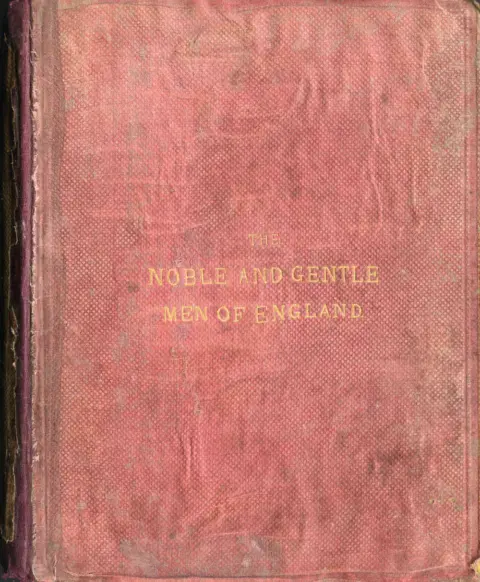
"The Noble and Gentle Men of England" by Evelyn Philip Shirley is a historical account written in the mid-19th century. The work aims to chronicle the arms and genealogies of ancient knightly and gentle families in England, arranged by their respective counties. It particularly focuses on those families that had established themselves before the 16th century, offering insights into the social structure and lineage of England's aristocracy. The opening of the text sets the stage for the author's exploration of England's noble families, outlining his methodology and the limitations he imposed on his investigation. Shirley discusses the criteria for inclusion, emphasizing the importance of direct male descent and the historical ties to the land. He acknowledges the challenges of genealogy, such as distinguishing between ancient and more recent claims to lineages. The introduction also references various sources from county histories and manuscripts, indicating a rigorous approach to documenting the legacy of aristocratic families. These early details lay a foundation for the detailed genealogies that will follow in the subsequent chapters.
Introduction adapted from the source catalogue; source summaries may be automatically generated.
Free to read · English · 64,026 words · No account needed
MAKE TIME FOR A GOOD BOOK
On by default. Untick to stop anonymous reading totals. Each page counts after 10 seconds in view. How this works.
Anonymous counting is on unless you have switched it off.
Wake of Courtenhall, 158
Walcot of Bitterley, 206
Waldegrave of Naverstoke, 85
Wallop of Wallop, 225
Walpole of Wolterton, 147
Walrond of Dulford, 69
Waterton of Walton, 307
Welby of Denton, 134
Weld of Lulworth, 79
West of Buckhurst, 257
Weston of West Horsley, 250
Whichcote of Aswarby, 142
Whitgreve of Moseley, 239
Whitmore of Apley, 205
Wilbraham of Delamere, 20
Willoughby of Wollaton, 178
Wingfield of Tickencote, 190
Winnington of Stanford, 294
Wodehouse of Kimberley, 146
Wollaston of Shenton, 133
Wolryche of Croxley, 99
Wolseley of Wolseley, 235
Wombwell of Wombwell, 322
Wrey of Trebigh, 38
Wrottesley of Wrottesley, 230
Wybergh of Clifton, 282
Wykeham of Tythrop, 182
Wyndham of Dinton, 286
Wyvill of Constable-Burton, 302
[Transcriber's Notes:
The following misprints have been corrected:
[in this county of B ckingham] ->
[in this county of Buckingham]
[directly to the Couquest] ->
[directly to the Conquest]
[This family wrs originally] ->
[This family was originally]
[Torr-Abbey was purchasd] ->
[Torr-Abbey was purchased]
[Cornewwall of Delbury.] ->
[Cornewall of Delbury.]
See under "COMPTON OF COMPTON WYNIATE":
[the seventeenth eentury.] ->
[the seventeenth century.]
[extinct in the last centnry.] ->
[extinct in the last century.]
[who assumed the loca name] ->
[who assumed the local name]
[G. H. M'Gill's account], this may seem a misprint but
[M'Gill] is an existing name.
As the text below "DIGBY OF MILTON" suggests, the placename [Milton] should be [Tilton]. Confirmation for this has been found in "the Leicestershire Historian", vol. 2, no. 8 (the article "The Tilton Family in America and its Link with Tilton on the Hill" written by Peter D. A. Blakesley), page 7: "... the family of Digby, lords of the manor of Tilton from the twelfth century until the seventeenth century, when the manor was sold." [DIGBY OF MILTON, BARON] -> [DIGBY OF TILTON, BARON]
Another misprint for [Tilton] has been found in the "Index":
[Digby of Minton, 76] ->
[Digby of Tilton, 76]
[Bedingfeld of Oxburgh, 156] ->
[Bedingfeld of Oxburgh, 150]
[Leigh of East Hall, 21] ->
[Legh of East Hall, 21]
[Onslow of West Clandon, 52] ->
[Onslow of West Clandon, 251]
Two misprints in this one:
[Wake of Courtenhall, 138] ->
[Wake of Courteenhall, 158]
The author used asterixes to indicate notes.
Unfortunately 3 asterixes lack an explanation.
They are located at:
[Leicestershire, iv. pt. 2. p. 519.*]
[Leicestershire, iii. pt. 2, p. 1009*]
[ii. pt. i. p. *261;]
The word [coheiress] also occurs with the notation [co-heiress]. Both notations have been maintained.
The plain text file of this ebook uses underscores to indicate italic text and plus signs to indicate a bold Gothic typeface.
Each family description starts with an illustration representing their arms. In the plain text file these have been replaced with [Illustration].
A few cases of punctuation errors were corrected, but are
not mentioned here.
]
Your reading position is saved on this browser. Take it to another device with a library code. Reading pages adapt to text, rather than matching a printed edition.
BEHIND THE BOOK
This eBook is for the use of anyone anywhere in the United States and most other parts of the world at no cost and with almost no restrictions whatsoever. You may copy it, give it away or re-use it under the terms of the Project Gutenberg License included with this eBook or online at www.gutenberg.org. If you are not located in the United States, you will have to check the laws of the country where you are located before using this eBook. Read the source licence.
The original source file, including credits and licence, is retained by this library. Request an original-format copy at no charge. Please include the book title and Project Gutenberg identifier #58212.
KEEP YOUR CURIOSITY GOING
Cécile Tormay

Moritz Busch
John L. Ransom
Frances Wright
Cécile Tormay

Mabel Potter Daggett