THE CLASSIC COLLECTION✦Ghosts and Family Legends: A Volume for ChristmasCLASSIC FREE BOOKS
Ghosts and Family Legends: A Volume for Christmas
Catherine Crowe
THE CLASSIC COLLECTION · 1856
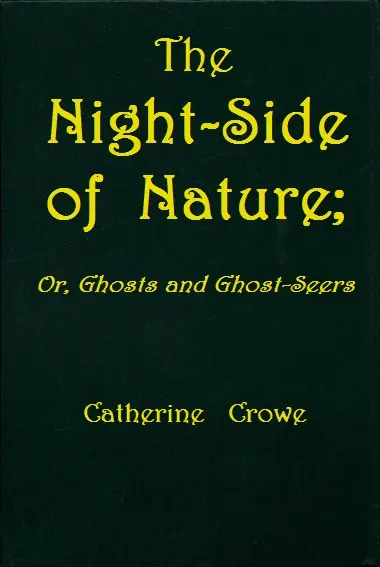
"The Night-Side of Nature; Or, Ghosts and Ghost-Seers" by Catherine Crowe is a philosophical exploration written in the mid-19th century. This work investigates supernatural phenomena, particularly ghosts and their significance, alongside dreams, presentiments, and the nature of the human soul. Crowe's approach reflects a blend of inquiry and skepticism, aiming to illuminate what remains hidden about the spiritual and psychical aspects of existence. At the start of the book, the author introduces her intentions by discussing the lack of attention given to spiritual topics by the scientific community. She draws parallels between the obscurity of the "night-side" of nature, as understood by German astronomers, and humanity's ignorance of spiritual truths. The opening emphasizes the importance of observing and reflecting on the common occurrences of dreams and apparitions throughout history. Crowe outlines her goal of prompting inquiry rather than dictating beliefs, hoping that by doing so, readers might reconsider their views on the paranormal and their implications for understanding the existence of the soul and life after death.
Introduction adapted from the source catalogue; source summaries may be automatically generated.
Free to read · English · 170,037 words · No account needed
MAKE TIME FOR A GOOD BOOK
On by default. Untick to stop anonymous reading totals. Each page counts after 10 seconds in view. How this works.
Anonymous counting is on unless you have switched it off.
Instances of this kind of phenomenon have been common in all ages of the world, insomuch that Lucretius, who did not believe in the immortality of the soul, and was yet unable to deny the facts, suggested the strange theory that the superficial surfaces of all bodies were continually flying off, like the coats of an onion, which accounted for the appearance of wraiths, ghosts, doubles, &c.; and a more modern author, Gaffarillus, suggests that corrupting bodies send forth vapors, which being compressed by the cold night air, appear visible to the eye in the forms of men.
It will not be out of place, here, to mention the circumstance recorded in Professor Gregory’s “Abstract of Baron von Reichenbach’s Researches in Magnetism,” regarding a person called Billing, who acted in the capacity of amanuensis to the blind poet Pfeffel, at Colmar. Having treated of various experiments, by which it was ascertained that certain sensitive persons were not only able to detect electric influences of which others were unconscious, but could also perceive, emanating from the wires and magnets, flames which were invisible to people in general; “the baron,” according to Dr. Gregory, “proceeded to a useful application of the results, which is, he says, so much the more welcome, as it utterly eradicates one of the chief foundations of superstition, that worst enemy to the development of human enlightenment and liberty. A singular occurrence, which took place at Colmar, in the garden of the poet Pfeffel, has been made generally known by various writings. The following are the essential facts. The poet, being blind, had employed a young clergyman, of the evangelical church, as amanuensis. Pfeffel, when he walked out, was supported and led by this young man, whose name was Billing. As they walked in the garden, at some distance from the town, Pfeffel observed, that as often as they passed over a particular spot, the arm of Billing trembled, and he betrayed uneasiness. On being questioned, the young man reluctantly confessed, that as often as he passed over that spot, certain feelings attacked him, which he could not control, and which he knew well, as he always experienced the same, in passing over any place where human bodies lay buried. He added, that at night, when he came near such places, he saw supernatural appearances. Pfeffel, with the view of curing the youth of what he looked on as fancy, went that night with him to the garden. As they approached the spot in the dark, Billing perceived a feeble light, and when still nearer, he saw a luminous ghostlike figure floating over the spot. This he described as a female form, with one arm laid across the body, the other hanging down, floating in the upright posture, but tranquil, the feet only a hand-breadth or two above the soil. Pfeffel went alone, as the young man declined to follow him, up to the place where the figure was said to be, and struck about in all directions with his stick, besides running actually through the shadow; but the figure was not more affected than a flame would have been; the luminous form, according to Billing always returned to its original position after these experiments. Many things were tried during several months, and numerous companies of people were brought to the spot, but the matter remained the same, and the ghost-seer adhered to his serious assertion, and to the opinion founded on it, that some individual lay buried there. At last, Pfeffel had the place dug up. At a considerable depth was found a firm layer of white lime, of the length and breadth of a grave, and of considerable thickness, and when this had been broken into, there were found the bones of a human being. It was evident that some one had been buried in the place, and covered with a thick layer of lime (quicklime), as is generally done in times of pestilence, of earthquakes, and other similar events. The bones were removed, the pit filled up, the lime scattered abroad, and the surface again made smooth. When Billing was now brought back to the place, the phenomena did not return, and the nocturnal spirit had for ever disappeared.
Your reading position is saved on this browser. Take it to another device with a library code. Reading pages adapt to text, rather than matching a printed edition.
BEHIND THE BOOK
This eBook is for the use of anyone anywhere in the United States and most other parts of the world at no cost and with almost no restrictions whatsoever. You may copy it, give it away or re-use it under the terms of the Project Gutenberg License included with this eBook or online at www.gutenberg.org. If you are not located in the United States, you will have to check the laws of the country where you are located before using this eBook. Read the source licence.
The original source file, including credits and licence, is retained by this library. Request an original-format copy at no charge. Please include the book title and Project Gutenberg identifier #54532.
KEEP YOUR CURIOSITY GOING

David Patterson (Spirit) Hatch

David Patterson (Spirit) Hatch

David Patterson (Spirit) Hatch
Coulson Kernahan

Ralph Waldo Emerson
Frances Wright