THE CLASSIC COLLECTION✦Ghosts and Family Legends: A Volume for ChristmasCLASSIC FREE BOOKS
Ghosts and Family Legends: A Volume for Christmas
Catherine Crowe
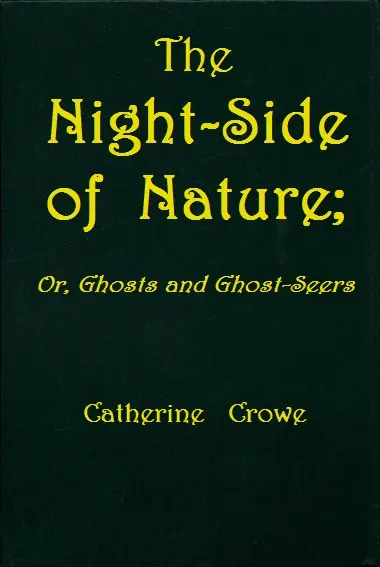
THE CLASSIC COLLECTION · 1856
"The Night-Side of Nature; Or, Ghosts and Ghost-Seers" by Catherine Crowe is a philosophical exploration written in the mid-19th century. This work investigates supernatural phenomena, particularly ghosts and their significance, alongside dreams, presentiments, and the nature of the human soul. Crowe's approach reflects a blend of inquiry and skepticism, aiming to illuminate what remains hidden about the spiritual and psychical aspects of existence. At the start of the book, the author introduces her intentions by discussing the lack of attention given to spiritual topics by the scientific community. She draws parallels between the obscurity of the "night-side" of nature, as understood by German astronomers, and humanity's ignorance of spiritual truths. The opening emphasizes the importance of observing and reflecting on the common occurrences of dreams and apparitions throughout history. Crowe outlines her goal of prompting inquiry rather than dictating beliefs, hoping that by doing so, readers might reconsider their views on the paranormal and their implications for understanding the existence of the soul and life after death.
Introduction adapted from the source catalogue; source summaries may be automatically generated.
Free to read · English · 170,037 words · No account needed
MAKE TIME FOR A GOOD BOOK
On by default. Untick to stop anonymous reading totals. Each page counts after 10 seconds in view. How this works.
Anonymous counting is on unless you have switched it off.
A much-esteemed secretary died a few years since, in the house of Mr. R—— von N——. About eight weeks afterward, Mr. R—— himself being ill, his daughter dreamed that the house-bell rang, and that, on looking out, she perceived the secretary at the door. Having admitted him, and inquired what he was come for, he answered, “To fetch somebody.” Upon which, alarmed for her father, she exclaimed, “I hope not my father!” He shook his head solemnly, in a manner that implied it was not the old man he had come for, and turned away toward a guest-chamber, at that time vacant, and there disappeared at the door. The father recovered, and the lady left home for a few days, on a visit. On her return, she found her brother had arrived in the interval to pay a visit to his parents, and was lying sick in that room, where he died.
I will here mention a curious circumstance regarding Mr. H——, the gentleman alluded to in a former page, who, being at the seaside, saw, in a dream, the danger that awaited his son when he went to bathe. This gentleman has frequently, on waking, felt a consciousness that he had been conversing with certain persons of his acquaintance—and, indeed, with some of whom he knew little—and has afterward, not without a feeling of awe, learned that these persons had died during the hours of his sleep.
Do not such circumstances entitle us to entertain the idea that I have suggested above, namely, that in sleep the spirit is free to see, and to know, and to communicate with spirit, although the memory of this knowledge is rarely carried into the waking state?
The story of the two Arcadians, who travelled together to Megara, though reprinted in other works, I can not omit here. One of these established himself, on the night of their arrival, at the house of a friend, while the other sought shelter in a public lodging-house for strangers. During the night, the latter appeared to the former, in a dream, and besought him to come to his assistance, as his villanous host was about to take his life, and only the most speedy aid could save him. The dreamer started from his sleep, and his first movement was to obey the summons, but, reflecting that it was only a dream, he presently lay down, and composed himself again to rest. But now his friend appeared before him a second time, disfigured by blood and wounds, conjuring him, since he had not listened to his first entreaties, that he would, at least, avenge his death. His host, he said, had murdered him, and was, at that moment, depositing his body in a dung-cart, for the purpose of conveying it out of the town. The dreamer was thoroughly alarmed, arose, and hastened to the gates of the city, where he found, waiting to pass out, exactly such a vehicle as his friend had described. A search being instituted, the body was found underneath the manure; and the host was consequently seized, and delivered over to the chastisement of the law.
Your reading position is saved on this browser. Take it to another device with a library code. Reading pages adapt to text, rather than matching a printed edition.
BEHIND THE BOOK
This eBook is for the use of anyone anywhere in the United States and most other parts of the world at no cost and with almost no restrictions whatsoever. You may copy it, give it away or re-use it under the terms of the Project Gutenberg License included with this eBook or online at www.gutenberg.org. If you are not located in the United States, you will have to check the laws of the country where you are located before using this eBook. Read the source licence.
The original source file, including credits and licence, is retained by this library. Request an original-format copy at no charge. Please include the book title and Project Gutenberg identifier #54532.
KEEP YOUR CURIOSITY GOING

David Patterson (Spirit) Hatch

David Patterson (Spirit) Hatch

David Patterson (Spirit) Hatch
Coulson Kernahan

Ralph Waldo Emerson
Frances Wright