THE CLASSIC COLLECTION✦Ghosts and Family Legends: A Volume for ChristmasCLASSIC FREE BOOKS
Ghosts and Family Legends: A Volume for Christmas
Catherine Crowe
THE CLASSIC COLLECTION · 1856
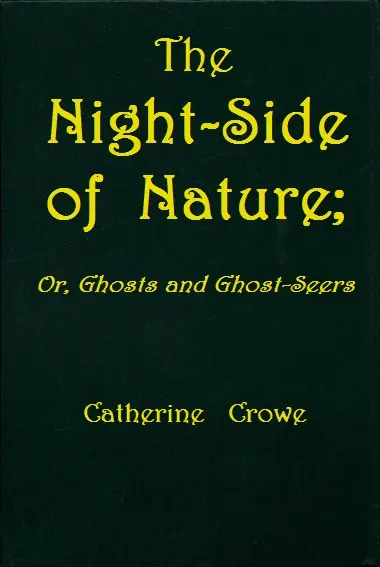
"The Night-Side of Nature; Or, Ghosts and Ghost-Seers" by Catherine Crowe is a philosophical exploration written in the mid-19th century. This work investigates supernatural phenomena, particularly ghosts and their significance, alongside dreams, presentiments, and the nature of the human soul. Crowe's approach reflects a blend of inquiry and skepticism, aiming to illuminate what remains hidden about the spiritual and psychical aspects of existence. At the start of the book, the author introduces her intentions by discussing the lack of attention given to spiritual topics by the scientific community. She draws parallels between the obscurity of the "night-side" of nature, as understood by German astronomers, and humanity's ignorance of spiritual truths. The opening emphasizes the importance of observing and reflecting on the common occurrences of dreams and apparitions throughout history. Crowe outlines her goal of prompting inquiry rather than dictating beliefs, hoping that by doing so, readers might reconsider their views on the paranormal and their implications for understanding the existence of the soul and life after death.
Introduction adapted from the source catalogue; source summaries may be automatically generated.
Free to read · English · 170,037 words · No account needed
MAKE TIME FOR A GOOD BOOK
On by default. Untick to stop anonymous reading totals. Each page counts after 10 seconds in view. How this works.
Anonymous counting is on unless you have switched it off.
The boat was then set afloat, and Captain S——, together with his horse and servant, and the ferryman’s son, embarked in it.
The distance was not great, but the storm was tremendous; and, after having with great difficulty got half way across the lake, it was found impossible to proceed. The danger of tacking was, of course, considerable; but, since they could not advance, there was no alternative but to turn back, and it was resolved to attempt it. The manœuvre, however, failed; the boat capsized, and they were all precipitated into the water.
“You keep hold of the horse—I can swim,” said Captain S—— to his servant, when he saw what was about to happen.
Being an excellent swimmer, and the distance from the shore inconsiderable, he hoped to save himself, but he had on a heavy top-coat, with boots and spurs. The coat he contrived to take off in the water, and then struck out with confidence; but, alas! the coat had got entangled with one of the spurs, and, as he swam, it clung to him, getting heavier and heavier as it became saturated with water, ever dragging him beneath the stream. He, however, reached the shore, where his anxious friend still stood watching the event; and, as the latter bent over him, he was just able to make a gesture with his hand, which seemed to say, “You see, it was to be!” and then expired.
The boatman was also drowned; but, by the aid of the horse, the servant
escaped.
As I do not wish to startle my readers, nor draw too suddenly on their faith, I have commenced with this class of phenomena, which it must be admitted are sufficiently strange, and, if true, must also be admitted to be well worthy of attention. No doubt these cases, and still more those to which I shall next proceed, give a painful shock to the received notions of polished and educated society in general—especially in this country, where the analytical or scientifical psychology of the eighteenth century has almost superseded the study of synthetic or philosophical psychology. It has become a custom to look at all the phenomena regarding man in a purely physiological point of view; for although it is admitted that he has a mind, and although there is such a science as metaphysics, the existence of what we call mind is never considered but as connected with the body. We know that body can exist without mind; for, not to speak of certain living conditions, the body subsists without mind when the spirit has fled; albeit, without the living principle it can subsist but for a short period, except under particular circumstances; but we seem to have forgotten that mind, though dependent upon body as long as the connection between them continues, can yet subsist without it. There have indeed been philosophers, purely materialistic, who have denied this, but they are not many; and not only the whole Christian world, but all who believe in a future state, must perforce admit it; for even those who hold that most unsatisfactory doctrine that there will be neither memory nor consciousness till a second incorporation takes place, will not deny that the mind, however in a state of abeyance and unable to manifest itself, must still subsist as an inherent property of man’s immortal part. Even if, as some philosophers believe, the spirit, when freed from the body by death, returns to the Deity and is reabsorbed in the being of God, not to become again a separate entity until reincorporated, still what we call mind can not be disunited from it. And when once we have begun to conceive of mind, and consequently of perception, as separated from and independent of bodily organs, it will not be very difficult to apprehend that those bodily organs must circumscribe and limit the view of the spiritual in-dweller, which must otherwise be necessarily perceptive of spirit like itself, though perhaps unperceptive of material objects and obstructions.
Your reading position is saved on this browser. Take it to another device with a library code. Reading pages adapt to text, rather than matching a printed edition.
BEHIND THE BOOK
This eBook is for the use of anyone anywhere in the United States and most other parts of the world at no cost and with almost no restrictions whatsoever. You may copy it, give it away or re-use it under the terms of the Project Gutenberg License included with this eBook or online at www.gutenberg.org. If you are not located in the United States, you will have to check the laws of the country where you are located before using this eBook. Read the source licence.
The original source file, including credits and licence, is retained by this library. Request an original-format copy at no charge. Please include the book title and Project Gutenberg identifier #54532.
KEEP YOUR CURIOSITY GOING

David Patterson (Spirit) Hatch

David Patterson (Spirit) Hatch

David Patterson (Spirit) Hatch
Coulson Kernahan

Ralph Waldo Emerson
Frances Wright