THE CLASSIC COLLECTION✦Ghosts and Family Legends: A Volume for ChristmasCLASSIC FREE BOOKS
Ghosts and Family Legends: A Volume for Christmas
Catherine Crowe
THE CLASSIC COLLECTION · 1856
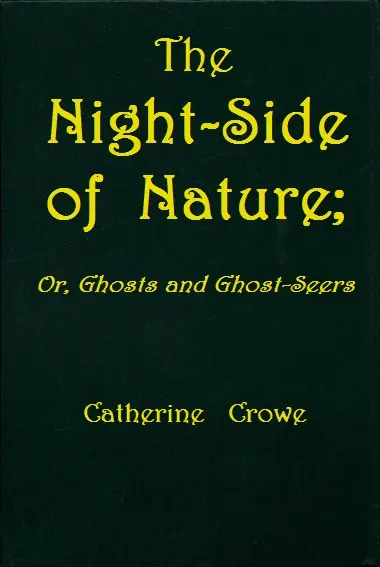
"The Night-Side of Nature; Or, Ghosts and Ghost-Seers" by Catherine Crowe is a philosophical exploration written in the mid-19th century. This work investigates supernatural phenomena, particularly ghosts and their significance, alongside dreams, presentiments, and the nature of the human soul. Crowe's approach reflects a blend of inquiry and skepticism, aiming to illuminate what remains hidden about the spiritual and psychical aspects of existence. At the start of the book, the author introduces her intentions by discussing the lack of attention given to spiritual topics by the scientific community. She draws parallels between the obscurity of the "night-side" of nature, as understood by German astronomers, and humanity's ignorance of spiritual truths. The opening emphasizes the importance of observing and reflecting on the common occurrences of dreams and apparitions throughout history. Crowe outlines her goal of prompting inquiry rather than dictating beliefs, hoping that by doing so, readers might reconsider their views on the paranormal and their implications for understanding the existence of the soul and life after death.
Introduction adapted from the source catalogue; source summaries may be automatically generated.
Free to read · English · 170,037 words · No account needed
MAKE TIME FOR A GOOD BOOK
On by default. Untick to stop anonymous reading totals. Each page counts after 10 seconds in view. How this works.
Anonymous counting is on unless you have switched it off.
Not to mention the modern Germans of eminence, who have devoted themselves to this investigation, there have been men remarkable for intellect in all countries, who have considered the subject worthy of inquiry. Among the rest, Plato, Pliny, and Lucien; and in our own country, that good old divine, Dr. Henry Moore, Dr. Johnson, Addison, Isaac Taylor, and many others. It may be objected that the eternally-quoted case of Nicolai, the bookseller at Berlin, and Dr. Ferriar’s “Theory of Apparitions,” had not then settled the question; but nobody doubts that Nicolai’s was a case of disease; and he was well aware of it himself, as it appears to me, everybody so afflicted, is. I was acquainted with a poor woman, in Edinburgh, who suffered from this malady, brought on, I believe, by drinking; but she was perfectly conscious of the nature of the illusions; and that temperance and a doctor were the proper exorcists to lay the spirits. With respect to Dr. Ferriar’s book, a more shallow one was assuredly never allowed to settle any question; and his own theory can not, without the most violent straining, and the assistance of what he calls coincidences, meet even half the cases he himself adduces. That such a disease, as he describes, exists, nobody doubts; but I maintain that there are hundreds of cases on record, for which the explanation does not suffice; and if they have been instances of spectral illusion, all that remains to be said, is, that a fundamental reconstruction of the theory on that subject is demanded.
La Place says, in his “Essay on Probabilities,” that “any case, however apparently incredible, if it be a recurrent case, is as much entitled, under the laws of induction, to a fair valuation, as if it had been more probable beforehand.” Now, no one will deny that the case in question possesses this claim to investigation. Determined skeptics may, indeed, deny that there exists any well-authenticated instance of an apparition; but that, at present, can only be a mere matter of opinion; since many persons, as competent to judge as themselves, maintain the contrary; and in the meantime, I arraign their right to make this objection till they have qualified themselves to do so, by a long course of patient and honest inquiry; always remembering that every instance of error or imposition discovered and adduced, has no positive value whatever in the argument, but as regards that single instance; though it may enforce upon us the necessity of strong evidence and careful investigation. With respect to the evidence, past and present, I must be allowed here to remark on the extreme difficulty of producing it. Not to mention the acknowledged carelessness of observers and the alleged incapacity of persons to distinguish between reality and illusion, there is an exceeding shyness in most people, who, either have seen, or fancied they have seen, an apparition, to speak of it at all, except to some intimate friend; so that one gets most of the stories second-hand; while even those who are less chary of their communications, are imperative against their name and authority being given to the public. Besides this, there is a great tendency in most people, after the impression is over, to think they may have been deceived; and where there is no communication or other circumstance rendering this conviction impossible, it is not difficult to acquire it, or at least so much of it as leaves the case valueless. The seer is glad to find this refuge from the unpleasant feelings engendered; while surrounding friends, sometimes from genuine skepticism, and sometimes from good-nature, almost invariably lean to this explanation of the mystery. In consequence of these difficulties and those attending the very nature of the phenomena, I freely admit that the facts I shall adduce, as they now stand, can have no scientific value; they can not in short, enter into the region of science at all, still less into that of philosophy. Whatever conclusions we may be led to form, can not be founded on pure induction. We must confine ourselves wholly within the region of opinion; if we venture beyond which, we shall assuredly founder. In the beginning, all sciences have been but a collection of facts, afterward to be examined, compared, and weighed, by intelligent minds. To the vulgar, who do not see the universal law which governs the universe, everything out of the ordinary course of events, is a prodigy; but to the enlightened mind there are no prodigies; for it perceives that in both the moral and the physical world, there is a chain of uninterrupted connection; and that the most strange and even apparently contradictory or supernatural fact or event will be found, on due investigation, to be strictly dependent on its antecedents. It is possible, that there may be a link wanting, and that our investigations may, consequently, be fruitless; but the link is assuredly there, although our imperfect knowledge and limited vision can not find it.
Your reading position is saved on this browser. Take it to another device with a library code. Reading pages adapt to text, rather than matching a printed edition.
BEHIND THE BOOK
This eBook is for the use of anyone anywhere in the United States and most other parts of the world at no cost and with almost no restrictions whatsoever. You may copy it, give it away or re-use it under the terms of the Project Gutenberg License included with this eBook or online at www.gutenberg.org. If you are not located in the United States, you will have to check the laws of the country where you are located before using this eBook. Read the source licence.
The original source file, including credits and licence, is retained by this library. Request an original-format copy at no charge. Please include the book title and Project Gutenberg identifier #54532.
KEEP YOUR CURIOSITY GOING

David Patterson (Spirit) Hatch

David Patterson (Spirit) Hatch

David Patterson (Spirit) Hatch
Coulson Kernahan

Ralph Waldo Emerson
Frances Wright