THE CLASSIC COLLECTION✦Ghosts and Family Legends: A Volume for ChristmasCLASSIC FREE BOOKS
Ghosts and Family Legends: A Volume for Christmas
Catherine Crowe
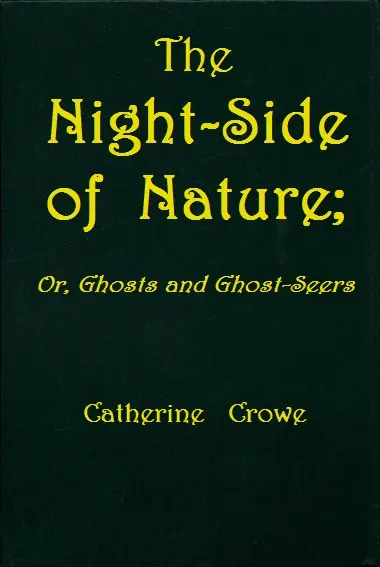
THE CLASSIC COLLECTION · 1856
"The Night-Side of Nature; Or, Ghosts and Ghost-Seers" by Catherine Crowe is a philosophical exploration written in the mid-19th century. This work investigates supernatural phenomena, particularly ghosts and their significance, alongside dreams, presentiments, and the nature of the human soul. Crowe's approach reflects a blend of inquiry and skepticism, aiming to illuminate what remains hidden about the spiritual and psychical aspects of existence. At the start of the book, the author introduces her intentions by discussing the lack of attention given to spiritual topics by the scientific community. She draws parallels between the obscurity of the "night-side" of nature, as understood by German astronomers, and humanity's ignorance of spiritual truths. The opening emphasizes the importance of observing and reflecting on the common occurrences of dreams and apparitions throughout history. Crowe outlines her goal of prompting inquiry rather than dictating beliefs, hoping that by doing so, readers might reconsider their views on the paranormal and their implications for understanding the existence of the soul and life after death.
Introduction adapted from the source catalogue; source summaries may be automatically generated.
Free to read · English · 170,037 words · No account needed
MAKE TIME FOR A GOOD BOOK
On by default. Untick to stop anonymous reading totals. Each page counts after 10 seconds in view. How this works.
Anonymous counting is on unless you have switched it off.
But, alas! poor Science has few such lovers! Les beaux yeux de sa cassette, I fear, are much more frequently the objects of attraction than her own fair face.
The belief in a God, and in the immortality of what we call the soul, is common to all nations; but our own intellect does not enable us to form any conception of either one or the other. All the information we have on these subjects is comprised in such hints as the Scripture here and there give us: whatever other conclusions we draw, must be the result of observation and experience. Unless founded upon these, the opinion of the most learned theologian or the most profound student of science that ever lived, is worth no more than that of any other person. They know nothing whatever about these mysteries; and all a priori reasoning on them is utterly valueless. The only way, therefore, of attaining any glimpses of the truth in an inquiry of this nature, where our intellect can serve us so little, is to enter on it with the conviction that, knowing nothing, we are not entitled to reject any evidence that may be offered to us, till it has been thoroughly sifted, and proved to be fallacious. That the facts presented to our notice appear to us absurd, and altogether inconsistent with the notions our intellects would have enabled us to form, should have no weight whatever in the investigation. Our intellects are no measure of God Almighty’s designs; and, I must say, that I do think one of the most irreverent, dangerous, and sinful things man or woman can be guilty of, is to reject with scorn and laughter any intimation which, however strangely it may strike upon our minds, and however adverse it may be to our opinions, may possibly be showing us the way to one of God’s truths. Not knowing all the conditions, and wanting so many links of the chain, it is impossible for us to pronounce on what is probable and consistent, and what is not; and, this being the case, I think the time is ripe for drawing attention to certain phenomena, which, under whatever aspect we may consider them, are, beyond doubt, exceedingly interesting and curious; while, if the view many persons are disposed to take of them be the correct one, they are much more than this. I wish, also, to make the English public acquainted with the ideas entertained on these subjects by a large proportion of German minds of the highest order. It is a distinctive characteristic of the thinkers of that country, that, in the first place, they do think independently and courageously; and, in the second, that they never shrink from promulgating the opinions they have been led to form, however new, strange, heterodox, or even absurd, they may appear to others. They do not succumb, as people do in this country, to the fear of ridicule; nor are they in danger of the odium that here pursues those who deviate from established notions; and the consequence is, that, though many fallacious theories and untenable propositions may be advanced, a great deal of new truth is struck out from the collision; and in the result, as must always be the case, what is true lives and is established, and what is false dies and is forgotten. But here, in Britain, our critics and colleges are in such haste to strangle and put down every new discovery that does not emanate from themselves, or which is not a fulfilling of the ideas of the day, but which, being somewhat opposed to them, promises to be troublesome from requiring new thought to render it intelligible, that one might be induced to suppose them divested of all confidence in this inviolable law; while the more important and the higher the results involved may be, the more angry they are with those who advocate them. They do not quarrel with a new metal or a new plant, and even a new comet or a new island stands a fair chance of being well received; the introduction of a planet appears, from late events, to be more difficult; while phrenology and mesmerism testify that any discovery tending to throw light on what most deeply concerns us, namely, our own being, must be prepared to encounter a storm of angry persecution. And one of the evils of this hasty and precipitate opposition is, that the passions and interests of the opposers become involved in the dispute: instead of investigators, they become partisans; having declared against it in the outset, it is important to their petty interests that the thing shall not be true; and they determine that it shall not, if they can help it. Hence, these hasty, angry investigations of new facts, and the triumph with which failures are recorded; and hence the wilful overlooking of the axiom that a thousand negatives can not overthrow the evidence of one affirmative experiment. I always distrust those who have declared themselves strongly in the beginning of a controversy. Opinions which, however rashly avowed, may have been honest at first, may have been changed for many a long day before they are retracted. In the meantime, the march of truth is obstructed, and its triumph is delayed; timid minds are alarmed; those who dare not or can not think for themselves, are subdued; there is much needless suffering incurred, and much good lost; but the truth goes quietly on its way, and reaches the goal at last.
Your reading position is saved on this browser. Take it to another device with a library code. Reading pages adapt to text, rather than matching a printed edition.
BEHIND THE BOOK
This eBook is for the use of anyone anywhere in the United States and most other parts of the world at no cost and with almost no restrictions whatsoever. You may copy it, give it away or re-use it under the terms of the Project Gutenberg License included with this eBook or online at www.gutenberg.org. If you are not located in the United States, you will have to check the laws of the country where you are located before using this eBook. Read the source licence.
The original source file, including credits and licence, is retained by this library. Request an original-format copy at no charge. Please include the book title and Project Gutenberg identifier #54532.
KEEP YOUR CURIOSITY GOING

David Patterson (Spirit) Hatch

David Patterson (Spirit) Hatch

David Patterson (Spirit) Hatch
Coulson Kernahan

Ralph Waldo Emerson
Frances Wright