THE CLASSIC COLLECTION✦Ghosts and Family Legends: A Volume for ChristmasCLASSIC FREE BOOKS
Ghosts and Family Legends: A Volume for Christmas
Catherine Crowe
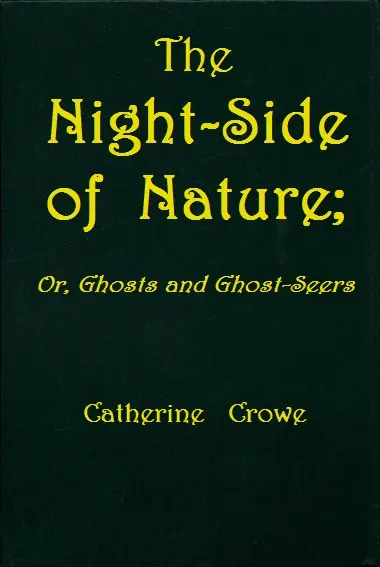
THE CLASSIC COLLECTION · 1856
"The Night-Side of Nature; Or, Ghosts and Ghost-Seers" by Catherine Crowe is a philosophical exploration written in the mid-19th century. This work investigates supernatural phenomena, particularly ghosts and their significance, alongside dreams, presentiments, and the nature of the human soul. Crowe's approach reflects a blend of inquiry and skepticism, aiming to illuminate what remains hidden about the spiritual and psychical aspects of existence. At the start of the book, the author introduces her intentions by discussing the lack of attention given to spiritual topics by the scientific community. She draws parallels between the obscurity of the "night-side" of nature, as understood by German astronomers, and humanity's ignorance of spiritual truths. The opening emphasizes the importance of observing and reflecting on the common occurrences of dreams and apparitions throughout history. Crowe outlines her goal of prompting inquiry rather than dictating beliefs, hoping that by doing so, readers might reconsider their views on the paranormal and their implications for understanding the existence of the soul and life after death.
Introduction adapted from the source catalogue; source summaries may be automatically generated.
Free to read · English · 170,037 words · No account needed
MAKE TIME FOR A GOOD BOOK
On by default. Untick to stop anonymous reading totals. Each page counts after 10 seconds in view. How this works.
Anonymous counting is on unless you have switched it off.
“After the campaign of the Prussians against the French, in the year 1806, the reigning prince of Hohenlohe gave orders to Councillor Hahn, who was in his service, to proceed to Slawensick, and there to wait his return. His serene highness advanced from Leignitz toward his principality, and Hahn also commenced his journey toward Upper Silesia on the 19th November. At the same period, Charles Kern, of Kuntzlau, who had fallen into the hands of the French, being released on parole, and arriving at Leignitz in an infirm condition, he was allowed to spend some time with Hahn, while awaiting his exchange.
“Hahn and Kern had been friends in their youth, and their destinies having brought them both at this time into the Prussian states, they were lodged together in the same apartment of the castle, which was one on the first floor, forming an angle at the back of the building, one side looking toward the north and the other to the east. On the right of the door of this room was a glass door, which led into a chamber divided from those which followed by a wainscot partition. The door in this wainscot, which communicated to those adjoining rooms, was entirely closed up, because in them all sorts of household utensils were kept. Neither in this chamber, nor in the sitting-room which preceded it, was there any opening whatever which could furnish the means of communication from without; nor was there anybody in the castle besides the two friends, except the prince’s two coachmen and Hahn’s servant. The whole party were fearless people; and as for Hahn and Kern, they believed in nothing less than ghosts or witches, nor had any previous experience induced them to turn their thoughts in that direction. Hahn, during his collegiate life, had been much given to philosophy—had listened to Fichte, and earnestly studied the writings of Kant. The result of his reflections was a pure materialism; and he looked upon created man, not as an aim, but merely as a means to a yet undeveloped end. These opinions he has since changed, like many others who think very differently in their fortieth year to what they did in their twentieth. The particulars here given are necessary in order to obtain credence for the following extraordinary narrative; and to establish the fact that the phenomena were not merely accepted by ignorant superstition, but coolly and courageously investigated by enlightened minds. During the first days of their residence in the castle, the two friends, living together in solitude, amused their long evenings with the works of Schiller, of whom they were both great admirers; and Hahn usually read aloud. Three days had thus passed quietly away, when, as they were sitting at the table, which stood in the middle of the room, about nine o’clock in the evening, their reading was interrupted by a small shower of lime which fell around them. They looked at the ceiling, concluding it must have come thence, but could perceive no abraded parts; and while they were yet seeking to ascertain whence the lime had proceeded, there suddenly fell several larger pieces, which were quite cold, and appeared as if they had belonged to the external wall. At length, concluding the lime must have fallen from some part of the wall, giving up further inquiry, they went to bed, and slept quietly till morning, when, on awaking, they were somewhat surprised at the quantity which strewed the floor, more especially as they could still discover no part of the walls or ceiling from which it could have fallen. But they thought no more of the matter till evening, when, instead of the lime falling as before, it was thrown, and several pieces struck Hahn. At the same time they heard heavy blows, sometimes below, and sometimes over their heads, like the sound of distant guns; still, attributing these sounds to natural causes, they went to bed as usual, but the uproar prevented their sleeping, and each accused the other of occasioning it by kicking with his feet against the foot-board of his bed, till, finding that the noise continued when they both got out and stood together in the middle of the room, they were satisfied that this was not the case. On the following evening, a third noise was added, which resembled the faint and distant beating of a drum. Upon this, they requested the governess of the castle to send them the key of the apartments above and below, which was brought them by her son; and while he and Kern went to make their investigations, Hahn remained in their own room. Above, they found an empty room; below, a kitchen. They knocked, but the noise they made was very different to that which Hahn continued all the while to hear around him. When they returned, Hahn said, jestingly, ‘The place is haunted!’ On this night, when they went to bed, with a light burning, they heard what seemed like a person walking about the room with slippers on, and a stick, with which he struck the floor as he moved step by step. Hahn continued to jest, and Kern to laugh, at the oddness of these circumstances, for some time, when they both, as usual, fell asleep, neither in the slightest degree disturbed by these events, nor inclined to attribute them to any supernatural cause. But on the following evening the affair became more inexplicable: various articles in the room were thrown about; knives, forks, brushes, caps, slippers, padlocks, funnel, snuffers, soap—everything, in short, that was moveable; while lights darted from the corners, and everything was in confusion; at the same time, the lime fell and the blows continued. Upon this, the two friends called up the servants, Knittel, the castle watch, and whoever else was at hand, to be witnesses of these mysterious operations. In the morning all was quiet, and generally continued so till after midnight. One evening, Kern going into the chamber to fetch something, and hearing an uproar that almost drove him backward to the door, Hahn caught up the light, and both rushed into the room, where they found a large piece of wood lying close to the wainscot. But supposing this to be the cause of the noise, who had set it in motion? For Kern was sure the door was shut, even while the noise was making; neither had there been any wood in the room. Frequently, before their eyes, the knives and snuffers rose from the table, and fell, after some minutes, to the ground; and Hahn’s large shears were once lifted in this manner between him and one of the prince’s cooks, and falling to the ground, stuck into the floor. As some nights, however, passed quite quietly, Hahn was determined not to leave the rooms; but when, for three weeks, the disturbance was so constant that they could get no rest, they resolved on removing their beds into the large room above, in hopes of once more enjoying a little quiet sleep. Their hopes were vain—the thumping continued as before; and not only so, but articles flew about the room which they were quite sure they had left below. ‘They may fling as they will,’ cried Hahn, ‘sleep I must;’ while Kern began to undress, pondering on these matters as he walked up and down the room. Suddenly Hahn saw him stand, as if transfixed, before the looking-glass on which he had accidentally cast his eyes. He had so stood for some time, when he was seized with a violent trembling, and turned from the mirror with his face as white as death. Hahn, fancying the cold of an uninhabited room had seized him, hastened to throw a cloak over him, when Kern, who was naturally very courageous, recovered himself, and related, though with trembling lips, that as he had accidentally looked in the glass, he had seen a white female figure looking out of it; she was in front of his own image, which he distinctly saw behind her. At first he could not believe his eyes; he thought it must be fancy, and for that reason he had stood so long; but when he saw that the eyes of the figure moved, and looked into his, a shudder had seized him, and he had turned away. Hahn, upon this, advanced with firm steps to the front of the mirror, and called upon the apparition to show itself to him; but he saw nothing, although he remained a quarter of an hour before the glass, and frequently repeated his exhortation. Kern then related that the features of the apparition were very old, but not gloomy or morose; the expression was that of indifference; but the face was very pale, and the head was wrapped in a cloth which left only the features visible.
Your reading position is saved on this browser. Take it to another device with a library code. Reading pages adapt to text, rather than matching a printed edition.
BEHIND THE BOOK
This eBook is for the use of anyone anywhere in the United States and most other parts of the world at no cost and with almost no restrictions whatsoever. You may copy it, give it away or re-use it under the terms of the Project Gutenberg License included with this eBook or online at www.gutenberg.org. If you are not located in the United States, you will have to check the laws of the country where you are located before using this eBook. Read the source licence.
The original source file, including credits and licence, is retained by this library. Request an original-format copy at no charge. Please include the book title and Project Gutenberg identifier #54532.
KEEP YOUR CURIOSITY GOING

David Patterson (Spirit) Hatch

David Patterson (Spirit) Hatch

David Patterson (Spirit) Hatch
Coulson Kernahan

Ralph Waldo Emerson
Frances Wright