THE CLASSIC COLLECTION✦Ghosts and Family Legends: A Volume for ChristmasCLASSIC FREE BOOKS
Ghosts and Family Legends: A Volume for Christmas
Catherine Crowe
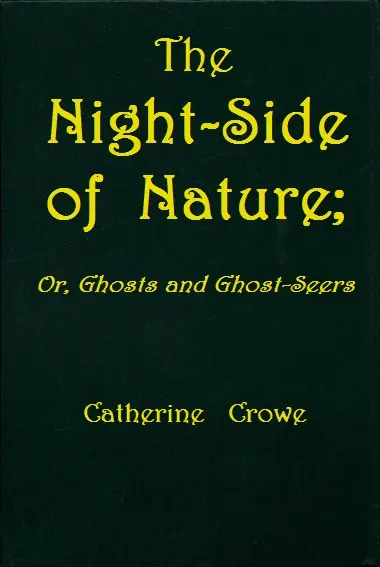
THE CLASSIC COLLECTION · 1856
"The Night-Side of Nature; Or, Ghosts and Ghost-Seers" by Catherine Crowe is a philosophical exploration written in the mid-19th century. This work investigates supernatural phenomena, particularly ghosts and their significance, alongside dreams, presentiments, and the nature of the human soul. Crowe's approach reflects a blend of inquiry and skepticism, aiming to illuminate what remains hidden about the spiritual and psychical aspects of existence. At the start of the book, the author introduces her intentions by discussing the lack of attention given to spiritual topics by the scientific community. She draws parallels between the obscurity of the "night-side" of nature, as understood by German astronomers, and humanity's ignorance of spiritual truths. The opening emphasizes the importance of observing and reflecting on the common occurrences of dreams and apparitions throughout history. Crowe outlines her goal of prompting inquiry rather than dictating beliefs, hoping that by doing so, readers might reconsider their views on the paranormal and their implications for understanding the existence of the soul and life after death.
Introduction adapted from the source catalogue; source summaries may be automatically generated.
Free to read · English · 170,037 words · No account needed
MAKE TIME FOR A GOOD BOOK
On by default. Untick to stop anonymous reading totals. Each page counts after 10 seconds in view. How this works.
Anonymous counting is on unless you have switched it off.
The knockings and sounds of people at work, asserted to be heard in mines, is a fact maintained by many very sensible men, overseers, and superintendents, &c., as well as by the workmen themselves; and there is a strong persuasion, I know, among the miners of Cornwall, and those of Mendip, that these visionary workmen are sometimes heard among them; on which occasions the horses evince their apprehensions by trembling and sweating; but as I have no means of verifying these reports, I do not dwell upon them further.
When the mother of George Canning, then Mrs. Hunn, was an actress in the provinces, she went, among other places, to Plymouth, having previously requested her friend, Mr. Bernard, of the theatre, to procure her a lodging. On her arrival Mr. B. told her that if she was not afraid of a ghost, she might have a comfortable residence at a very low rate, “For there is,” said he, “a house belonging to our carpenter, that is reported to be haunted, and nobody will live in it. If you like to have it, you may, and for nothing, I believe, for he is so anxious to get a tenant; only you must not let it be known that you do not pay rent for it.”
Mrs. Hunn, alluding to the theatrical apparitions, said it would not be the first time she had had to do with a ghost, and that she was very willing to encounter this one; so she had her luggage taken to the house in question, and the bed prepared. At her usual hour, she sent her maid and her children to bed, and, curious to see if there was any foundation for the rumor she had heard, she seated herself, with a couple of candles and a book, to watch the event. Beneath the room she occupied was the carpenter’s workshop, which had two doors. The one which opened into the street was barred and bolted within; the other, a smaller one, opening into the passage, was only on the latch; and the house was, of course, closed for the night. She had read something more than half an hour, when she perceived a noise issuing from this lower apartment, which sounded very much like the sawing of wood. Presently other such noises as usually proceed from a carpenter’s workshop were added, till by-and-by, there was a regular concert of knocking and hammering, and sawing and planing, &c.; the whole sounding like half a dozen busy men in full employment. Being a woman of considerable courage, Mrs. Hunn resolved, if possible, to penetrate the mystery; so taking off her shoes, that her approach might not be heard, with her candle in her hand, she very softly opened her door and descended the stairs, the noise continuing as loud as ever, and evidently proceeding from the workshop, till she opened the door, when instantly all was silent—all was still—not a mouse was stirring; and the tools and the wood, and everything else, lay as they had been left by the workmen when they went away. Having examined every part of the place, and satisfied herself that there was nobody there, and that nobody could get into it, Mrs. Hunn ascended to her room again, beginning almost to doubt her own senses, and question with herself whether she had really heard the noise or not, when it recommenced and continued, without intermission, for about half an hour. She however went to bed, and the next day told nobody what had occurred, having determined to watch another night before mentioning the affair to any one. As, however, this strange scene was acted over again, without her being able to discover the cause of it, she now mentioned the circumstance to the owner of the house and to her friend Bernard; and the former, who would not believe it, agreed to watch with her, which he did. The noise began as before, and he was so horror-struck that, instead of entering the workshop as she wished him to do, he rushed into the street. Mrs. Hunn continued to inhabit the house the whole summer; and, when referring afterward to the adventure, she observed that use was second nature, and that she was sure if any night these ghostly carpenters had not pursued their visionary labors, she should have been quite frightened, lest they should pay her a visit up stairs.
Your reading position is saved on this browser. Take it to another device with a library code. Reading pages adapt to text, rather than matching a printed edition.
BEHIND THE BOOK
This eBook is for the use of anyone anywhere in the United States and most other parts of the world at no cost and with almost no restrictions whatsoever. You may copy it, give it away or re-use it under the terms of the Project Gutenberg License included with this eBook or online at www.gutenberg.org. If you are not located in the United States, you will have to check the laws of the country where you are located before using this eBook. Read the source licence.
The original source file, including credits and licence, is retained by this library. Request an original-format copy at no charge. Please include the book title and Project Gutenberg identifier #54532.
KEEP YOUR CURIOSITY GOING

David Patterson (Spirit) Hatch

David Patterson (Spirit) Hatch

David Patterson (Spirit) Hatch
Coulson Kernahan

Ralph Waldo Emerson
Frances Wright