THE CLASSIC COLLECTION✦Ghosts and Family Legends: A Volume for ChristmasCLASSIC FREE BOOKS
Ghosts and Family Legends: A Volume for Christmas
Catherine Crowe
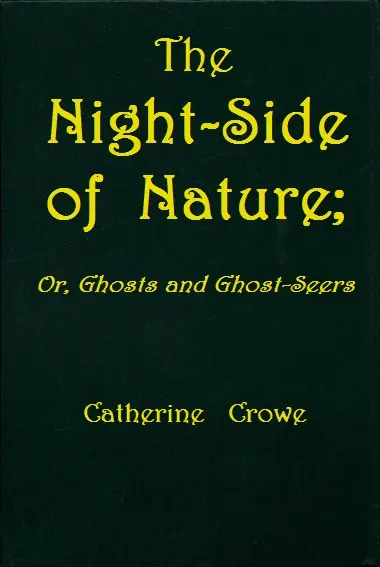
THE CLASSIC COLLECTION · 1856
"The Night-Side of Nature; Or, Ghosts and Ghost-Seers" by Catherine Crowe is a philosophical exploration written in the mid-19th century. This work investigates supernatural phenomena, particularly ghosts and their significance, alongside dreams, presentiments, and the nature of the human soul. Crowe's approach reflects a blend of inquiry and skepticism, aiming to illuminate what remains hidden about the spiritual and psychical aspects of existence. At the start of the book, the author introduces her intentions by discussing the lack of attention given to spiritual topics by the scientific community. She draws parallels between the obscurity of the "night-side" of nature, as understood by German astronomers, and humanity's ignorance of spiritual truths. The opening emphasizes the importance of observing and reflecting on the common occurrences of dreams and apparitions throughout history. Crowe outlines her goal of prompting inquiry rather than dictating beliefs, hoping that by doing so, readers might reconsider their views on the paranormal and their implications for understanding the existence of the soul and life after death.
Introduction adapted from the source catalogue; source summaries may be automatically generated.
Free to read · English · 170,037 words · No account needed
MAKE TIME FOR A GOOD BOOK
On by default. Untick to stop anonymous reading totals. Each page counts after 10 seconds in view. How this works.
Anonymous counting is on unless you have switched it off.
What is this but clear-seeing, backward and forward, the past and the future? The one faculty is not a whit more surprising and incomprehensible than the other, to those who possess neither; only we see the material product of one, and therefore believe in it. But, as Passavent justly observes, these coruscations belong not to genius exclusively—they are latent in all men. In the highly-gifted this divine spark becomes a flame to light the world withal; but even in the coarsest and least-developed organizations, it may and does momentarily break forth. The germ of the highest spiritual life is in the rudest, according to its degree, as well as in the highest form of man we have yet seen;—he is but a more imperfect type of the race, in whom this spiritual germ has not unfolded itself.
Then, with respect to our second source of information, I am quite aware that it is equally difficult to establish its validity; but there are a few arguments in our favor here, too. In the first place, as Dr. Johnson says, though all reason is against us, all tradition is for us; and this conformity of tradition is surely of some weight, since I think it would be difficult to find any parallel instance of a universal tradition that was entirely without a foundation in truth; for with respect to witchcraft, the belief in which is equally universal, we now know that the phenomena were generally facts, although the interpretations put upon them were fables. It may certainly be objected that this universal belief in ghosts only arises from the universal prevalence of spectral illusions; but if so, as I have before observed, these spectral illusions become a subject of very curious inquiry; for, in the first place, they frequently occur under circumstances the least likely to induce them, and to people whom we should least expect to find the victims of them; and, in the second, there is a most remarkable conformity here, too, not only between the individual cases occurring among all classes of persons, who had never exhibited the slightest tendency to nervous derangement or somnambulism, but also between these and the revelations of the somnambules. In short, it seems to me that life is reduced to a mere phantasmagoria, if spectral illusions are so prevalent, so complicated in their nature, and so delusive as they must be if all the instances of ghost-seeing that come before us are to be referred to that theory. How numerous these are, I confess myself not to have had the least idea, till my attention was directed to the inquiry; and that these instances have been equally frequent in all periods and places we can not doubt, from the variety of persons that have given in their adhesion, or at least that have admitted, as Addison did, that he could not refuse the universal testimony in favor of the reappearance of the dead, strengthened by that of many credible persons with whom he was acquainted. Indeed, the testimony in favor of the facts has been at all periods too strong to be wholly rejected; so that even the materialists, like Lucretius and the elder Pliny, find themselves obliged to acknowledge them; while, on the other hand, the extravagant admissions that are demanded of us by those who endeavor to explain them away, prove that their disbelief rests on no more solid foundation than their own prejudices. I acknowledge all the difficulty of establishing the facts—such difficulties as indeed encompass few other branches of inquiry; but I maintain that the position of the opponents is still worse, although, by their high tone and contemptuous laugh, they assume to have taken up one that, being fortified by reason, is quite impregnable, forgetting that the wisdom of man is pre-eminently “foolishness before God,” when it wanders into this region of unknown things;—forgetting, also, that they are just serving this branch of inquiry, as their predecessors, whom they laughed at, did physiology; concocting their systems out of their own brains, instead of the responses of nature—and with still more rashness and presumption, this department of her kingdom being more inaccessible, more incapable of demonstration, and more entirely beyond our control; for these spirits will not “come when we do call them;”—and I confess it often surprises me to hear the very shallow nonsense that very clever men talk upon the subject, and the inefficient arguments they use to disprove what they know nothing about. I am quite conscious that the facts I shall adduce are open to controversy: I can bring forward no evidence that will satisfy a scientific mind; but neither are my opponents a whit better fortified. All I do hope to establish is, not a proof, but a presumption; and the conviction I desire to awaken in people’s minds is, not that these things are so, but that they may be so, and that it is well worth our while to inquire whether they are or not.
Your reading position is saved on this browser. Take it to another device with a library code. Reading pages adapt to text, rather than matching a printed edition.
BEHIND THE BOOK
This eBook is for the use of anyone anywhere in the United States and most other parts of the world at no cost and with almost no restrictions whatsoever. You may copy it, give it away or re-use it under the terms of the Project Gutenberg License included with this eBook or online at www.gutenberg.org. If you are not located in the United States, you will have to check the laws of the country where you are located before using this eBook. Read the source licence.
The original source file, including credits and licence, is retained by this library. Request an original-format copy at no charge. Please include the book title and Project Gutenberg identifier #54532.
KEEP YOUR CURIOSITY GOING

David Patterson (Spirit) Hatch

David Patterson (Spirit) Hatch

David Patterson (Spirit) Hatch
Coulson Kernahan

Ralph Waldo Emerson
Frances Wright