THE CLASSIC COLLECTION✦Ghosts and Family Legends: A Volume for ChristmasCLASSIC FREE BOOKS
Ghosts and Family Legends: A Volume for Christmas
Catherine Crowe
THE CLASSIC COLLECTION · 1856
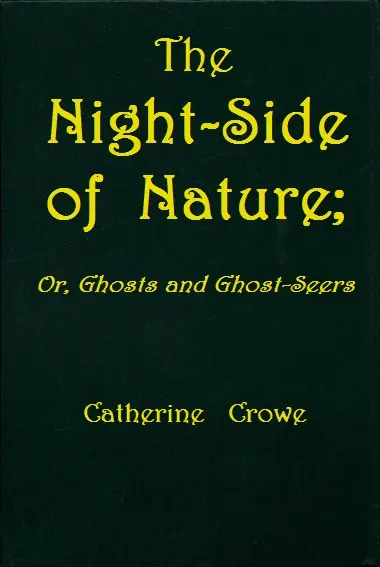
"The Night-Side of Nature; Or, Ghosts and Ghost-Seers" by Catherine Crowe is a philosophical exploration written in the mid-19th century. This work investigates supernatural phenomena, particularly ghosts and their significance, alongside dreams, presentiments, and the nature of the human soul. Crowe's approach reflects a blend of inquiry and skepticism, aiming to illuminate what remains hidden about the spiritual and psychical aspects of existence. At the start of the book, the author introduces her intentions by discussing the lack of attention given to spiritual topics by the scientific community. She draws parallels between the obscurity of the "night-side" of nature, as understood by German astronomers, and humanity's ignorance of spiritual truths. The opening emphasizes the importance of observing and reflecting on the common occurrences of dreams and apparitions throughout history. Crowe outlines her goal of prompting inquiry rather than dictating beliefs, hoping that by doing so, readers might reconsider their views on the paranormal and their implications for understanding the existence of the soul and life after death.
Introduction adapted from the source catalogue; source summaries may be automatically generated.
Free to read · English · 170,037 words · No account needed
MAKE TIME FOR A GOOD BOOK
On by default. Untick to stop anonymous reading totals. Each page counts after 10 seconds in view. How this works.
Anonymous counting is on unless you have switched it off.
It may be answered, that this is an argument which may be directed against the fact of such appearances being permitted at all; but that is a fallacious objection. Earthquakes and hurricanes are occasionally permitted, which overthrow the work of man’s hands for centuries; but if these convulsions of nature were of every-day occurrence, nobody would think it worth their while to build a house or cultivate the earth, and the world would be a wreck and a wilderness. The apparitions that do appear, are not without their use to those who believe in them; while there is too great an uncertainty attending the subject, generally to allow of its ever being taken into consideration in mundane affairs.
The old, so-called, superstition of the people, that a person’s “dying with something on his mind” is one of the frequent causes of these revisitings, seems, like most other of their superstitions, to be founded on experience. I meet with many cases in which some apparently trivial anxiety, or some frustrated communication, prevents the uneasy spirit flinging off the bonds that bind it to the earth. I could quote many examples characterized by this feature, but will confine myself to two or three.
Jung Stilling gives a very curious one, which occurred in the year 1746, and for the authenticity of which he vouches. A gentleman of the name of Dorrien, of most excellent character and amiable disposition, who was tutor in the Carolina Colleges, at Brunswick, died there in that year; and immediately previous to his death he sent to request an interview with another tutor, of the name of Hofer, with whom he had lived on terms of friendship. Hofer obeyed the summons, but came too late, the dying man was already in the last agonies. After a short time, rumors began to circulate that Herr Dorrien had been seen by different persons about the college; but as it was with the pupils that these rumors originated, they were supposed to be mere fancies, and no attention whatever was paid to them. At length, however, in the month of October, three months after the decease of Herr Dorrien, a circumstance occurred that excited considerable amazement among the professors. It formed part of the duty of Hofer to go through the college every night, between the hours of eleven and twelve, for the purpose of ascertaining that all the scholars were in bed, and that nothing irregular was going on among them. On the night in question, on entering one of the ante-rooms in the execution of this duty, he saw, to his great amazement, Herr Dorrien, seated, in the dressing-gown and white cap he was accustomed to wear, and holding the latter with his right hand, in such a manner as to conceal the upper part of the face; from the eyes to the chin, however, it was distinctly visible. This unexpected sight naturally startled Hofer, but, summoning resolution, he advanced into the young men’s chamber, and, having ascertained that all was in order, closed the door; he then turned his eyes again toward the spectre, and there it sat as before, whereupon he went up to it, and stretched out his arm toward it; but he was now seized with such a feeling of indescribable horror, that he could scarcely withdraw his hand, which became swollen to a degree that for some months he had no use of it. On the following day he related this circumstance to the professor of mathematics, Oeder, who of course treated the thing as a spectral illusion. He, however, consented to accompany Hofer on his rounds the ensuing night, satisfied that he should be able either to convince him it was a mere phantasm, or else a spectre of flesh and blood that was playing him a trick. They accordingly went at the usual hour, but no sooner had the professor set his foot in that same room, than he exclaimed, “By Heavens! it is Dorrien himself!” Hofer, in the meantime, proceeded into the chamber as before, in the pursuance of his duties, and, on his return, they both contemplated the figure for some time; neither of them had, however, the courage to address or approach it, and finally quitted the room, very much impressed, and perfectly convinced that they had seen Dorrien.
Your reading position is saved on this browser. Take it to another device with a library code. Reading pages adapt to text, rather than matching a printed edition.
BEHIND THE BOOK
This eBook is for the use of anyone anywhere in the United States and most other parts of the world at no cost and with almost no restrictions whatsoever. You may copy it, give it away or re-use it under the terms of the Project Gutenberg License included with this eBook or online at www.gutenberg.org. If you are not located in the United States, you will have to check the laws of the country where you are located before using this eBook. Read the source licence.
The original source file, including credits and licence, is retained by this library. Request an original-format copy at no charge. Please include the book title and Project Gutenberg identifier #54532.
KEEP YOUR CURIOSITY GOING

David Patterson (Spirit) Hatch

David Patterson (Spirit) Hatch

David Patterson (Spirit) Hatch
Coulson Kernahan

Ralph Waldo Emerson
Frances Wright