THE CLASSIC COLLECTION✦The city in the seaCLASSIC FREE BOOKS
The city in the sea
H. De Vere (Henry De Vere) Stacpoole
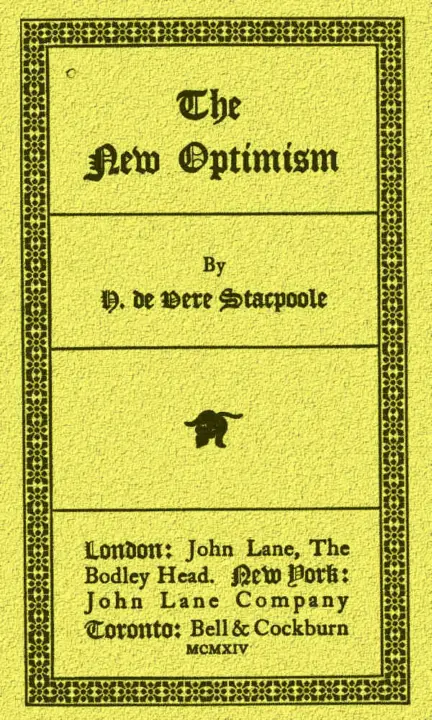
THE CLASSIC COLLECTION · 1914
"The New Optimism" by H. De Vere Stacpoole is a philosophical treatise written in the early 20th century. This work explores themes of evolution, the nature of existence, and the inherent goodness of the universe through a dialogue between two characters discussing humanity's past and its trajectory moving forward. The book posits that understanding our evolutionary heritage can illuminate the positive potential of life and the universe itself. At the start of the book, the narrator observes the sea while conversing with a companion about the fascination of water, which leads to discussions on evolution, consciousness, and the struggle between benevolence and malevolence in the universe. The narrator explains that life has evolved from a chaotic state into a complex web of relationships, emphasizing a journey from ferocity to kindness. Their dialogue delves into the theme of universal development toward goodness, establishing that the earth and life have a coherent meaning that transcends apparent chaos and suffering. As they examine the transformations from simple forms of life to complex beings like humans, the conversation highlights a belief in a world spirit propelling humanity toward beneficial outcomes, despite setbacks and challenges.
Introduction adapted from the source catalogue; source summaries may be automatically generated.
Free to read · English · 20,664 words · No account needed
MAKE TIME FOR A GOOD BOOK
On by default. Untick to stop anonymous reading totals. Each page counts after 10 seconds in view. How this works.
Anonymous counting is on unless you have switched it off.
I have said very little about Anarchism—merely mentioned it by name; yet the inquiries I have made into this subject reveal an organisation and a literature astonishing to the everyday mind. To use the words of that ardent bibliophile, H. Bourdin:
“To most people the word Anarchy is evil-sounding, but it is not the same to learned men and to collectors and lovers who acquire the desire of accumulating documents for history’s sake.
“The Anarchist literature has not a determined origin, being not the expression of a system invented and progressively elaborated, but the negation of all systems, produced by the desire to batter down the despotic in all its forms, the rules and duty imposed by prejudice or by force, and to give impulse to the free development of humanity. All acts which have been accomplished and all words which have been pronounced in hatred of this constraint and in favour of this freedom are consciously or unconsciously the production of Anarchy.
“It is astonishing when one glances at the huge quantity of literature of all kinds which has been printed in the space of the last half-century for the exposition of their ideal thought; no other party or sect, for whatever cause they had to defend, can be compared to this, except Christianity, which has taken about 2,000 years over it. Consider the difficulty which they have met in publishing clandestinely their periodicals, broadsides, etc., hunted by society as wild beasts; domiciliary perquisitions destroyed their works, which were merely their thoughts.”
M. Bourdin has courteously allowed me to inspect the huge library of Anarchistical literature which he has collected, consisting of journals, broadsides, pamphlets, volumes, songs, theatrical plays, etc.
To give you an idea of the extent and nature of the Anarchistical press, I enumerate a few of the journals:
L’Anarchie, Journal de l’Ordre, May, 1850.
(In 1850, Anarchy had already a press.)
Le Libertaire, 1858–1861.
L’Egalité, 1869–1872.
L’Internationale, 1870–1873.
La Révolution Sociale, 1871–1872.
L’Ami du Peuple (Liège), 1873–1875.
Ni Dieu ni Maître, 1880. (You see we are getting on in titles.)
La Révolution Sociale, 1880.
Le Drapeau Noir, 1883.
L’Emeute, 1883–1884.
La Lutte, 1883.
Le Défi, 1884.
La Guerre Sociale, 1885. (Brussels).
La Révolte, 1894.
L’Antipatriote, 1899. (Cat out of the bag.)
Le Tocsin, 1892–1894.
La Débâcle, 1893.
L’Insurgé (Lyons), 1893.
Le Cyclone (Buenos Aires), 1895–1896.
La Cravache, 1898.
Le Cravacheur, idem.
Le Cri de Révolte, 1898–9.
Les Crimes de Dieu, 1898.
La Bastille, 1902–3.
Germinal, 1904–1910.
L’Anarchie, 1905.
L’Anarchiste, 1907.
L’Action Directe, 1907–1908.
La Mère Peinard, 1908.
La Révolution, 1909.
Les Révoltés, 1909.
La Bataille Syndicaliste, 1911.
The Anarchist (Glasgow), 1912.
Your reading position is saved on this browser. Take it to another device with a library code. Reading pages adapt to text, rather than matching a printed edition.
H. De Vere (Henry De Vere) Stacpoole
H. De Vere (Henry De Vere) Stacpoole

H. De Vere (Henry De Vere) Stacpoole

H. De Vere (Henry De Vere) Stacpoole
BEHIND THE BOOK
This eBook is for the use of anyone anywhere in the United States and most other parts of the world at no cost and with almost no restrictions whatsoever. You may copy it, give it away or re-use it under the terms of the Project Gutenberg License included with this eBook or online at www.gutenberg.org. If you are not located in the United States, you will have to check the laws of the country where you are located before using this eBook. Read the source licence.
The original source file, including credits and licence, is retained by this library. Request an original-format copy at no charge. Please include the book title and Project Gutenberg identifier #54840.
KEEP YOUR CURIOSITY GOING

David Patterson (Spirit) Hatch
Coulson Kernahan

Ralph Waldo Emerson
Frances Wright

Edwin Abbott Abbott

Joseph Droz