THE CLASSIC COLLECTION✦The city in the seaCLASSIC FREE BOOKS
The city in the sea
H. De Vere (Henry De Vere) Stacpoole
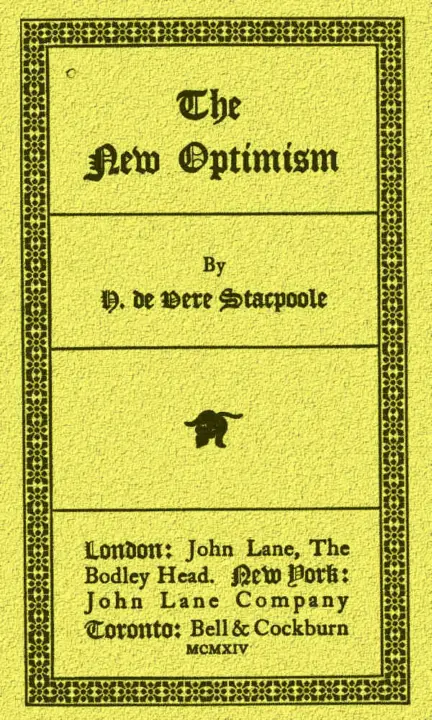
THE CLASSIC COLLECTION · 1914
"The New Optimism" by H. De Vere Stacpoole is a philosophical treatise written in the early 20th century. This work explores themes of evolution, the nature of existence, and the inherent goodness of the universe through a dialogue between two characters discussing humanity's past and its trajectory moving forward. The book posits that understanding our evolutionary heritage can illuminate the positive potential of life and the universe itself. At the start of the book, the narrator observes the sea while conversing with a companion about the fascination of water, which leads to discussions on evolution, consciousness, and the struggle between benevolence and malevolence in the universe. The narrator explains that life has evolved from a chaotic state into a complex web of relationships, emphasizing a journey from ferocity to kindness. Their dialogue delves into the theme of universal development toward goodness, establishing that the earth and life have a coherent meaning that transcends apparent chaos and suffering. As they examine the transformations from simple forms of life to complex beings like humans, the conversation highlights a belief in a world spirit propelling humanity toward beneficial outcomes, despite setbacks and challenges.
Introduction adapted from the source catalogue; source summaries may be automatically generated.
Free to read · English · 20,664 words · No account needed
MAKE TIME FOR A GOOD BOOK
On by default. Untick to stop anonymous reading totals. Each page counts after 10 seconds in view. How this works.
Anonymous counting is on unless you have switched it off.
[Sidenote: The Beach We Came From]
I was standing by the sea-wall, watching the green water foaming round the stakes of the breakwater, when my companion, a charming and elegant woman, turned to me:
“What is there in water that fascinates one?” she asked.
“Do you feel the fascination?”
“Yes.”
“Do you not know why you feel it?”
“No.”
“Shall I tell you?”
“Yes.”
“Because you were once a swimming reptile.”
“Thank you.”
“Oh, there is nothing to thank me for, though the fact is the most glorious in the universe.”
“The fact that I was once a reptile?”
“Precisely.”
She pondered on this for a moment, and then:
“I don’t see where the glory comes in,” said she.
“Nevertheless, it is there, for the fact is the master key to the meaning of the universe, the one light that shines in a world of darkness, and the one sure hope in a world of doubt.”
“The fact that I was once a reptile?”
“And I—yes. I would not give what the webbing between my fingers tells me for all the promises of all the religions of all the countries on earth.”
“Ancestral pride is evidently not your strong point.”
“I don’t know about that; but up to a year ago mental darkness was my portion. I had no religion.”
“And have you any now?”
“No, but I have a certainty.”
“Of what?”
“Of the fact that the world has a meaning and life an aim. Shall we sit down on this seat and talk for a while, if I am not boring you?—and may I light a cigarette?”
“You are not boring me—yet. And if you can prove what you say, I shall not mind even if you bore me. But I must tell you, first of all, that, to me, the world seems absolutely without a meaning and life without an aim. I mean, of course, the general life of the world, which implies, as far as I can see, general suffering. If suffering did people good, then I could understand that we were placed here to grow and develop; but suffering and poverty, as far as I can see, only stunt and twist and spoil everything they touch.”
“Precisely.”
“Then, if you admit that, you must admit that the meaning and aim of the world is far from being glorious.”
“Never. That is what I wish to disprove.”
“Then disprove it.”
[Sidenote: The Growth of the World]
“Tell me,” I said. “Why is it that an ordinary human being placed before a flower sees only a flower and nothing of the wonder that is in it?”
Your reading position is saved on this browser. Take it to another device with a library code. Reading pages adapt to text, rather than matching a printed edition.
H. De Vere (Henry De Vere) Stacpoole
H. De Vere (Henry De Vere) Stacpoole

H. De Vere (Henry De Vere) Stacpoole

H. De Vere (Henry De Vere) Stacpoole
BEHIND THE BOOK
This eBook is for the use of anyone anywhere in the United States and most other parts of the world at no cost and with almost no restrictions whatsoever. You may copy it, give it away or re-use it under the terms of the Project Gutenberg License included with this eBook or online at www.gutenberg.org. If you are not located in the United States, you will have to check the laws of the country where you are located before using this eBook. Read the source licence.
The original source file, including credits and licence, is retained by this library. Request an original-format copy at no charge. Please include the book title and Project Gutenberg identifier #54840.
KEEP YOUR CURIOSITY GOING

David Patterson (Spirit) Hatch
Coulson Kernahan

Ralph Waldo Emerson
Frances Wright

Edwin Abbott Abbott

Joseph Droz