THE CLASSIC COLLECTION✦The city in the seaCLASSIC FREE BOOKS
The city in the sea
H. De Vere (Henry De Vere) Stacpoole
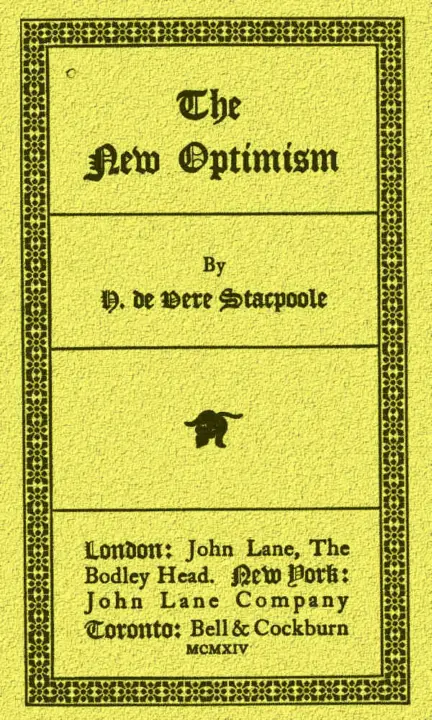
THE CLASSIC COLLECTION · 1914
"The New Optimism" by H. De Vere Stacpoole is a philosophical treatise written in the early 20th century. This work explores themes of evolution, the nature of existence, and the inherent goodness of the universe through a dialogue between two characters discussing humanity's past and its trajectory moving forward. The book posits that understanding our evolutionary heritage can illuminate the positive potential of life and the universe itself. At the start of the book, the narrator observes the sea while conversing with a companion about the fascination of water, which leads to discussions on evolution, consciousness, and the struggle between benevolence and malevolence in the universe. The narrator explains that life has evolved from a chaotic state into a complex web of relationships, emphasizing a journey from ferocity to kindness. Their dialogue delves into the theme of universal development toward goodness, establishing that the earth and life have a coherent meaning that transcends apparent chaos and suffering. As they examine the transformations from simple forms of life to complex beings like humans, the conversation highlights a belief in a world spirit propelling humanity toward beneficial outcomes, despite setbacks and challenges.
Introduction adapted from the source catalogue; source summaries may be automatically generated.
Free to read · English · 20,664 words · No account needed
MAKE TIME FOR A GOOD BOOK
On by default. Untick to stop anonymous reading totals. Each page counts after 10 seconds in view. How this works.
Anonymous counting is on unless you have switched it off.
“‘Woman must have a freer life.’
“‘To evolve her genius, woman has but one need—Freedom.’
“‘She must be free to form her own ideas and morals.’
“‘Woman must reorganize the mind and soul of humanity, for man has
disintegrated it.’
“Those are some of the teachings of the Apostles of Feminism. I take them from the work of a clever American woman, and they are a fair statement of the case for Feminism.
“To the first I give an unqualified assent.
“Freedom, within limits, is the basic condition of growth.
“But what does the Feminist mean by Freedom?
“The third dictum answers that.
“‘She must be free to form her own ideas and morals.’
“One would fancy from that that ‘woman’ was an animal capable of evolving ideas and a moral code different from man. Since woman is just the same human animal, we may put this aside, and ask again what the Feminist means.
“She asks, in fact, that women may be free to change their morals (we shall leave the talk about ideas aside for the present) in any way they please.
“Now, morals cannot be changed in a horizontal direction. It’s up, or down, or stationary. Any change in morals is for the better or for the worse.
“Does the Feminist ask for freedom to change her morals for the better? She has perfect freedom to do that; most men will applaud her, and most women, too.
“Does she ask for freedom to change her morals for the worse?
“If she is making that demand, let her frankly avow that what she wants is license, not freedom.
“There is a lot of difference between the two.
“I am not arguing to get the Feminist in a hole, but simply to clear
the ground of brambles.
“She does want license, as a matter of fact; one would be blind who looked at her programme and did not see that.
“And the license she wants is not the license to steal, or lie, or murder, or commit arson. When she talks of forming her own morals, she has one morality entirely and solely in view—the morality that presides over Love; and when she asks for license, it is license in Love.
“Men have more license in this matter than women. That is undoubtedly
so.
“Men, since the beginning of the world, have had more license than women; but that license is a relic of barbarism. It was useful once, but it is becoming less useful every day, and pari passu men are becoming more moral.”
“Useful once?”
Your reading position is saved on this browser. Take it to another device with a library code. Reading pages adapt to text, rather than matching a printed edition.
H. De Vere (Henry De Vere) Stacpoole
H. De Vere (Henry De Vere) Stacpoole

H. De Vere (Henry De Vere) Stacpoole

H. De Vere (Henry De Vere) Stacpoole
BEHIND THE BOOK
This eBook is for the use of anyone anywhere in the United States and most other parts of the world at no cost and with almost no restrictions whatsoever. You may copy it, give it away or re-use it under the terms of the Project Gutenberg License included with this eBook or online at www.gutenberg.org. If you are not located in the United States, you will have to check the laws of the country where you are located before using this eBook. Read the source licence.
The original source file, including credits and licence, is retained by this library. Request an original-format copy at no charge. Please include the book title and Project Gutenberg identifier #54840.
KEEP YOUR CURIOSITY GOING

David Patterson (Spirit) Hatch
Coulson Kernahan

Ralph Waldo Emerson
Frances Wright

Edwin Abbott Abbott

Joseph Droz