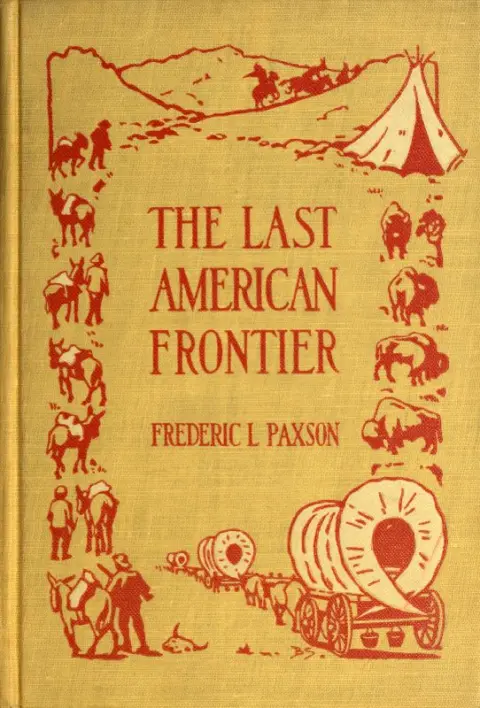
The Last American Frontier
Frederic L. (Frederic Logan) Paxson
THE CLASSIC COLLECTION · 1912
"The New Nation" by Frederic L. Paxson is a historical account written in the early 20th century. The book explores the profound changes that occurred in the United States following the Civil War, addressing the political, economic, and social transformations that shaped the nation during that period. Paxson examines how the nation's identity evolved amidst post-war reconstruction, financial upheaval, and the rise of industrial society, providing insights into the shifting dynamics between state and federal authority. The opening of "The New Nation" discusses the aftermath of the Civil War, emphasizing the complexity of the political landscape and the challenges faced by the United States in maintaining unity and governance. Paxson highlights the rise of the Republican Party and the efforts of leaders like Abraham Lincoln to foster a cohesive national identity while navigating the political turmoil of the time. The text delves into the implications of economic advancements and the changing social fabric, setting the stage for a broader analysis of how these elements defined the American experience in the decades that followed.
Introduction adapted from the source catalogue; source summaries may be automatically generated.
Free to read · English · 87,263 words · No account needed
MAKE TIME FOR A GOOD BOOK
On by default. Untick to stop anonymous reading totals. Each page counts after 10 seconds in view. How this works.
Anonymous counting is on unless you have switched it off.
Greeley, Horace, nominated for President by Liberal Republicans, 56;
a quaint political figure, 57;
quoted, 89.
Greenback movement, the, advocates of, 30, 65, 66;
Eastern opinion of, contrasted with Western, 68;
and silver inflation, 88, 180, 181.
Greenbacks, 9;
value of, 10;
depreciation of, 27;
withdrawal of, 28;
further retirement of, forbidden by law, 30;
rising in value, 65;
issued during panic of 1873, 66.
Guam, ceded to United States, 273.
Guiteau, William B., 105.
Hadley, Pres. Arthur T., 310.
Hague, the, court of arbitration at, 283;
Venezuelan claims referred to, 284;
second conference, 318.
Hancock, Gen. Winfield Scott, 80, 99, 100, 101.
Hanna, Marcus Alonzo, raises funds for Republicans, 102, 233, 238, 239;
appointed Senator, 252;
helps settle coal strike, 300, 302;
grows in popularity, 302, 303;
death, 304.
Harmon, Gov. Judson, 336.
Harriman, Edward H., 294, 295.
Harrison, Benjamin, nominated for Presidency, 169;
elected as a minority President, 171, 211;
friction with Chile, 212, 213;
renominated, 214;
defeated, 215, 216.
Hawaiian Islands, 273, 274, 278.
Hay, John, on McKinley, 251;
Secretary of State, 273, 282;
career of, 281.
Hay-Pauncefote Treaty, for Isthmian canal, 286, 287.
Hayes, Rutherford B., receives nomination for President, 82;
difficulties of his election, 83, 84;
alienates many Republicans by his attitude toward the South, 85;
his troubles with Democratic congress, 87;
removes Chester A. Arthur from office, 87, 98, 103;
financial policy of his administration, 89, 90;
a new period of growth begun during his term of office, 90, 92;
end of his term, 97, 102;
and the Panama Canal, 144;
becomes head of Slater fund, 201.
Hearst, William R., 305, 312.
Hendricks, Thomas A., candidate for Vice-President, 80, 81, 131.
Hepburn Railway Bill, the, 315.
Hill, Gov. David B., 214, 215, 248.
Hill, James J., 295, 296.
Hobart, Garrett P., Vice-President with McKinley, 234;
dies in office, 280.
Homestead Act, the, 21, 155.
Hopkins, Johns, 60.
Howells, William Dean, 188.
Huerta, Victoriano, President of Mexico, 340.
Hughes, Charles E., exposes wrongdoing of insurance companies, 312; mentioned for Presidency, 324.
Hull House, 251.
Humphreys, Benjamin G., 46.
Husbandry, Patrons of, 193.
Idaho, becomes a Territory, 21;
admitted to the Union, 152.
Immigration movement, the, influences of, 123, 124.
Income tax, 221, 327, 338.
Indians, removal of, 22, 25;
outbreaks of, 25, 86;
Dawes Bill, 142, 151, 319.
Industrial Commission, 298.
Industrial consolidation, evolves new type of trust, 297, 299.
Industrial revival, after 1897, 293, 294.
Industrial revolution, effects of, 95.
Inflation Bill, the, 66.
Ingersoll, Robert G., quoted, 92.
Initiative and referendum, 249, 250.
Interstate Commerce Act, the, 142, 158, 159;
commission created, 159, 160;
influence of rebate system on, 165;
had little immediate effect, 180;
an imperfect statute, 314;
strengthened by Congress, 315, 330.
Irons, Martin, 135.
Irrigation, 142, 291.
Italians, lynched in New Orleans, 213.
Jackson, Andrew, 8, 111.
James, Thomas L., 102, 103, 104.
Japan, at war with Russia, 317.
Johnson, Andrew, candidate for the Vice-Presidency, 4;
becomes President upon death of Lincoln, 32;
opposition of Congress to, 33, 34;
impeached by House, 35;
acquitted, 36;
vetoes arbitrary acts of Congress, 48.
Johnson, Gov. Hiram, 337.
Johnson, Reverdy, 55.
Journalism, expansion of, 162;
reorganized in the later nineties, 311.
Kansas City, important as meeting place of railways, 150, 151.
Kearney, Dennis, 94, 124.
Keifer, J. Warren, 108.
Kelly, John, 131.
Kerr, Michael C., 108.
Kipling, Rudyard, The White Man's Burden, 274.
Knickerbocker Trust Company, suspension of, 322.
Knights of Labor, secret society in the East, 94;
meet with disfavor, 121;
demands of, 122;
fight the Gould railways, 135;
success of, 183;
union with Farmers' Alliance, 186, 187;
in Pullman strike, 222.
Knox, Philander C., 296, 320, 331.
Ku-Klux Klan, the, 52.
Your reading position is saved on this browser. Take it to another device with a library code. Reading pages adapt to text, rather than matching a printed edition.
Frederic L. (Frederic Logan) Paxson
BEHIND THE BOOK
This eBook is for the use of anyone anywhere in the United States and most other parts of the world at no cost and with almost no restrictions whatsoever. You may copy it, give it away or re-use it under the terms of the Project Gutenberg License included with this eBook or online at www.gutenberg.org. If you are not located in the United States, you will have to check the laws of the country where you are located before using this eBook. Read the source licence.
The original source file, including credits and licence, is retained by this library. Request an original-format copy at no charge. Please include the book title and Project Gutenberg identifier #27953.
KEEP YOUR CURIOSITY GOING
Cécile Tormay

Moritz Busch
John L. Ransom
Frances Wright
Cécile Tormay

Mabel Potter Daggett