Lady Kilpatrick
Robert Williams Buchanan
THE CLASSIC COLLECTION · 1884
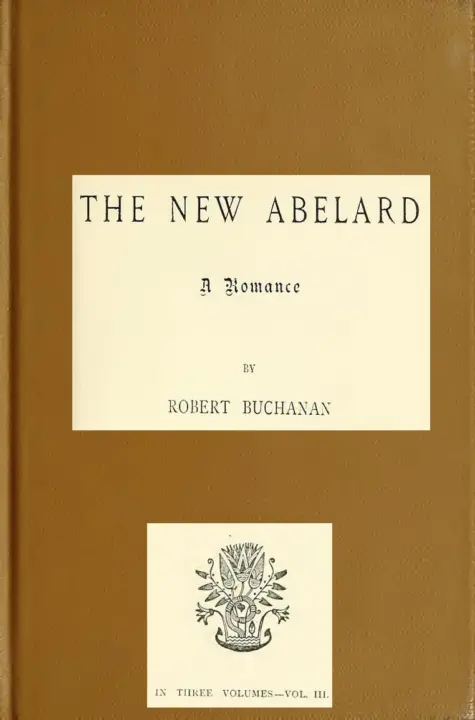
"The New Abelard: A Romance, Volume 2" by Robert Williams Buchanan is a novel written in the late 19th century. This book continues the exploration of complex relationships and societal norms, particularly focusing on Ambrose Bradley, a controversial preacher, and his connection with Alma Craik, the woman he loves. Themes of love, betrayal, and the clash between traditional beliefs and new ideologies shape the narrative as the characters navigate their intertwined destinies. At the start of the novel, the conversation between George Craik and Cholmondeley reveals deep-seated emotions surrounding Alma's engagement with Bradley, who has sparked scandal through his new church. As George grapples with his family's honor and his feelings for Alma, tensions rise when he discovers that Alma and Bradley have been seen together, sparking his jealousy and obsession. The narrative delves into the characters' backgrounds and motivations, hinting at past relationships that complicate their current situations, setting the stage for further conflict and emotional turmoil. The tense interactions between the characters foreshadow dramatic confrontations and revelations that will unfold as the story progresses.
Introduction adapted from the source catalogue; source summaries may be automatically generated.
Free to read · English · 32,366 words · No account needed
MAKE TIME FOR A GOOD BOOK
On by default. Untick to stop anonymous reading totals. Each page counts after 10 seconds in view. How this works.
Anonymous counting is on unless you have switched it off.
‘Spiritualism, as commonly understood, is one thing, sir,’ returned the Professor quietly; ‘spiritualistic materialism, or solar science, is another. Our creed, sir, like your own, is the destruction of supernaturalism. If you will permit me once more to quote our sublime Bard, he sings as follows:--
All things abide in Nature; Form and Soul,
Matter and Thought, Function, Desire, and Dream,
Evolve within her ever-heaving breast;
“Within her, we subsist; beyond and o’er her
Is naught hut Chaos and primaeval Night.
The Shadow of that Night for centuries
Projected Man’s phantasmic Deity,
Formless, fantastic, hideous, and unreal;
God is Existence, and as parts of God
Men ebb and flow, for evermore divine.
‘If you abolish supernaturalism,’ asked the clergyman impatiently, ‘what do you mean by manifestations?’
‘Just this,’ returned the little man glibly, ‘the interchange of communications between beings of this sphere and beings otherwise conditioned. This world is one of many, all of which have a two-fold existence--in the sphere of matter, and in the sphere of ideas. Death, which vulgar materialists consider the end of consciousness, is merely one of the many phenomena of change; and spiritualistic realities being indestructible----’
Bradley rose impatiently.
‘I am afraid,’ he exclaimed, ‘that I cannot discuss the matter any longer. Our opinions on the subject are hopelessly antagonistic, and to speak frankly, I have an invincible repugnance to the subject itself.’
‘Shared, I am sorry to say, by many of your English men of science.’
‘Shared, I am glad to say, by most thinking men.’
‘Well, well, sir, I won’t detain you at present,’ returned the Professor, not in the least ruffled. ‘Perhaps you will permit me to call upon you at a more suitable time, and to introduce my sister?’
‘Really, I----’ began Bradley with some embarrassment.
‘Eustasia Mapleleafe is a most remarkable woman, sir. She is a medium of the first degree; she possesses the power of prophecy, of clairvoyance, and of thought-reading. The book of the Soul is open to her, and you would wonder at her remarkable divinations.’
‘I must still plead my entire scepticism,’ said Bradley coldly.
‘I guess Eustasia Mapleleafe would convert you. She was one of your congregation today, and between ourselves is greatly concerned on your account.’
‘Concerned on my account!’ echoed the clergyman.
‘Yes, sir. She believes you to be under the sway of malign influences, possibly lunar or stellar. She perceived a dark spectrum on the radiant orb of your mind, troubling the solar effluence which all cerebral matter emits, and which is more particularly emitted by the phosphorescent cells of the human brain.’
Your reading position is saved on this browser. Take it to another device with a library code. Reading pages adapt to text, rather than matching a printed edition.
Robert Williams Buchanan
Robert Williams Buchanan
Robert Williams Buchanan
Robert Williams Buchanan
BEHIND THE BOOK
This eBook is for the use of anyone anywhere in the United States and most other parts of the world at no cost and with almost no restrictions whatsoever. You may copy it, give it away or re-use it under the terms of the Project Gutenberg License included with this eBook or online at www.gutenberg.org. If you are not located in the United States, you will have to check the laws of the country where you are located before using this eBook. Read the source licence.
The original source file, including credits and licence, is retained by this library. Request an original-format copy at no charge. Please include the book title and Project Gutenberg identifier #54856.
KEEP YOUR CURIOSITY GOING
Coulson Kernahan

Maurice Baring
Frances Wright
Cécile Tormay

Frederic Jesup Stimson

W. H. P. (William Henry Pope) Jarvis