Lady Kilpatrick
Robert Williams Buchanan
THE CLASSIC COLLECTION · 1884
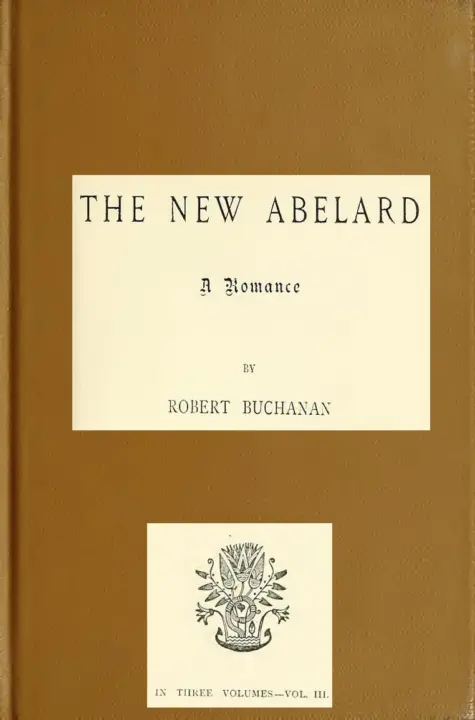
"The New Abelard: A Romance, Volume 2" by Robert Williams Buchanan is a novel written in the late 19th century. This book continues the exploration of complex relationships and societal norms, particularly focusing on Ambrose Bradley, a controversial preacher, and his connection with Alma Craik, the woman he loves. Themes of love, betrayal, and the clash between traditional beliefs and new ideologies shape the narrative as the characters navigate their intertwined destinies. At the start of the novel, the conversation between George Craik and Cholmondeley reveals deep-seated emotions surrounding Alma's engagement with Bradley, who has sparked scandal through his new church. As George grapples with his family's honor and his feelings for Alma, tensions rise when he discovers that Alma and Bradley have been seen together, sparking his jealousy and obsession. The narrative delves into the characters' backgrounds and motivations, hinting at past relationships that complicate their current situations, setting the stage for further conflict and emotional turmoil. The tense interactions between the characters foreshadow dramatic confrontations and revelations that will unfold as the story progresses.
Introduction adapted from the source catalogue; source summaries may be automatically generated.
Free to read · English · 32,366 words · No account needed
MAKE TIME FOR A GOOD BOOK
On by default. Untick to stop anonymous reading totals. Each page counts after 10 seconds in view. How this works.
Anonymous counting is on unless you have switched it off.
‘Why, certainly. Spiritualism is materialism; in other words, everything is spirit matter. All bodies, as the great Swedenborg demonstrated long ago, are spirit; thought is spirit--that is to say, sir, sunlight. The same great principle of which I have spoken is the destruction of all religion save the religion of solar science. It demolishes Theism, which has been the will-o’-the-wisp of the world, abolishes Christianity, which has been its bane. The God of the universe is solar Force, which is universal and pantheistic.’
‘Pray sit down,’ said Bradley, now for the first time becoming interested. ‘If I understand you, there is no personal God?’
‘Of course not,’ returned the little man, sidling into a chair and dropping his eyeglass. ‘A personal God is, as the scientists call it, merely an anthropomorphic Boom. As the great cosmic Bard of solar biology expresses it in his sublime epic:
The radiant flux and reflux, the serene
Atomic ebb and flow of force divine,
This, this alone, is God, the Demiurgus;
By this alone we are, and still shall be.
O joy! the Phantom of the Uncondition’d
Fades into nothingness before the breath
Of that eternal ever-effluent Life
Whose centre is the shining solar Heart
Of countless throbbing pulses, each a world!
The quotation was delivered with extraordinary rapidity, and in the offhand matter-of-fact manner characteristic of the speaker. Then, after pausing a moment, and fixing his glass again, the Professor demanded eagerly: ‘What do you think of that, sir?’
‘I think,’ answered Bradley, laughing contemptuously, ‘that it is very poor science, and still poorer poetry.’
‘You think so, really?’ cried the Professor, not in the least disconcerted. ‘I think I could convince you by a few ordinary manifestations, that it’s at any rate common sense.’
It was now quite clear to Bradley that the man was a charlatan, and he was in no mood to listen to spiritualistic jargon. What both amused and puzzled him was that two such men as his American correspondents should have franked the Professor to decent society by letters of introduction. He reflected, however, that from time immemorial men of genius, eager for glimpses of a better life and a serener state of things, had been led ‘by the nose,’ like Faust, by charlatans. Now, Bradley, though an amiable man, had a very ominous frown when he was displeased; and just now his brow came down, and his eyes looked out of positive caverns, as he said:
‘I have already told you what I think of spiritualism and spiritualistic manifestations. I believe my opinion is that of all educated men.’
Your reading position is saved on this browser. Take it to another device with a library code. Reading pages adapt to text, rather than matching a printed edition.
Robert Williams Buchanan
Robert Williams Buchanan
Robert Williams Buchanan
Robert Williams Buchanan
BEHIND THE BOOK
This eBook is for the use of anyone anywhere in the United States and most other parts of the world at no cost and with almost no restrictions whatsoever. You may copy it, give it away or re-use it under the terms of the Project Gutenberg License included with this eBook or online at www.gutenberg.org. If you are not located in the United States, you will have to check the laws of the country where you are located before using this eBook. Read the source licence.
The original source file, including credits and licence, is retained by this library. Request an original-format copy at no charge. Please include the book title and Project Gutenberg identifier #54856.
KEEP YOUR CURIOSITY GOING
Coulson Kernahan

Maurice Baring
Frances Wright
Cécile Tormay

Frederic Jesup Stimson

W. H. P. (William Henry Pope) Jarvis