THE CLASSIC COLLECTION✦The Shield of LoveCLASSIC FREE BOOKS
The Shield of Love
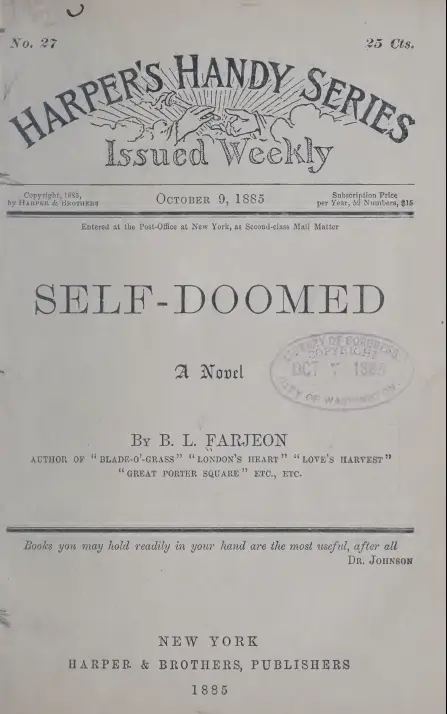
B. L. (Benjamin Leopold) Farjeon
THE CLASSIC COLLECTION · 1890
"The Mystery of M. Felix" by B. L. Farjeon is a detective novel written during the late 19th century. The story unfolds in a snowstorm in London, centering around a mysterious character known as M. Felix, with a setting that combines elements of urban life and suspense. The narrative introduces Constable Wigg and his comrade, Constable Nightingale, who find themselves embroiled in the enigma surrounding Felix shortly after a cry for help is heard late at night. At the start of the novel, a restless constable on his beat hears a cry for help amid a severe storm, prompting concern and suspicion about M. Felix, a peculiar lodger living in a nearby house. Meanwhile, the housekeeper, Mrs. Middlemore, goes out for her regular supper beer and returns to find the street door open and a strange man escaping. This incident leads to a chain of events involving the constables investigating the situation inside, where they encounter ominous signs, including bloodstains and a locked door with no response from Felix. The urgency builds as the constables, Mrs. Middlemore, and a local doctor converge to uncover the truth about the mysterious happenings surrounding M. Felix and the implications of his possible absence or misfortune.
Introduction adapted from the source catalogue; source summaries may be automatically generated.
Free to read · English · 154,824 words · No account needed
MAKE TIME FOR A GOOD BOOK
On by default. Untick to stop anonymous reading totals. Each page counts after 10 seconds in view. How this works.
Anonymous counting is on unless you have switched it off.
"My daughter will put you in the way of it."
"Thank you. Ask her to get ready. I will give her half-a-crown for her
trouble."
I called to Sophy, and asked her if she was ready fur a long walk.
"I am ready for anything," she said, "along o' you."
"Ten miles there, and ten miles back, Sophy," I said, for it was my intention to return to the inn that night.
"I'll walk all night if yer want me to."
"Come along, then, my girl."
I settled my account with the landlord before I left, and then,
accompanied by his daughter, a girl of fourteen, we walked to Deering
Woods.
"There!" said she, "keep on this track and it will take you right through the woods till you reach the road for Glasserton. When you come to two tracks keep to the left."
The directions she gave were clear, and I made her happy with the
promised half-a-crown.
"How far do the woods extend?" I asked.
"You'll have to walk six or seven miles," she replied, "before you get out of 'em--and mind you take care of the cliffs. They're dangerous."
"We shall see them, I suppose, before we come on them?"
"Oh, you'll see 'em right enough, but nobody goes nearer to 'em than
they can help."
She stood looking after us till thick clusters of trees hid us from
her sight.
"Step out, Sophy," I said, "we've got a long walk before us."
An explanation of the motive for my sudden visit to Glasserton will be found in the following extracts from the Fleetdyke Herald:
"Tampering with a Register Book. Strange Case.--M. Bordier and his son, Julian Bordier, of Swiss extraction, were charged with erasing a name, and writing another over it, from a marriage entry in the register book of marriages in the parish of Glasserton. Mr. Hare, the registrar, stated that the accused visited him yesterday afternoon, for the purpose, as they said, of verifying a copy of a marriage certificate which they brought with them. The marriage in question was solemnized over nineteen years ago, and, according to the entry as it now stands, was between Gerald Paget and Emilia Braham, The elder of the accused made the examination, and professed himself satisfied. He then requested the registrar to step out of the office with him, saying that he wished to make some private inquiries of him. The registrar consented, and the two went outside for a few minutes, the questions which M. Bordier asked relating to the witnesses to the marriage, Julian Bordier meanwhile remaining alone in the office with, the register book. Mr. Hare, who has been registrar for nine or ten months only, answered the questions to the best of his ability, and then M. Bordier summoned his son from the office, and the accused departed. In the evening Mr. Hare had occasion to consult the register book, and as a matter of curiosity he referred to the entry which his visitors in the afternoon had called to verify. To his astonishment he discovered that the name of the bridegroom had been erased, and the name of Gerald Paget written over the erasure. His suspicions fell immediately upon M. Bordier and Julian Bordier, and learning that they had left the village, he obtained a warrant for their arrest, and, with a policeman, started in pursuit. The accused were greatly agitated when told to consider themselves under arrest, and the elder of the two commenced an explanation, to which, however, Mr. Hare and the constable refused to listen. He then begged to be permitted to write and telegraph to London for legal and professional assistance which, he said, would establish their innocence, and his request being granted, he wrote and despatched both letters and telegrams. The registrar having finished his evidence, the magistrate said the case was quite clear, and asked the accused what they had to say in their defence. M. Bordier, who assumed the office of spokesman, his son preserving a somewhat scornful silence, handed the magistrate two telegrams he had received from London in reply to those he had despatched. M. Bordier said that he refrained from putting any questions to the registrar, giving as a reason that he was ignorant of the procedure in English Courts of Justice. The magistrate, having read the telegrams, remarked that the names attached to them were those of eminent and renowned gentlemen whose time must be very valuable. As they promised to attend the court on the following morning and were anxious to return on the same day the accused were therefore remanded till to-morrow for the production of these important witnesses from London."
Your reading position is saved on this browser. Take it to another device with a library code. Reading pages adapt to text, rather than matching a printed edition.
B. L. (Benjamin Leopold) Farjeon
B. L. (Benjamin Leopold) Farjeon
B. L. (Benjamin Leopold) Farjeon
B. L. (Benjamin Leopold) Farjeon
BEHIND THE BOOK
This eBook is for the use of anyone anywhere in the United States and most other parts of the world at no cost and with almost no restrictions whatsoever. You may copy it, give it away or re-use it under the terms of the Project Gutenberg License included with this eBook or online at www.gutenberg.org. If you are not located in the United States, you will have to check the laws of the country where you are located before using this eBook. Read the source licence.
The original source file, including credits and licence, is retained by this library. Request an original-format copy at no charge. Please include the book title and Project Gutenberg identifier #53263.
KEEP YOUR CURIOSITY GOING
Coulson Kernahan

Maurice Baring
Frances Wright
Cécile Tormay

Frederic Jesup Stimson

W. H. P. (William Henry Pope) Jarvis