THE CLASSIC COLLECTION✦The Shield of LoveCLASSIC FREE BOOKS
The Shield of Love
B. L. (Benjamin Leopold) Farjeon
THE CLASSIC COLLECTION · 1890
"The Mystery of M. Felix" by B. L. Farjeon is a detective novel written during the late 19th century. The story unfolds in a snowstorm in London, centering around a mysterious character known as M. Felix, with a setting that combines elements of urban life and suspense. The narrative introduces Constable Wigg and his comrade, Constable Nightingale, who find themselves embroiled in the enigma surrounding Felix shortly after a cry for help is heard late at night. At the start of the novel, a restless constable on his beat hears a cry for help amid a severe storm, prompting concern and suspicion about M. Felix, a peculiar lodger living in a nearby house. Meanwhile, the housekeeper, Mrs. Middlemore, goes out for her regular supper beer and returns to find the street door open and a strange man escaping. This incident leads to a chain of events involving the constables investigating the situation inside, where they encounter ominous signs, including bloodstains and a locked door with no response from Felix. The urgency builds as the constables, Mrs. Middlemore, and a local doctor converge to uncover the truth about the mysterious happenings surrounding M. Felix and the implications of his possible absence or misfortune.
Introduction adapted from the source catalogue; source summaries may be automatically generated.
Free to read · English · 154,824 words · No account needed
MAKE TIME FOR A GOOD BOOK
On by default. Untick to stop anonymous reading totals. Each page counts after 10 seconds in view. How this works.
Anonymous counting is on unless you have switched it off.
In a fit of terror the constable dropped the lantern, and the cat, unseen by the occupants of the kitchen, scuttled away.
"If you don't light the candle," gasped Mrs. Middlemore, "I shall go off." And she forthwith proceeded to demonstrate by screaming, "Oh, oh, oh!"
"She's done it, Wigg," said Constable Nightingale. "Strike a light, there's a good fellow, and pick up the lantern. I can't do it myself; I've got my arms full."
Constable Wigg had now recovered his courage, and inspired by jealousy, quickly struck a match and lit the candle. Mrs. Middlemore lay comfortably in the arms of Constable Nightingale, who did not seem anxious to rid himself of his burden. Stirred to emulative sympathy, Constable Wigg took possession of one of Mrs. Middlemore's hands, and pressed and patted it with a soothing, "There, there, there! What has made you come over like this? There's nothing to be frightened of, is there, Nightingale?"
"Nothing at all," replied Constable Nightingale, irascibly, for he by no means relished his comrade's insidious attempt to slide into Mrs. Middlemore's affections. "You're better now, ain't you?"
"A little," murmured Mrs. Middlemore, "a very little."
"Take a sip of this," said Constable Wigg, holding a glass to her
lips, "it'll bring you round."
Ignoring her previous declaration that she did not "drink sperrits," Mrs. Middlemore sipped the glass of whiskey, and continued to sip, with intermittent shudders, till she had drained the last drop. Then she summoned sufficient strength to raise herself languidly from Constable Nightingale's arms, and look toward the door.
"Where's it gone to?" she asked, in a trembling voice. "What's become
of the 'orrid creature?"
"What horrid creature, my dear?" inquired Constable Nightingale,
winking at his comrade.
"The cat! The red cat!"
"A red cat!" exclaimed Constable Nightingale, in a jocular voice; "who ever heard of such a thing? Who ever saw such a thing?"
"Why, I did--and you did, too."
"Not me," said Constable Nightingale, with another wink at Constable
Wigg.
"Nor me," said that officer, following the lead.
"Do you mean to tell me you didn't see a cat, and that the cat you sor
wasn't red?"
"I saw a cat, yes," said Constable Nightingale, "but not a red 'un--no, not a red un'. What do you say, Wigg?"
"I say as you says, Nightingale."
"There's lobsters, now," said Constable Nightingale; "we know what color they are when they're boiled, but we don't boil cats, that I know of, and if we did they wouldn't turn red. You learned natural history when you was at school, Wigg. What did they say about red cats?"
Your reading position is saved on this browser. Take it to another device with a library code. Reading pages adapt to text, rather than matching a printed edition.
B. L. (Benjamin Leopold) Farjeon
B. L. (Benjamin Leopold) Farjeon
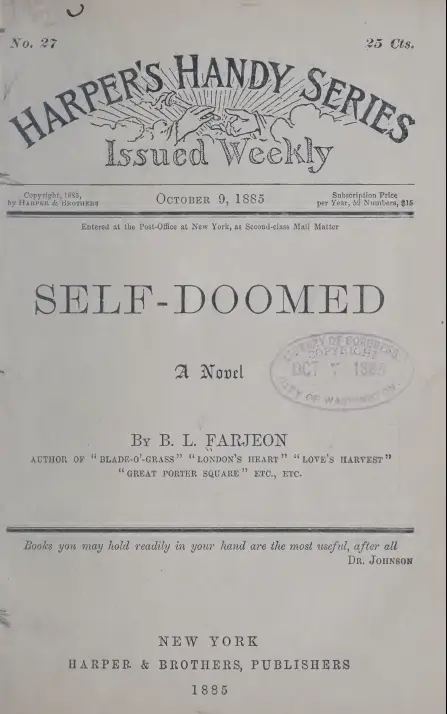
B. L. (Benjamin Leopold) Farjeon
B. L. (Benjamin Leopold) Farjeon
BEHIND THE BOOK
This eBook is for the use of anyone anywhere in the United States and most other parts of the world at no cost and with almost no restrictions whatsoever. You may copy it, give it away or re-use it under the terms of the Project Gutenberg License included with this eBook or online at www.gutenberg.org. If you are not located in the United States, you will have to check the laws of the country where you are located before using this eBook. Read the source licence.
The original source file, including credits and licence, is retained by this library. Request an original-format copy at no charge. Please include the book title and Project Gutenberg identifier #53263.
KEEP YOUR CURIOSITY GOING
Coulson Kernahan

Maurice Baring
Frances Wright
Cécile Tormay

Frederic Jesup Stimson

W. H. P. (William Henry Pope) Jarvis