THE CLASSIC COLLECTION✦The Shield of LoveCLASSIC FREE BOOKS
The Shield of Love
B. L. (Benjamin Leopold) Farjeon
THE CLASSIC COLLECTION · 1890
"The Mystery of M. Felix" by B. L. Farjeon is a detective novel written during the late 19th century. The story unfolds in a snowstorm in London, centering around a mysterious character known as M. Felix, with a setting that combines elements of urban life and suspense. The narrative introduces Constable Wigg and his comrade, Constable Nightingale, who find themselves embroiled in the enigma surrounding Felix shortly after a cry for help is heard late at night. At the start of the novel, a restless constable on his beat hears a cry for help amid a severe storm, prompting concern and suspicion about M. Felix, a peculiar lodger living in a nearby house. Meanwhile, the housekeeper, Mrs. Middlemore, goes out for her regular supper beer and returns to find the street door open and a strange man escaping. This incident leads to a chain of events involving the constables investigating the situation inside, where they encounter ominous signs, including bloodstains and a locked door with no response from Felix. The urgency builds as the constables, Mrs. Middlemore, and a local doctor converge to uncover the truth about the mysterious happenings surrounding M. Felix and the implications of his possible absence or misfortune.
Introduction adapted from the source catalogue; source summaries may be automatically generated.
Free to read · English · 154,824 words · No account needed
MAKE TIME FOR A GOOD BOOK
On by default. Untick to stop anonymous reading totals. Each page counts after 10 seconds in view. How this works.
Anonymous counting is on unless you have switched it off.
That night Emilia was once more in her native town. Eighteen years had passed since she left it, and it was with sadness she recognized familiar landmarks with which her childhood had been associated. She had taken the precaution of effecting a change in her appearance. She darkened her eyebrows and arranged her hair in a fashion so strange as to be startled when she looked into the glass. Moreover, she wore a thick veil. "No one will know me," she thought. But when she issued from the hotel the next morning she was a little afraid, for among the first persons she met was Mrs. Seaton. The cruel woman was but little altered; her features were more pinched, her eyes more stern than of yore, but Emilia knew her instantly. Mrs. Seaton, however, did not recognize Emilia, although she looked at her sharply, as was her wont with strangers. There was in the town a gossip who kept a small shop, and thither Emilia went, and, entering the shop, was greeted by the same woman who used to serve her in former years. Making some purchases and bargaining for others, Emilia drew the woman into conversation, and learned all she wished to know. Oh, yes, the woman remembered the brothers Paget very well, very well indeed. They were not brothers, no, they were stepbrothers. There was a fire in their house, and it was burned down, how many years ago? Eighteen or twenty, she could not quite say to a year or two; and a young lady, Miss Braham--Emilia Braham, that was her right name--rushed out of the house in the middle of the night while the fire was raging. There was a lot of talk about it. Miss Braham's father died suddenly--was killed by the falling of a scaffold--and Emilia was left alone, without a shilling in the world. Then she got a situation with Mrs. Seaton--Oh, everybody knew Mrs. Seaton; she had a sharp tongue, and had more enemies than friends--and she left her mistress' house at a moment's notice. Late at night, too. Mrs. Seaton said she had planned a secret meeting with Mr. Gerald Paget--he was the handsomest and the youngest of the step-brothers--and that was the reason of her going away so suddenly. It did look suspicious, didn't it? And it looked more than suspicious when she rushed out of Mr. Gerald's house in the middle of the night to save herself from being burned alive. That is often how people are found out in a way they little expect. But there were some people afterward who took Miss Braham's part, and said she wasn't guilty, though appearances were so much against her. That was because two ladies--old maids they were, and sisters--stood up for her, and went about saying all sorts of kind things about Miss Braham. What is that you say? God bless them for it! Yes, they deserve all that; they were kind-hearted ladies. They're in the churchyard now, and know more than we do. Well, these old maids took Miss Braham home on the night of the fire, when she was in a high fever, and no wonder, with what was on her mind; and Mrs. Seaton went there and told them they were being imposed upon by a shameless young woman. It was a hard thing to do, and she might have held her tongue, but that is not Mrs. Seaton's way. Once she takes a grudge against a body she don't let them alone, not she. While she was, with the old maids talking against Miss Braham, the young lady herself heard it, it seems, and she ran away, no one knew where to. Mr. Gerald, who must have been very much in love with her, was in a dreadful way about her, and the lawyers were busy trying to find her; and his step-brother, Mr. Leonard, who had come home from Australia that very morning, helped him, too. Then the two brothers went away together, and nothing was heard of them, or of Miss Braham, for months and months, till it got about that poor Mr. Gerald had been killed by falling over a precipice in foreign parts. Then Mr. Leonard came home, and took possession of the property, which all fell to him. What did he do with it? He sold it all off, and went to London to live, and that's where he is now, for all she knew. It was a lot of money he came into; some say as much as five or six thousand pounds a year, but he was just the sort of gentleman to make ducks and drakes with it. That was the whole story of the two brothers and Miss Emilia Braham. You would like to know something more! What is it? When Mr. Leonard Paget came home didn't he say anything about Miss Braham? No, not a word, so far as she knew, and she would have been sure to hear of it if he had. No, she was positive he never said one single word about her. She did not suppose he knew what became of her, and most likely, after a time, he forgot her altogether.
Your reading position is saved on this browser. Take it to another device with a library code. Reading pages adapt to text, rather than matching a printed edition.
B. L. (Benjamin Leopold) Farjeon
B. L. (Benjamin Leopold) Farjeon
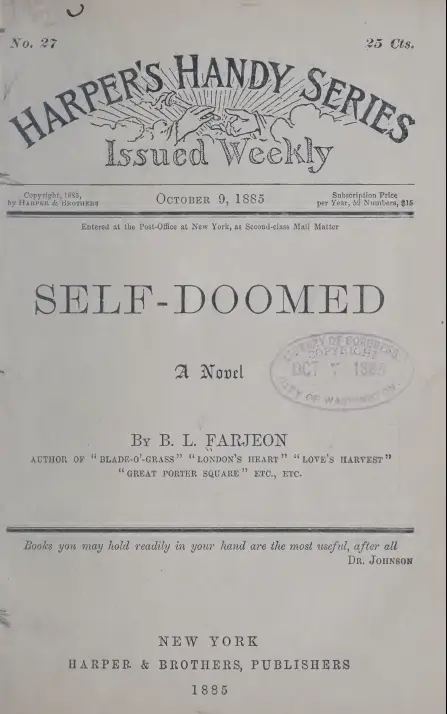
B. L. (Benjamin Leopold) Farjeon
B. L. (Benjamin Leopold) Farjeon
BEHIND THE BOOK
This eBook is for the use of anyone anywhere in the United States and most other parts of the world at no cost and with almost no restrictions whatsoever. You may copy it, give it away or re-use it under the terms of the Project Gutenberg License included with this eBook or online at www.gutenberg.org. If you are not located in the United States, you will have to check the laws of the country where you are located before using this eBook. Read the source licence.
The original source file, including credits and licence, is retained by this library. Request an original-format copy at no charge. Please include the book title and Project Gutenberg identifier #53263.
KEEP YOUR CURIOSITY GOING
Coulson Kernahan

Maurice Baring
Frances Wright
Cécile Tormay

Frederic Jesup Stimson

W. H. P. (William Henry Pope) Jarvis