THE CLASSIC COLLECTION✦The ocean wireless boys of the iceberg patrolCLASSIC FREE BOOKS
The ocean wireless boys of the iceberg patrol
John Henry Goldfrap
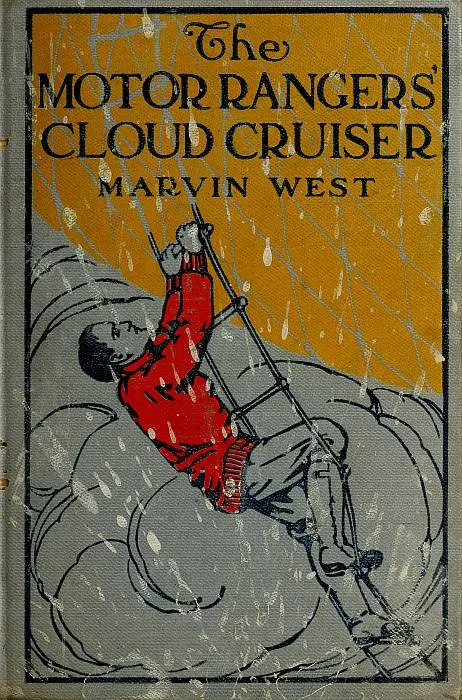
THE CLASSIC COLLECTION · 1912
"The Motor Rangers' Cloud Cruiser" by Marvin West is a fictional adventure novel written in the early 20th century. It follows the escapades of a group of adventurous boys known as the Motor Rangers, particularly focusing on their leader, Nat Trevor, and his friends, Joe Hartley and William "Ding-Dong" Bell, as they navigate treacherous seas after departing from the Marquesas Islands. The story promises to be filled with thrilling discoveries, mechanical challenges, and unforeseen dangers in the vast Pacific Ocean. At the start of the narrative, the Motor Rangers aboard their vessel, the "Nomad", face turbulent weather conditions while approaching an intriguing island that seems to defy the navigational charts. Nat's leadership is put to the test as he and his friends grapple with powerful ocean currents drawing them toward a mysterious passage between two volcanic islands. As they brave the mounting storm, Joe is swept overboard, prompting Nat to make a daring rescue. The intensity of the unfolding situation hints at greater volcanic perils that await the trio, setting the stage for a whirlwind of encounters and future adventures.
Introduction adapted from the source catalogue; source summaries may be automatically generated.
Free to read · English · 48,842 words · No account needed
MAKE TIME FOR A GOOD BOOK
On by default. Untick to stop anonymous reading totals. Each page counts after 10 seconds in view. How this works.
Anonymous counting is on unless you have switched it off.
“They are bigger than the biggest turkey buzzard I ever saw in California,” said Nat, gazing at them. “Let’s have a look through the field glasses.”
He took the instruments out of their box near the helmsman’s wheel and applied them to his eyes.
“Why, they look like small aeroplanes!” he exclaimed in astonishment. “Their wing spread must be ten or twelve feet, judging from here.”
“How many of them are there, anyhow?” demanded Joe.
“Easily fifty, I should say. Maybe more. It would be impossible to
count them accurately.”
“They are right on our course,” said Joe, glancing at the compass, “so that we shall soon have a close view of them.”
“I’ll go and rouse the professor. He’s taking a nap; but I know he’d like to see such a sight.”
And Nat hastened off on his errand.
By the time he returned with the professor, the Discoverer was much closer to the giant birds. The man of science scrutinized them through the glasses.
“Condors,” he announced. “This is most interesting. These birds are the largest birds of prey in existence. Humboldt, the famous traveler, said that Indians told him that they had been found measuring eighteen feet from wing tip to wing tip.”
“Well, I should say they are aeroplanes,” exclaimed Nat. “Do they
ever attack men?”
“Cases of it are not unknown,” said the professor, “and almost every Andean village has a story about a condor flying off with a baby. As a matter of fact, though, I guess they confine their attentions mostly to young sheep or calves light enough for them to carry.”
As they drew closer to the soaring mass of birds, they could see that if they were interested in the birds, the birds were quite as much interested in them. One or two began making long, wheeling arcs that brought them closer to the Discoverer.
“I guess they are wondering what sort of a bird we are, anyhow,”
laughed Nat.
Indeed, it seemed so. Almost imperceptibly the birds gathered about the Discoverer, wheeling and screaming all about the craft. It could now be seen that they had sharp, large, hooked beaks, and a ruffle of dark flesh at the bottom of a flabby neck. Their wings were of a dull gray color, with black tip feathers, and were of a sweep and size undreamed of hitherto by the boys.
“They look like the harpies we used to read about in school,” said Joe.
“They do, indeed,” said the professor. “One could readily imagine such creatures tearing unfortunate human beings to pieces.”
Your reading position is saved on this browser. Take it to another device with a library code. Reading pages adapt to text, rather than matching a printed edition.
John Henry Goldfrap
John Henry Goldfrap
John Henry Goldfrap
John Henry Goldfrap
BEHIND THE BOOK
This eBook is for the use of anyone anywhere in the United States and most other parts of the world at no cost and with almost no restrictions whatsoever. You may copy it, give it away or re-use it under the terms of the Project Gutenberg License included with this eBook or online at www.gutenberg.org. If you are not located in the United States, you will have to check the laws of the country where you are located before using this eBook. Read the source licence.
The original source file, including credits and licence, is retained by this library. Request an original-format copy at no charge. Please include the book title and Project Gutenberg identifier #48270.
KEEP YOUR CURIOSITY GOING
Coulson Kernahan

Maurice Baring
Frances Wright
Cécile Tormay

Frederic Jesup Stimson

W. H. P. (William Henry Pope) Jarvis