THE CLASSIC COLLECTION✦The ocean wireless boys of the iceberg patrolCLASSIC FREE BOOKS
The ocean wireless boys of the iceberg patrol
John Henry Goldfrap
THE CLASSIC COLLECTION · 1912
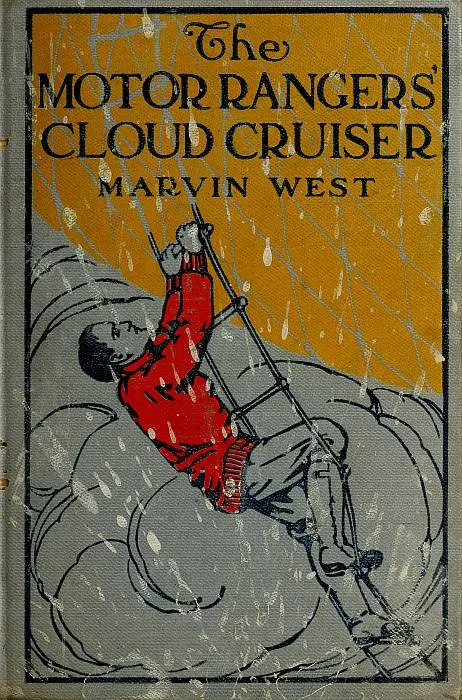
"The Motor Rangers' Cloud Cruiser" by Marvin West is a fictional adventure novel written in the early 20th century. It follows the escapades of a group of adventurous boys known as the Motor Rangers, particularly focusing on their leader, Nat Trevor, and his friends, Joe Hartley and William "Ding-Dong" Bell, as they navigate treacherous seas after departing from the Marquesas Islands. The story promises to be filled with thrilling discoveries, mechanical challenges, and unforeseen dangers in the vast Pacific Ocean. At the start of the narrative, the Motor Rangers aboard their vessel, the "Nomad", face turbulent weather conditions while approaching an intriguing island that seems to defy the navigational charts. Nat's leadership is put to the test as he and his friends grapple with powerful ocean currents drawing them toward a mysterious passage between two volcanic islands. As they brave the mounting storm, Joe is swept overboard, prompting Nat to make a daring rescue. The intensity of the unfolding situation hints at greater volcanic perils that await the trio, setting the stage for a whirlwind of encounters and future adventures.
Introduction adapted from the source catalogue; source summaries may be automatically generated.
Free to read · English · 48,842 words · No account needed
MAKE TIME FOR A GOOD BOOK
On by default. Untick to stop anonymous reading totals. Each page counts after 10 seconds in view. How this works.
Anonymous counting is on unless you have switched it off.
Spinning along at a height the barograph showed to be 1,500 feet, was an exhilarating experience. The slight feeling of apprehension which the Motor Rangers had felt when they set out on their novel cruise, soon wore off, and was replaced by a buoyant sensation.
“Well, Master Nat, what do you think of it?” inquired the professor, emerging from the cabin and coming “aft” to where Nat was standing by the smoothly running motor.
“It’s glorious,” replied Nat enthusiastically. “I had no idea, though, that it was possible to get used to it so soon.”
“Well, a craft of this kind is vastly different from an aeroplane,” commented the man of science. “It is my belief that the aerial trans-Atlantic liner of the future will be a dirigible.”
“I wouldn’t mind undertaking the trip in the Discoverer,” declared Nat, with glowing eyes and cheeks.
“What speed are we making?” inquired Joe Hartley.
“About forty miles an hour,” said the professor; “but you can tell the exact speed by stepping into the pilot-house and examining the instruments.”
The lads followed his advice, and found that the speed recorder registered a shade more than the professor had assumed. Mr. Tubbs had the wheel, and was gazing straight ahead, like a steamboat pilot.
The pilot-house of the Discoverer, in fact, was not unlike that of a steamer, although much smaller, of course. The registers and indicators, too, that were fastened to the walls, or rather the framework of the Discoverer’s “hull,” were totally unlike any that the lads had seen before.
Joe Hartley, who had been appointed chief cook and bottle washer, soon left, to begin his preparations for lunch. But Nat lingered on, fascinated. Joe’s meal proved an excellent one, and the fact that they were so high above the earth did not affect the boys’ appetites in the least. In fact, Ding-dong Bell observed that he had never felt so hungry in all his life before.
After the meal was concluded, the motors of the craft were slowed down a bit, so as to economize on gasolene as much as possible. The fact that the westerly wind had increased made it possible to slow the engine down and still make good progress.
“I wonder what they think of us down below there?” said Joe, as he stood by Nat’s side, leaning over the forward deck-rail and watching the dwarfed figures of the inhabitants of a village above which they were passing, scurrying to and fro like ants.
“I guess they must think we are some sort of demoniacal bird,” grinned
Nat. “Hark!”
Faintly, very faintly, borne to their ears, came the sound of church
bells ringing furiously.
Your reading position is saved on this browser. Take it to another device with a library code. Reading pages adapt to text, rather than matching a printed edition.
John Henry Goldfrap
John Henry Goldfrap
John Henry Goldfrap

John Henry Goldfrap
BEHIND THE BOOK
This eBook is for the use of anyone anywhere in the United States and most other parts of the world at no cost and with almost no restrictions whatsoever. You may copy it, give it away or re-use it under the terms of the Project Gutenberg License included with this eBook or online at www.gutenberg.org. If you are not located in the United States, you will have to check the laws of the country where you are located before using this eBook. Read the source licence.
The original source file, including credits and licence, is retained by this library. Request an original-format copy at no charge. Please include the book title and Project Gutenberg identifier #48270.
KEEP YOUR CURIOSITY GOING
Coulson Kernahan

Maurice Baring
Frances Wright
Cécile Tormay

Frederic Jesup Stimson

W. H. P. (William Henry Pope) Jarvis