
Last letters from the living dead man
David Patterson (Spirit) Hatch
THE CLASSIC COLLECTION · 1819
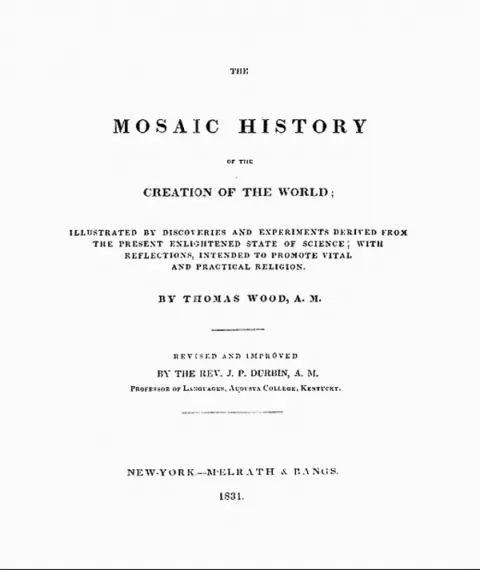
"The Mosaic History of the Creation of the World" by Thomas Wood is a theological treatise written in the early 19th century. The work seeks to illustrate the Biblical account of creation as narrated by Moses, integrating insights from contemporary science while promoting reflections on religion. The aim is to reconcile faith with scientific understanding, intending to enlighten readers on the nature of God and creation." The opening of the book delves into the character of God as revealed in the Scriptures, emphasizing His attributes such as goodness, self-existence, and the concept of the Trinity. Wood presents a discussion on the historical context of how the divine name "Jehovah" offers insights into God's nature, asserting that understanding the creation narrative requires recognizing the unity and plurality embodied within the Godhead. The author lays a theological foundation for exploring the details of creation, ultimately directing the reader to consider the manifestations of God's work in nature and their implications for religious belief and practice.
Introduction adapted from the source catalogue; source summaries may be automatically generated.
Free to read · English · 213,017 words · No account needed
MAKE TIME FOR A GOOD BOOK
On by default. Untick to stop anonymous reading totals. Each page counts after 10 seconds in view. How this works.
Anonymous counting is on unless you have switched it off.
[172] Aristotle asserts that spinning and weaving were first learned from the spider. Thence it has its Greek name αραχνης, Latin Aranea, French Araignce, from the Hebrew Aragnevit, texuit, or Arach, textura. And it is not improbable that our English word Spider is but a corruption of Spinner, for Spinn is the German word for Spider. With this agrees that poetic fancy, that Arachne an excellent spinster, was by Pallas turned into a Spider. Pallas was the goddess of wisdom, war, weaving, spinning, and the liberal arts; and she was invoked by almost every artist, particularly such as worked in wool, embroidery, painting, and sculpture.--Edward’s Demonstration, &c.
[173] See Jones’s Disquisition concerning clean and unclean
Animals.
[174] See D’Assigny on the Hieroglyphics of Egypt.
[175] Epist. cap. v.
[176] Simil. ix, sect. 13.
[177] Ad. Autol. lib. 2, p. 96.
[178] Lib. iv, cap. 37, et lib. v. c. 15.
[179] Lib. iv, cap. 75.
[180] Adv. Prax. c. 12.
[181] Cap. 21, 25.
[182] Cont. Cel. lib. i, p. 63.
[183] Socrat. lib. ii. c. 30, where the Creed may be seen
at large.
[184] Hæres. 23, n. 2.
[185] Hæres. 44, n. 4. See Bibliotheca Biblica on the place.
[186] Lib. iv, cap. 37.
[187] Two Dissertations, &c. pp. 29, 30.
[188] Among the numerous traditions of the New-Zealanders, says Nicholas, there is one which is very remarkable. It refers to the creation of man, and has been handed down from father to son, through all generations. They believe the first man to have been created by three gods, Mowheerangaranga, or Toopoonah, or grandfather, Mowheermooha, and Mowheebotakee; but give the greatest share in the business to the first-mentioned of these deities.
[189] Moses says, “the life, נפש nephesh, of the flesh is in the blood.” And St. Paul affirms, “God hath made of one blood all nations of men.” This sentence of Moses, which, in conjunction with that of St. Paul, contains a most important truth, had existed in the sacred Scriptures for 3,600 years, before it arrested the attention of any philosopher. This is more surprising, as the nations in which philosophy flourished, were those which especially enjoyed the Divine oracles in their respective languages. That the blood actually possesses a living principle, and that the life of the whole body is derived from it, is a doctrine of Divine revelation, and which the observations and experiments of the most accurate anatomists have served strongly to confirm. The proper circulation of this important fluid through the whole human system, was taught by Solomon in figurative language, Eccles. xii, 6; and discovered, as it is called, and demonstrated by Dr. Harvey in 1628; though some Italian philosophers had the same notion a little before. This distinguished anatomist was the first who fully revived the Mosaic notion of the vitality of the blood; and which correct view was afterwards adopted by the justly celebrated Mr. John Hunter, whose strong reasoning and accurate experiments have served to sanction and give publicity to a fact so long unknown to mankind. The doctrine of Moses and St. Paul proves the truth of the doctrine of Harvey and Hunter: and the reasonings and experiments of the latter, illustrate and confirm the doctrine of the former.--See Dr. A. Clarke on Lev. xvii, 11.
Your reading position is saved on this browser. Take it to another device with a library code. Reading pages adapt to text, rather than matching a printed edition.
BEHIND THE BOOK
This eBook is for the use of anyone anywhere in the United States and most other parts of the world at no cost and with almost no restrictions whatsoever. You may copy it, give it away or re-use it under the terms of the Project Gutenberg License included with this eBook or online at www.gutenberg.org. If you are not located in the United States, you will have to check the laws of the country where you are located before using this eBook. Read the source licence.
The original source file, including credits and licence, is retained by this library. Request an original-format copy at no charge. Please include the book title and Project Gutenberg identifier #44636.
KEEP YOUR CURIOSITY GOING
David Patterson (Spirit) Hatch

David Patterson (Spirit) Hatch

David Patterson (Spirit) Hatch
Cécile Tormay

Moritz Busch
Coulson Kernahan