
Last letters from the living dead man
David Patterson (Spirit) Hatch
THE CLASSIC COLLECTION · 1819
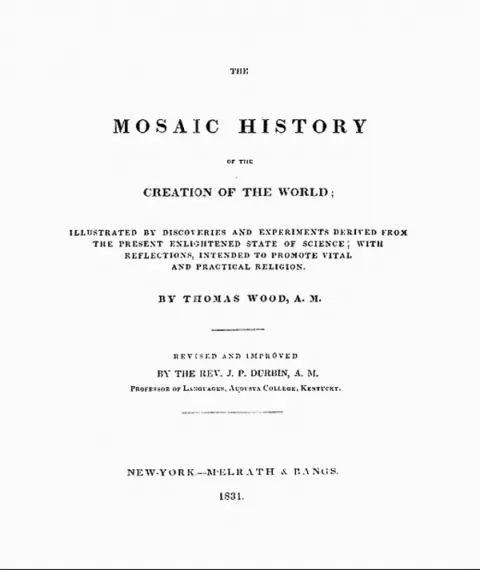
"The Mosaic History of the Creation of the World" by Thomas Wood is a theological treatise written in the early 19th century. The work seeks to illustrate the Biblical account of creation as narrated by Moses, integrating insights from contemporary science while promoting reflections on religion. The aim is to reconcile faith with scientific understanding, intending to enlighten readers on the nature of God and creation." The opening of the book delves into the character of God as revealed in the Scriptures, emphasizing His attributes such as goodness, self-existence, and the concept of the Trinity. Wood presents a discussion on the historical context of how the divine name "Jehovah" offers insights into God's nature, asserting that understanding the creation narrative requires recognizing the unity and plurality embodied within the Godhead. The author lays a theological foundation for exploring the details of creation, ultimately directing the reader to consider the manifestations of God's work in nature and their implications for religious belief and practice.
Introduction adapted from the source catalogue; source summaries may be automatically generated.
Free to read · English · 213,017 words · No account needed
MAKE TIME FOR A GOOD BOOK
On by default. Untick to stop anonymous reading totals. Each page counts after 10 seconds in view. How this works.
Anonymous counting is on unless you have switched it off.
[161] To this may be referred an economical experiment well known to the Dutch, that when eight Cows have been in a pasture, and can no longer get nourishment, two horses will do very well there for some days; and when nothing is left for the Horses, four Sheep will live on it.
[162] The Arabians, when travelling, and in want of water, frequently kill their camels to obtain a supply, which, though taken out of the animal, they find perfectly good.
[163] Dr. Paley’s Natural Theology, p. 278.
[164] Dr. Percival’s Instructions, p. 23.
[165] See Annual Register, vol. iii, p. 90.
[166] Dr. Beattie’s Dissertations, Moral and Critical.
[167] Dr. Percival’s Instructions, p. 8.
The Chinese consider the flesh of this animal as a dainty, and public shambles are erected for the sale of it. In Canton particularly, there is a street appropriated to that purpose; and, what is very extraordinary, whenever a dog-butcher appears, all the dogs in the place pursue him in full cry. They know their enemy, and persecute him as far as they are able.--Goldsmith’s History of the Earth.
[168] Wesley’s Philosophy, vol. i, p. 233.
[169] For a description of the Crocodile, given by Divine inspiration, see Job chap. xli. It is a great question among learned men, says Mr. Benson, what creature is meant by לויתן, leviathan. Our translators were evidently uncertain respecting it, and therefore have given us the original term untranslated. The Seventy, however, have rendered it δρακων, the dragon; but that is far from being correct. The dragon is a genus belonging to the order of amphibia reptilia. There are two species, 1. The volans, or flying dragon, with the wings entirely distinct from the fore-legs, which is found in Africa and the East Indies. 2. The præpos, with the wings fixed to the fore-legs, which is a native of America. They are both harmless creatures; and feed on flies, ants, and small insects. The word לויתן, leviathan is supposed to be derived from לוי, levi, joined, or coupled, and תן, than, or תנין thannin, a dragon, that is, a large serpent, or fish, the word thannin being used both for a land-serpent, and a kind of fish. And “after comparing what Bochart and others have written on the subject, it appears to me,” says Parkhurst, “that the compound word לויתן, leviathan, the coupled dragon, denotes some animal, partaking of the nature both of the land serpents, and fishes, and, in this place, signifies the crocodile, which lives as well under water as on the shore.”
[170] Bingley’s Animal Biography, vol. ii, p. 410, &c.
[171] Dr. Paley’s Natural Theology, p. 286.
Your reading position is saved on this browser. Take it to another device with a library code. Reading pages adapt to text, rather than matching a printed edition.
BEHIND THE BOOK
This eBook is for the use of anyone anywhere in the United States and most other parts of the world at no cost and with almost no restrictions whatsoever. You may copy it, give it away or re-use it under the terms of the Project Gutenberg License included with this eBook or online at www.gutenberg.org. If you are not located in the United States, you will have to check the laws of the country where you are located before using this eBook. Read the source licence.
The original source file, including credits and licence, is retained by this library. Request an original-format copy at no charge. Please include the book title and Project Gutenberg identifier #44636.
KEEP YOUR CURIOSITY GOING
David Patterson (Spirit) Hatch

David Patterson (Spirit) Hatch

David Patterson (Spirit) Hatch
Cécile Tormay

Moritz Busch
Coulson Kernahan