THE CLASSIC COLLECTION✦The haunts of menCLASSIC FREE BOOKS
The haunts of men
Robert W. (Robert William) Chambers
THE CLASSIC COLLECTION · 1919
"The Moonlit Way: A Novel" by Robert W. Chambers is a fictional narrative written in the early 20th century. The story unfolds in an enchanting, moonlit setting, primarily in Constantinople, where intrigues of European nobility and a captivating dancer named Nihla Quellen intertwine with themes of love, betrayal, and ambition. The plot hints at layers of complex relationships against a backdrop of rising political tensions and the glamour of the East. At the start of the novel, the atmosphere is rich with vivid imagery of the moonlit Bosphorus, inviting the reader into the opulence of a gathering at the German Embassy, where various characters discuss their fascination with Nihla, a beautiful dancer who has just made a striking entrance. Set among a cast of diplomats and socialites, we are introduced to Count d’Eblis, who is eager to make Nihla the center of attention while Ferez Bey, an influential figure, schemes behind the scenes. As the prologue unfolds, Nihla is revealed as not just an alluring performer but also a pawn in a complex game of power and desire, setting the stage for her dramatic entanglements that echo themes of fate and the quests for personal gain.
Introduction adapted from the source catalogue; source summaries may be automatically generated.
Free to read · English · 105,024 words · No account needed
MAKE TIME FOR A GOOD BOOK
On by default. Untick to stop anonymous reading totals. Each page counts after 10 seconds in view. How this works.
Anonymous counting is on unless you have switched it off.
"You should have practised it enough to say good morning to me during these last five years," said Dulcie gravely.
"Oh, I say! You're rather severe, you know! You were just a little thing running about underfoot!--I'm sorry you feel angry----"
"I do not. But how can I have anything to talk to you about, Mr. Trenor, when you have never even noticed me all these years, although often I have handed you your keys and your letters."
"It was quite stupid of me. I'm sorry. But a man, you see, doesn't
notice children----"
"Some men do."
"You mean Mr. Barres! That is unkind. Why rub it in, Dulcie? I'm rather an interesting fellow, after all."
"Are you?" she asked absently.
Her honest indifference to him was perfectly apparent to Esme Trenor. This would never do. She must be subdued, made sane, disciplined!
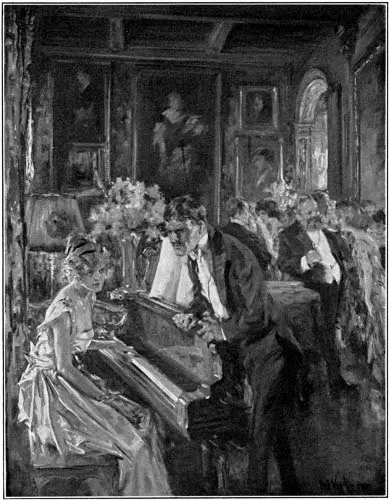
"Do you know," he drawled, leaning lankly nearer, dropping both arms on the cloth, and fixing his heavy-lidded eyes intensely on her,"--do you know--do you guess, perhaps, why I never spoke to you in all these years?"
"You did not trouble yourself to speak to me, I imagine."
"You are wrong. I was afraid!" And he stared at her pallidly.
"Afraid?" she repeated, puzzled.
He leaned nearer, confidential, sad:
"Shall I tell you a precious secret, Dulcie? I am a coward. I am a slave of fear. I am afraid of beauty! Isn't that a very strange thing to say? Can you understand the subtlety of that indefinable psychology? Fear is an emotion. Fear of the beautiful is still a subtler emotion. Fear, itself, is beautiful beyond words. Beauty is Fear. Fear is Beauty. Do you follow me, Dulcie?"
"No," said the girl, bewildered.
Esme sighed:
"Some day you will follow me. It is my destiny to be followed, pursued, haunted by loveliness impotently seeking to express itself to me, while I, fearing it, dare only to express my fear with brush and pencil!... When shall I paint you?" he added with sad benevolence.
"What?"
"When shall I try to interpret upon canvas my subtle fear of you?" And, as the girl remained mute: "When," he explained languidly, "shall I appoint an hour for you to sit to me?"
"I am Mr. Barres's model," she said, flushing.
"I shall have to arrange it with him, then," he nodded, wearily.
"I don't think you can."
"Fancy! Why not?"
"Because I do not wish to sit to anybody except Mr. Barres," she said candidly, "and what you paint does not interest me at all."
"Are you familiar with my work?" he asked incredulously.
Your reading position is saved on this browser. Take it to another device with a library code. Reading pages adapt to text, rather than matching a printed edition.
Robert W. (Robert William) Chambers
Robert W. (Robert William) Chambers

Robert W. (Robert William) Chambers
Robert W. (Robert William) Chambers
BEHIND THE BOOK
This eBook is for the use of anyone anywhere in the United States and most other parts of the world at no cost and with almost no restrictions whatsoever. You may copy it, give it away or re-use it under the terms of the Project Gutenberg License included with this eBook or online at www.gutenberg.org. If you are not located in the United States, you will have to check the laws of the country where you are located before using this eBook. Read the source licence.
The original source file, including credits and licence, is retained by this library. Request an original-format copy at no charge. Please include the book title and Project Gutenberg identifier #33557.
KEEP YOUR CURIOSITY GOING
Coulson Kernahan

Maurice Baring
Frances Wright
Cécile Tormay

Frederic Jesup Stimson

W. H. P. (William Henry Pope) Jarvis