THE CLASSIC COLLECTION✦The haunts of menCLASSIC FREE BOOKS
The haunts of men
Robert W. (Robert William) Chambers
THE CLASSIC COLLECTION · 1919
"The Moonlit Way: A Novel" by Robert W. Chambers is a fictional narrative written in the early 20th century. The story unfolds in an enchanting, moonlit setting, primarily in Constantinople, where intrigues of European nobility and a captivating dancer named Nihla Quellen intertwine with themes of love, betrayal, and ambition. The plot hints at layers of complex relationships against a backdrop of rising political tensions and the glamour of the East. At the start of the novel, the atmosphere is rich with vivid imagery of the moonlit Bosphorus, inviting the reader into the opulence of a gathering at the German Embassy, where various characters discuss their fascination with Nihla, a beautiful dancer who has just made a striking entrance. Set among a cast of diplomats and socialites, we are introduced to Count d’Eblis, who is eager to make Nihla the center of attention while Ferez Bey, an influential figure, schemes behind the scenes. As the prologue unfolds, Nihla is revealed as not just an alluring performer but also a pawn in a complex game of power and desire, setting the stage for her dramatic entanglements that echo themes of fate and the quests for personal gain.
Introduction adapted from the source catalogue; source summaries may be automatically generated.
Free to read · English · 105,024 words · No account needed
MAKE TIME FOR A GOOD BOOK
On by default. Untick to stop anonymous reading totals. Each page counts after 10 seconds in view. How this works.
Anonymous counting is on unless you have switched it off.
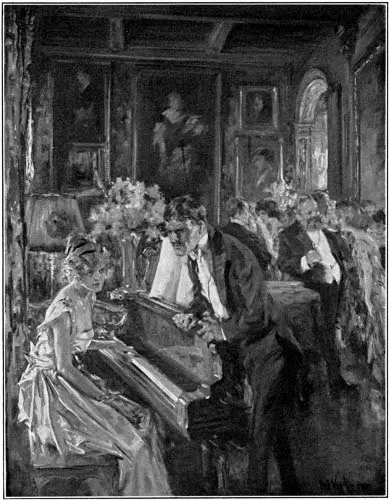
But nobody seemed to be inclined to worship; Damaris scarcely deigned to notice him, his impudence, perhaps, still rankling. Thessalie, laughingly engaged with Barres, remained oblivious to the fashionable portrait painter. As for Elsena Helmund, that youthful matron was busily pretending to comprehend Corot Mandel's covert orientalisms, and secretly wondering whether they were, perhaps, as improper as Westmore kept whispering to her they were, urging her to pick up her skirts and run.
Esme Trenor permitted a few weary but slightly disturbed glances to
rest on Dulcie from time to time, but made no effort to entertain
her.
And she, on her part, evinced no symptoms of worshipping him. And all the while he was thinking to himself:
"Can this be the janitor's daughter? Is she the same rather soiled, impersonal child whom I scarcely ever noticed--the thin, immature, negligible little drudge with a head full of bobbed red hair?"
His lack of vision, of finer discernment, deeply annoyed him. Her lack of inclination to worship him, now that she had the God-sent opportunity, irritated him.
"The silly little bounder," he thought, "how can she sit beside me without timidly venturing to entertain me?"
He stole another profoundly annoyed glance at Dulcie. The child was certainly beautiful--a slim, lovely, sensitive thing of qualities so delicate that the painter of pretty women became even more surprised and chagrined that it had taken Barres to discover this desirable girl in the silent, shabby child of Larry Soane.
Presently he lurched part way toward her in his chair, and looked at her with bored but patronising encouragement.
"Talk to me," he said languidly.
Dulcie turned and looked at him out of uninterested grey eyes.
"What?" she said.
"Talk to me," he repeated pettishly.
"Talk to yourself," retorted Dulcie, and turned again to listen to the gay nonsense which Damaris and Westmore were exchanging amid peals of general laughter.
But Esme Trenor was thunderstruck. A deep and painful colour stained his pallid features. Never before had mortal woman so flouted him. It was unthinkable. It really wouldn't do. There must be some explanation for this young girl's monstrous attitude toward offered opportunity.
"I say," he insisted, still very red, "are you bashful, by any
chance?"
Dulcie slowly turned toward him again:
"Sometimes I am bashful; not now."
"Oh. Then wouldn't you like to talk to me?"
"I don't think so."
"Fancy! And why not, Dulcie?"
"Because I haven't anything to say to you."
"Dear child, that is the incentive to all conversation--lack of
anything to say. You should practise the art of saying nothing
politely."
Your reading position is saved on this browser. Take it to another device with a library code. Reading pages adapt to text, rather than matching a printed edition.
Robert W. (Robert William) Chambers
Robert W. (Robert William) Chambers

Robert W. (Robert William) Chambers
Robert W. (Robert William) Chambers
BEHIND THE BOOK
This eBook is for the use of anyone anywhere in the United States and most other parts of the world at no cost and with almost no restrictions whatsoever. You may copy it, give it away or re-use it under the terms of the Project Gutenberg License included with this eBook or online at www.gutenberg.org. If you are not located in the United States, you will have to check the laws of the country where you are located before using this eBook. Read the source licence.
The original source file, including credits and licence, is retained by this library. Request an original-format copy at no charge. Please include the book title and Project Gutenberg identifier #33557.
KEEP YOUR CURIOSITY GOING
Coulson Kernahan

Maurice Baring
Frances Wright
Cécile Tormay

Frederic Jesup Stimson

W. H. P. (William Henry Pope) Jarvis