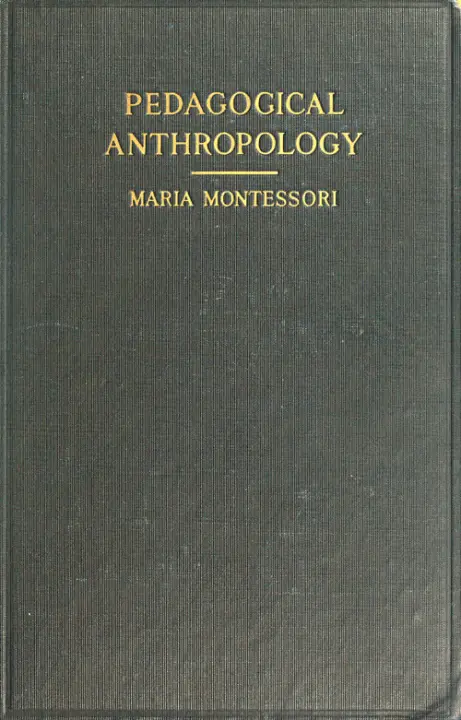
Pedagogical Anthropology
Maria Montessori
THE CLASSIC COLLECTION · 1917
"The Montessori Elementary Material" by Maria Montessori is an educational treatise written in the early 20th century. This text provides a comprehensive overview of the Montessori Method, emphasizing the use of specially designed materials for teaching various subjects including grammar, reading, and mathematics to elementary-aged children. The work serves as a practical guide for educators looking to implement Montessori principles in their classrooms. The opening of the book introduces the foundational concepts behind Montessori's educational philosophy, particularly the transition children undergo from mechanical learning to intellectual understanding. It explains how children naturally progress from simply mastering the mechanics of reading and writing to developing deeper cognitive skills. Montessori presents the use of different colored alphabets and cards to help children classify words, laying the groundwork for a structured approach to grammar and communication. By giving examples of practical exercises that integrate sensory learning with language skills, the text sets the stage for a hands-on, engaging learning environment that supports children's natural curiosity and developmental needs.
Introduction adapted from the source catalogue; source summaries may be automatically generated.
Free to read · English · 102,460 words · No account needed
MAKE TIME FOR A GOOD BOOK
On by default. Untick to stop anonymous reading totals. Each page counts after 10 seconds in view. How this works.
Anonymous counting is on unless you have switched it off.
The permutations of clauses permitted by our materials give empirical evidence of the pauses and accordingly of the functions of the orthographical signs of suspense in the sentence. These signs are included also in our alphabets. All the exercises hitherto given require more or less spontaneous attention to punctuation. We offer, however, in addition, several series of sentences for analysis in illustration of the principal rules for the use of punctuation points. Almost all of our Italian sentences are taken from Manzoni, a writer especially noteworthy for his care in punctuation. (The majority of the sentences below are taken from the Book of Knowledge, by special permission of the publishers.)
The comma may separate coordinate elements.
--The mother took a glowing pride in the beauty of her children's faces, the grace and strength of their bodies, their reckless daring and unflinching courage.
--The little star fell plump into the middle of a big
puddle, and there it lay sad and shaken and quaking
with fright.
--It was dumb and half blind, it had a soiled face,
and could give no more light.
--A mouse was just then peeping from its hole to see
whether it was going to rain, and whether it would be
safe to cross the fields.
--The mouse started running again, and ran until it
was tired out and had to sit down.
--The little star poured a flood of bright light over
the poor woman, and made her bright and cheerful and
strong again, and then the little girl became very
happy.
A comma isolates vocatives and incidental clauses.
--"Cæsar, let your men go forward," said the guide.
--Why do you want to find your father, Mora?
--"No," said he, "I shall be very well presently."
--"Boys," said our host, "I know whose hand it is."
--That, excuse me for saying so, is not the way to
speak to a friend.
--"Come with us, you handsome young huntsman," he
cried.
A comma separates clauses, especially for clearness, when the elements of one clause might seem to apply equally well to another clause, and when one clause is interpolated between the essential elements of another.
--Mohammed taught that men should pray at stated
times, wherever they are.
--George, who was only five years old, could not go
with his father to fight.
--The tribemen, after quarreling a long time, decided
to march away.
--He went that evening, as he had planned, to the
doctor's house.
--The poor Indian had been kept moving, ever since he was born, to regions farther and farther north.
Your reading position is saved on this browser. Take it to another device with a library code. Reading pages adapt to text, rather than matching a printed edition.
Maria Montessori
Maria Montessori
Maria Montessori
BEHIND THE BOOK
This eBook is for the use of anyone anywhere in the United States and most other parts of the world at no cost and with almost no restrictions whatsoever. You may copy it, give it away or re-use it under the terms of the Project Gutenberg License included with this eBook or online at www.gutenberg.org. If you are not located in the United States, you will have to check the laws of the country where you are located before using this eBook. Read the source licence.
The original source file, including credits and licence, is retained by this library. Request an original-format copy at no charge. Please include the book title and Project Gutenberg identifier #42869.
KEEP YOUR CURIOSITY GOING

Charles G. (Charles Griffith) Ross
Hannah Webster Foster

Emily Lawless
Edwin Hamlin Carr

Charles De Lano Hine
Andrew Ure