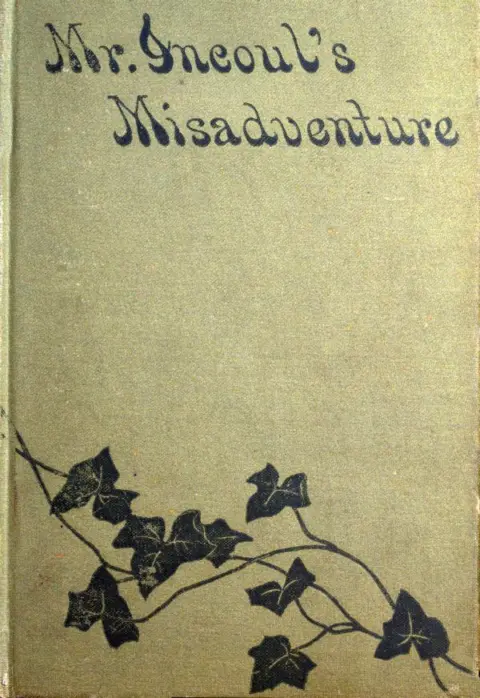
Mr. Incoul’s Misadventure
Edgar Saltus
THE CLASSIC COLLECTION · 1913
"The Monster" by Edgar Saltus is a novel written in the early 20th century. The story begins with a bride, Leilah, who is in a state of blissful romanticism with her husband, Gulian Verplank, as they prepare for a honeymoon. However, this idyllic beginning quickly darkens when Leilah receives a disturbing letter that reveals deep secrets about her past, causing her to confront an inner turmoil that drastically changes the course of her life and relationship. At the start of the novel, we are introduced to a lush, tropical scene where Leilah and Gulian are in love and planning their future. Their conversation reveals their deep affection, but soon the mood shifts when Leilah discovers an unsettling letter that sets off a chain reaction of emotions, including fear and despair. The initial atmosphere of romance and excitement crumbles as Leilah grapples with the implications of her father's message and the monstrous truths it contains, leading to her frantic decisions to escape her past and the overwhelming presence of this "monster" in her life. This gripping beginning sets the stage for a complex exploration of themes such as identity, love, and the consequences of hidden truths.
Introduction adapted from the source catalogue; source summaries may be automatically generated.
Free to read · English · 43,968 words · No account needed
MAKE TIME FOR A GOOD BOOK
On by default. Untick to stop anonymous reading totals. Each page counts after 10 seconds in view. How this works.
Anonymous counting is on unless you have switched it off.
De Fresnoy, as he spoke, made a gesture, a wide movement of the arm which indicated, or was intended to indicate, the uttermost limits of the world.
“It is Barouffski,” Silverstairs, with some idea that de Fresnoy might be aware of the anterior complication, threw out.
“Barouffski!” de Fresnoy repeated, his head held appreciatively a little to one side. “In a bout he is very clever. Barring d’Arcy, Helley-Quetgen”--and myself he was about to add, but throwing the veil he desisted--“I don’t know his equal. How he is on the field, personally I cannot say. But there, the absence of buttons, the absence of masks, the inevitable emotion, the sight of the other man, the consciousness of an injury to be maintained or avenged, the consciousness too of the definite character of any thrust you may give and particularly of any thrust you may receive, these things have such an effect that often the cleverest acts like a fool. On the boards, fencing is an exercise, it is an amusement. On the field, it is another man’s blood--or yours. Though, after all, one is rarely killed except by one’s seconds.”
He turned to Verplank. “You fence? Or is it that you shoot?”
Verplank leaned back in his chair. “Oh, I suppose I can fire a gun.”
Silverstairs laughed. “I say now! You are too modest by half.” He looked at de Fresnoy. “Verplank is one of the crack shots of America.”
De Fresnoy turned again to Verplank. “You should demand pistols then. Barouffski draws well, but at twenty paces he is less sure of himself. Have you selected your seconds?”
“I suppose I may count on Silverstairs for one----”
The young earl nodded. “That’s of course, and perhaps you, de Fresnoy,
will act with me.”
The Parisian smoothed his moustache. “I shall be much honoured. In that case, however, as necessary preliminary, I shall have to ask to be made acquainted with all the circumstances.”
But now Léopold, bearing a dish on which were oysters green as stagnant scum, approached and with an air of infinite tenderness, much as though it were a baby, placed it before de Fresnoy.
Leisurely he began to eat.
Verplank, who had been looking out of the window, leaned forward. “The circumstances are evangelical in their simplicity. Last evening I was about to speak to Madame Barouffska when he put himself between us and eyed me in the manner which I have described.”
De Fresnoy, considering him over an oyster, said:
“You were at the Joyeuses then?”
Verplank nodded.
“And there Barouffski objected to your speaking to his wife?”
“Yes.”
Your reading position is saved on this browser. Take it to another device with a library code. Reading pages adapt to text, rather than matching a printed edition.
Edgar Saltus
Edgar Saltus
Edgar Saltus
Edgar Saltus
BEHIND THE BOOK
This eBook is for the use of anyone anywhere in the United States and most other parts of the world at no cost and with almost no restrictions whatsoever. You may copy it, give it away or re-use it under the terms of the Project Gutenberg License included with this eBook or online at www.gutenberg.org. If you are not located in the United States, you will have to check the laws of the country where you are located before using this eBook. Read the source licence.
The original source file, including credits and licence, is retained by this library. Request an original-format copy at no charge. Please include the book title and Project Gutenberg identifier #47654.
KEEP YOUR CURIOSITY GOING
Coulson Kernahan

Maurice Baring
Frances Wright
Cécile Tormay

Frederic Jesup Stimson

W. H. P. (William Henry Pope) Jarvis