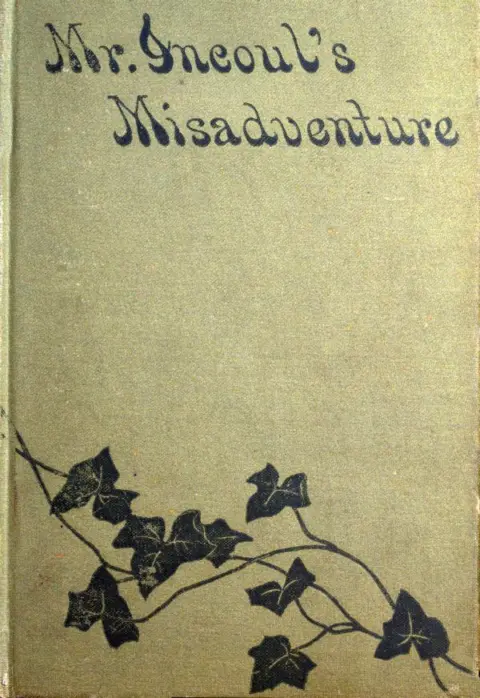
Mr. Incoul’s Misadventure
Edgar Saltus
THE CLASSIC COLLECTION · 1913
"The Monster" by Edgar Saltus is a novel written in the early 20th century. The story begins with a bride, Leilah, who is in a state of blissful romanticism with her husband, Gulian Verplank, as they prepare for a honeymoon. However, this idyllic beginning quickly darkens when Leilah receives a disturbing letter that reveals deep secrets about her past, causing her to confront an inner turmoil that drastically changes the course of her life and relationship. At the start of the novel, we are introduced to a lush, tropical scene where Leilah and Gulian are in love and planning their future. Their conversation reveals their deep affection, but soon the mood shifts when Leilah discovers an unsettling letter that sets off a chain reaction of emotions, including fear and despair. The initial atmosphere of romance and excitement crumbles as Leilah grapples with the implications of her father's message and the monstrous truths it contains, leading to her frantic decisions to escape her past and the overwhelming presence of this "monster" in her life. This gripping beginning sets the stage for a complex exploration of themes such as identity, love, and the consequences of hidden truths.
Introduction adapted from the source catalogue; source summaries may be automatically generated.
Free to read · English · 43,968 words · No account needed
MAKE TIME FOR A GOOD BOOK
On by default. Untick to stop anonymous reading totals. Each page counts after 10 seconds in view. How this works.
Anonymous counting is on unless you have switched it off.
“There are too many of us,” Verplank, the day following, found himself saying to Silverstairs.
The two men were lunching at Voisin’s.
The charming resort which, since the passing of Véry, of Véfour and the Maison Dorée, has become the ultimate refuge of the high gastronomic muse of Savarin and of Brisse was, on this forenoon, filled with its usual clientèle:--old men with pink cheeks, young women with ravishing hats, cosmopolitan sportsmen, ladies of both worlds, assortments of what Paris calls High Life and pronounces Hig Leaf.
Without, a fog draped the windows, blurred the movement of the street, transforming it into a cinematograph of misty silhouettes. But within, the brilliant damask, the glittering service, the studied excellence of everything, produced an atmosphere of wealth and ease.
Silverstairs, after swallowing a glass of Chablis, meditatively lit a cigar. But meditation was not his forte. The twentieth of his name, he was tall and robust. He had straw-coloured hair, blue eyes, a skin of brick, and an appearance of simple placidity. At the moment he was mentally fondling certain reminiscences of the Isis and certain bouts with bargees there.
“You know,” he said at last, “if I were you I would just march up to him and knock him down.”
Verplank nodded. “I dare say. But not if he had taken your wife.”
The suggestion, penetrating the earl’s placidity, punctured it. He threw back his head. “By George! If he had, I’d kill him.”
“There, you see!”
Silverstairs puffed at his cigar. His placidity now was reforming
itself.
“Yes,” he answered. “But then in taking yours, he did it after she was divorced. You can’t have him out for that.”
“All the same there are one too many of us.”
Silverstairs filled his mouth with smoke. Longly, with an air of considering the situation he expelled it. Then he said:
“It is what I call damned awkward. But what the deuce can you do?”
“What can I do?” Verplank with an uplift of the chin repeated. “Why, if only for the manner in which he acted last night--”
“I know,” Silverstairs interrupted. “The missis told me. He behaved like a fidgety Frenchman. I grant you that. But there were no words, nothing that you could put a finger on.”
Through an adjacent door a man strolled in. He had his hat on and in one gloved hand he held a thin umbrella of which the handle was studded with gold nails. With the other hand he smoothed a black moustache. Through a monocle he was surveying the room. He looked careless and cynical.
Your reading position is saved on this browser. Take it to another device with a library code. Reading pages adapt to text, rather than matching a printed edition.
Edgar Saltus
Edgar Saltus
Edgar Saltus
Edgar Saltus
BEHIND THE BOOK
This eBook is for the use of anyone anywhere in the United States and most other parts of the world at no cost and with almost no restrictions whatsoever. You may copy it, give it away or re-use it under the terms of the Project Gutenberg License included with this eBook or online at www.gutenberg.org. If you are not located in the United States, you will have to check the laws of the country where you are located before using this eBook. Read the source licence.
The original source file, including credits and licence, is retained by this library. Request an original-format copy at no charge. Please include the book title and Project Gutenberg identifier #47654.
KEEP YOUR CURIOSITY GOING
Coulson Kernahan

Maurice Baring
Frances Wright
Cécile Tormay

Frederic Jesup Stimson

W. H. P. (William Henry Pope) Jarvis