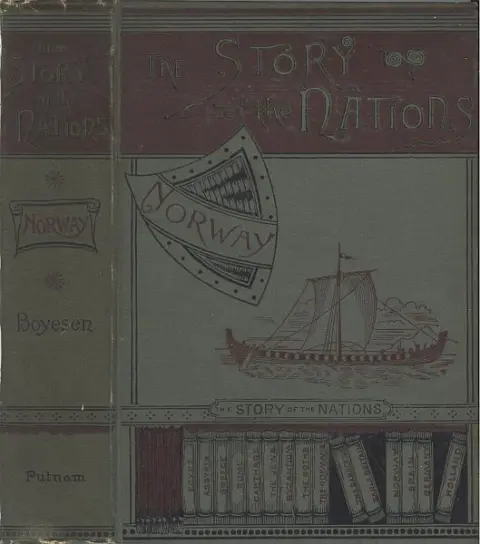
The Story of Norway
Hjalmar Hjorth Boyesen
THE CLASSIC COLLECTION · 1887
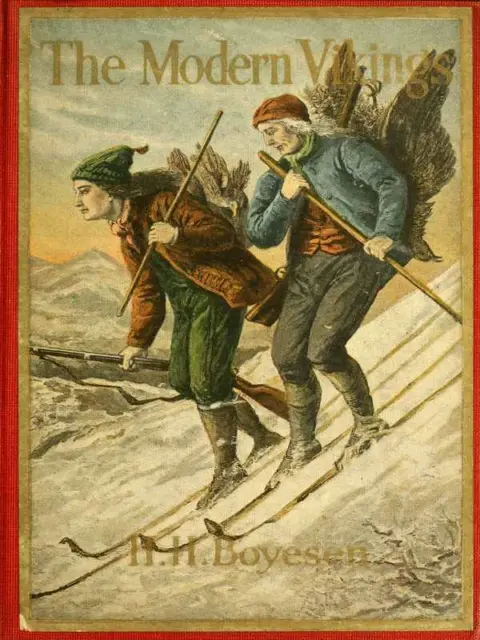
"The Modern Vikings: Stories of Life and Sport in the Norseland" by Hjalmar H. Boyesen is a collection of stories aimed at young readers, written in the late 19th century. The book explores themes related to the lives and adventures of children in Norway, with elements of life, nature, and sport set against the backdrop of the unique Nordic landscape. The opening portion introduces us to Tharald and Anders, two young boys who embark on an adventure that highlights their curiosity and playful nature, particularly as they encounter an otter while fishing. The beginning of the work sets the stage for an engaging narrative, showcasing the boys' interaction with the natural world around them. They are drawn into the hunt for an otter, which leads them into a series of thrilling events that create a bond between them and the creature, ultimately highlighting themes of friendship, adventure, and the innocence of childhood. As they pursue the otter, the story encapsulates the essence of youthful exploration, curiosity, and the delightful unpredictability of nature, suggesting that these early experiences will shape their understanding of the world and themselves as they grow.
Introduction adapted from the source catalogue; source summaries may be automatically generated.
Free to read · English · 74,505 words · No account needed
MAKE TIME FOR A GOOD BOOK
On by default. Untick to stop anonymous reading totals. Each page counts after 10 seconds in view. How this works.
Anonymous counting is on unless you have switched it off.
Magnie was consumed with the hunting fever. He had been away to school since he was ten years old, and had never had the chance of doing anything remarkable. While his brother, Olaf, who was a midshipman in the navy, roamed about the world, and had delightful adventures with Turks and Arabs, and all sorts of outlandish people, Magnie had to scan Virgil and Horace and torment his soul with algebraic problems. It was not at all the kind of life he had sketched out for himself, and if it had not been his father who had imposed it upon him, he would have broken away from all restraints and gone to Turkey or China, or some place where exciting things happened. In the meanwhile, as he lacked money for such an enterprise, he would content himself with whatever excitement there was in hunting, and as his brothers, Olaf and little Edwin (who was fourteen years old), were also at home for the vacation, there was a prospect of many delightful expeditions by sea and by land. Moreover, their old friend Grim Hering-Luck, who was their father’s right-hand man, had promised to be at their disposal and put them on the track of exciting experiences. They had got each a gun, and had practised shooting at a target daily since their return from the city. Magnie, or Magnus Birk, as his real name was, had once (though Olaf stoutly maintained that it was mere chance) hit the bull’s-eye at a hundred yards, and he was now eager to show his skill on something more valuable than a painted target. It was, therefore, decided that Grim and the boys should go reindeer-hunting. They were to be accompanied by the professional hunter, Bjarne Sheepskin.
It was a glorious morning. The rays of the sun shot from the glacier peaks in long radiant shafts down into the valley. The calm mirror of the fiord glittered in the light and fairly dazzled the eye, and the sea-birds drifted in noisy companies about the jutting crags, plunged headlong into the sea, and scattered the spray high into the air. The blue smoke rose perpendicularly from the chimneys of the fishermen’s cottages along the beach, and the housewives, still drowsy with sleep, came out, rubbed their eyes and looked toward the sun to judge of the hour. One boat after another was pushed out upon the water, and the ripples in their wakes spread in long diverging lines toward either shore. The fish leaped in the sun, heedless of the gulls which sailed in wide circles under the sky, keeping a sharp lookout for the movements of the finny tribe. The three boys could only stand and gaze in dumb astonishment upon the splendid sights which the combined heavens, earth, and sea afforded. Their father, who was much pleased with their determination and enterprise, had readily given his consent to the reindeer hunt, on condition that Grim should take command and be responsible for their safety. They were now mounted upon three sturdy ponies, while their provisions, guns, and other commodities were packed upon a fourth beast--a shaggy little monster named Bruno, who looked more like a hornless goat than a horse. Bjarne Sheepskin, a long, round-shouldered fellow, with a pair of small, lively eyes, was leading this heavily laden Bruno by the bridle, and the little caravan, being once set in motion, climbed the steep slopes toward the mountains with much persistence and dexterity. The ponies, which had been especially trained for mountain climbing, planted their hoofs upon the slippery rocks with a precision which was wonderful to behold, jumped from stone to stone, slipped, scrambled up and down, but never fell. As they entered the pine forest, where the huge trunks grew in long, dark colonnades, letting in here and there stray patches of sunshine, partridges and ptarmigan often started under the very noses of the horses, and Magnie clamored loudly for his gun, and grew quite angry with Bjarne, who would allow “no fooling with tomtits and chipmunks, when they were in search of big game.” Even hares were permitted to go unmolested; and it was not until a fine capercailzie[8] cock tumbled out of the underbrush close to the path, that Bjarne flung his gun to his cheek and fired. The capercailzie made a somersault in the air, and the feathers flew about it as it fell. Bjarne picked it up quietly, tied its legs together, and hung it on the pommel of Edwin’s saddle. “That will make a dinner for gentlefolks,” he said, “if the dairy-maids up on the saeters should happen to have nothing in the larder.”
Your reading position is saved on this browser. Take it to another device with a library code. Reading pages adapt to text, rather than matching a printed edition.
Hjalmar Hjorth Boyesen
Hjalmar Hjorth Boyesen
Hjalmar Hjorth Boyesen
Hjalmar Hjorth Boyesen
BEHIND THE BOOK
This eBook is for the use of anyone anywhere in the United States and most other parts of the world at no cost and with almost no restrictions whatsoever. You may copy it, give it away or re-use it under the terms of the Project Gutenberg License included with this eBook or online at www.gutenberg.org. If you are not located in the United States, you will have to check the laws of the country where you are located before using this eBook. Read the source licence.
The original source file, including credits and licence, is retained by this library. Request an original-format copy at no charge. Please include the book title and Project Gutenberg identifier #53070.
KEEP YOUR CURIOSITY GOING
Coulson Kernahan

Maurice Baring
Frances Wright
Cécile Tormay

Frederic Jesup Stimson

W. H. P. (William Henry Pope) Jarvis