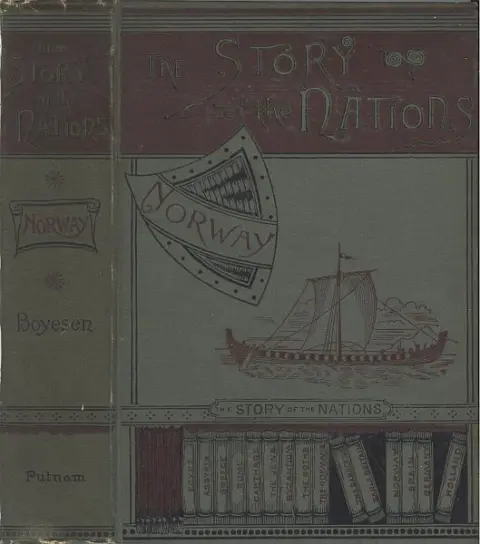
The Story of Norway
Hjalmar Hjorth Boyesen
THE CLASSIC COLLECTION · 1887
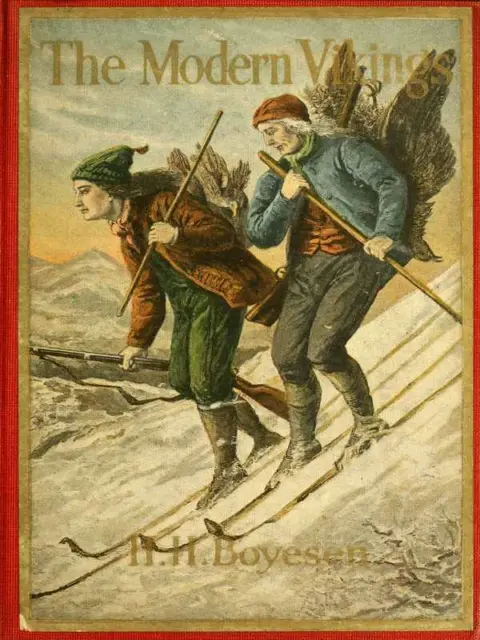
"The Modern Vikings: Stories of Life and Sport in the Norseland" by Hjalmar H. Boyesen is a collection of stories aimed at young readers, written in the late 19th century. The book explores themes related to the lives and adventures of children in Norway, with elements of life, nature, and sport set against the backdrop of the unique Nordic landscape. The opening portion introduces us to Tharald and Anders, two young boys who embark on an adventure that highlights their curiosity and playful nature, particularly as they encounter an otter while fishing. The beginning of the work sets the stage for an engaging narrative, showcasing the boys' interaction with the natural world around them. They are drawn into the hunt for an otter, which leads them into a series of thrilling events that create a bond between them and the creature, ultimately highlighting themes of friendship, adventure, and the innocence of childhood. As they pursue the otter, the story encapsulates the essence of youthful exploration, curiosity, and the delightful unpredictability of nature, suggesting that these early experiences will shape their understanding of the world and themselves as they grow.
Introduction adapted from the source catalogue; source summaries may be automatically generated.
Free to read · English · 74,505 words · No account needed
MAKE TIME FOR A GOOD BOOK
On by default. Untick to stop anonymous reading totals. Each page counts after 10 seconds in view. How this works.
Anonymous counting is on unless you have switched it off.
Sigurd, after some remonstrance, yielded, as was his wont, to his son’s resolution and courage. Stepping off his skees, which he stuck endwise into the snow, and burrowing his feet down until they reached the solid rock, he tied the rope around his waist and twisted it about his hands, and at last, with quaking heart, gave the signal for the perilous enterprise. The promontory, which rose abruptly to a height of two or three hundred feet from the sea, presented a jagged wall full of nooks and crevices glazed with frozen snow on the windward side, but black and partly bare to leeward.
“Now let go!” shouted Thoralf; “and stop when I give a slight pull
at the rope.”
“All right,” replied his father.
And slowly, slowly, hovering in mid-air, now yielding to an irresistible impulse of dread, now brave, cautious, and confident, Thoralf descended the cliff, which no human foot had ever trod before. He held in his hand the pole with the horse-hair noose, and over his shoulder hung a foxskin hunting-bag. With alert, wide-open eyes he spied about him, exploring every cranny of the rock, and thrusting his pole into the holes where he suspected the birds might have taken refuge. Sometimes a gust of wind would have flung him violently against the jagged wall if he had not, by means of his pole, warded off the collision. At last he caught sight of a bare ledge, where he might gain a secure foothold; for the rope cut him terribly about the waist, and made him anxious to relieve the strain, if only for a moment. He gave the signal to his father, and by the aid of the pole swung himself over to the projecting ledge. It was uncomfortably narrow, and, what was worse, the remnants of a dozen auks’ nests had made the place extremely slippery. Nevertheless, he seated himself, allowing his feet to dangle, and gazed out upon the vast ocean, which looked in its icy grandeur like a forest of shining towers and minarets. It struck him for the first time in his life that perhaps his father was right in his belief that Iceland was the fairest land the sun doth shine upon; but he could not help reflecting that it was a very unprofitable kind of beauty. The storm whistled and howled overhead, but under the lee of the sheltering rock it blew only in fitful gusts with intermissions of comparative calm. He knew that in fair weather this was the haunt of innumerable sea birds, and he concluded that even now they could not be far away. He pulled up his legs, and crept carefully on hands and feet along the slippery ledge, peering intently into every nook and crevice. His eyes, which had been half-blinded by the glare of the snow, gradually recovered their power of vision. There! What was that? Something seemed to move on the ledge below. Yes, there sat a long row of auks, some erect as soldiers, as if determined to face it out; others huddled together in clusters, and comically woe-begone. Quite a number lay dead at the base of the rock, whether from starvation or as the victims of fierce fights for the possession of the sheltered ledges could scarcely be determined. Thoralf, delighted at the sight of anything eatable (even though it was poor eating), gently lowered the end of his pole, slipped the noose about the neck of a large, military-looking fellow, and, with a quick pull, swung him out over the ice-field. The auk gave a few ineffectual flaps with his useless wings,[4] and expired. His picking off apparently occasioned no comment whatever in his family, for his comrades never uttered a sound nor stirred an inch, except to take possession of the place he had vacated. Number two met his fate with the same listless resignation; and numbers three, four, and five were likewise removed in the same noiseless manner, without impressing their neighbors with the fact that their turn might come next. The birds were half-benumbed with hunger, and their usually alert senses were drowsy and stupefied. Nevertheless, number six, when it felt the noose about its neck, raised a hubbub that suddenly aroused the whole colony, and, with a chorus of wild screams, the birds flung themselves down the cliffs or, in their bewilderment, dashed headlong down upon the ice, where they lay half stunned or helplessly sprawling. So, through all the caves and hiding-places of the promontory the commotion spread, and the noise of screams and confused chatter mingled with the storm and filled the vault of the sky. In an instant a great flock of gulls was on the wing, and circled with resentful shrieks about the head of the daring intruder who had disturbed their wintry peace. The wind whirled them about, but they still held their own, and almost brushed with their wings against his face, while he struck out at them with his pole. He had no intention of catching them; but, by chance, a huge burgomaster gull[5] got its foot into the noose. It made an ineffectual attempt to disentangle itself, then, with piercing screams, flapped its great wings, beating the air desperately. Thoralf, having packed three birds into his hunting-bag, tied the three others together by the legs, and flung them across his shoulders. Then, gradually trusting his weight to the rope, he slid off the rock, and was about to give his father the signal to hoist him up. But, greatly to his astonishment, his living captive, by the power of its mighty wings, pulling at the end of the pole, swung him considerably farther into space than he had calculated. He would have liked to let go both the gull and the pole, but he perceived instantly that if he did, he would, by the mere force of his weight, be flung back against the rocky wall. He did not dare take that risk, as the blow might be hard enough to stun him. A strange, tingling sensation shot through his nerves, and the blood throbbed with a surging sound in his ears. There he hung suspended in mid-air, over a terrible precipice--and a hundred feet below was the jagged ice-field with its sharp, fiercely-shining steeples! With a powerful effort of will, he collected his senses, clinched his teeth, and strove to think clearly. The gull whirled wildly eastward and westward, and he swayed with its every motion like a living pendulum between sea and sky. He began to grow dizzy, but again his powerful will came to his rescue, and he gazed resolutely up against the brow of the precipice and down upon the projecting ledges below, in order to accustom his eye and his mind to the sight. By a strong effort he succeeded in giving a pull at the rope, and expected to feel himself raised upward by his father’s strong arms. But, to his amazement, there came no response to his signal. He repeated it once, twice, thrice; there was a slight tugging at the rope, but no upward movement. Then the brave lad’s heart stood still, and his courage wellnigh failed him.
Your reading position is saved on this browser. Take it to another device with a library code. Reading pages adapt to text, rather than matching a printed edition.
Hjalmar Hjorth Boyesen
Hjalmar Hjorth Boyesen
Hjalmar Hjorth Boyesen
Hjalmar Hjorth Boyesen
BEHIND THE BOOK
This eBook is for the use of anyone anywhere in the United States and most other parts of the world at no cost and with almost no restrictions whatsoever. You may copy it, give it away or re-use it under the terms of the Project Gutenberg License included with this eBook or online at www.gutenberg.org. If you are not located in the United States, you will have to check the laws of the country where you are located before using this eBook. Read the source licence.
The original source file, including credits and licence, is retained by this library. Request an original-format copy at no charge. Please include the book title and Project Gutenberg identifier #53070.
KEEP YOUR CURIOSITY GOING
Coulson Kernahan

Maurice Baring
Frances Wright
Cécile Tormay

Frederic Jesup Stimson

W. H. P. (William Henry Pope) Jarvis