THE CLASSIC COLLECTION✦Automatic Pistol Shooting Together with Information on Handling the Duelling Pistol and RevolverCLASSIC FREE BOOKS
Automatic Pistol Shooting Together with Information on Handling the Duelling Pistol and Revolver
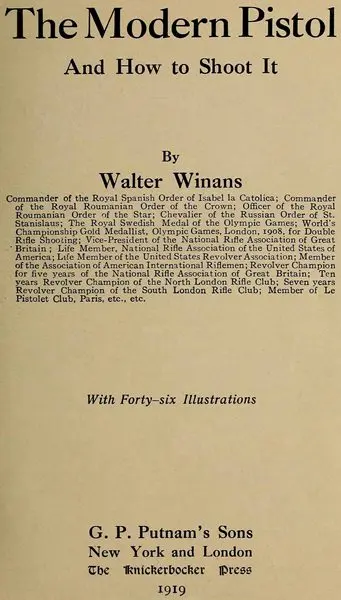
Walter Winans
THE CLASSIC COLLECTION · 1919
"The Modern Pistol and How to Shoot It" by Walter Winans is a practical guide on modern pistol shooting techniques, written in the early 20th century. The book focuses on the transition from revolver shooting to the more contemporary automatic pistol, providing instruction and safety guidance for aspiring shooters. Winans, an experienced marksman and competitive shooter, emphasizes the effectiveness of automatic pistols over revolvers and shares his insights on developing shooting skills. At the start of the work, Winans reflects on the changing landscape of firearm usage, noting that revolvers are now considered obsolete except for certain niche applications. He stresses the importance of proper training and safety measures, warning against the dangers of mishandling firearms by novices. Additionally, he critiques the existing approaches to teaching pistol shooting, advocating for more engaging and practical methods that enhance skill development. Winans sets the stage for a comprehensive exploration of automatic pistol shooting, addressing both the mechanics of the firearm and the vital responsibilities of the shooter.
Introduction adapted from the source catalogue; source summaries may be automatically generated.
Free to read · English · 77,057 words · No account needed
MAKE TIME FOR A GOOD BOOK
On by default. Untick to stop anonymous reading totals. Each page counts after 10 seconds in view. How this works.
Anonymous counting is on unless you have switched it off.
Now that the pupil has learned how to handle the single-shot pistol with safety to himself and others, he can be trusted to learn how to shoot the automatic pistol. (See Plates 7 and 13.)
Before giving such instruction, it is necessary to explain what an automatic pistol is, and in what it differs from a single-shot pistol.
The first pistol, as the first rifle, was naturally a single-shot one.
The pistol and rifle both proceeded in development along the same lines.
First the match-lock, wheel-lock, flint-lock, percussion lock. Then through muzzle-loader to rim fire, pin fire, to central fire breechloader, hammer, hammerless, and ejector.
The double barrel, and multi-barrel, and from smooth-bore to rifled bore, were evolved at the same time.
Here the pistol and rifle parted company slightly; though the principle was the same in each case, it was differently applied.
The rifle became a magazine loader, and it will next be an automatic loader (though at present automatic loading is principally used in machine guns and low-power rifles).
The pistol, instead of becoming a magazine loader (in the sense of being loaded by cartridges brought up from a magazine by operating a bolt), became a revolver--that is, the cartridges were fired out of the magazine instead of being first inserted into the barrel from a magazine.
When cartridges are inserted into the barrel, there is no escape of gas at the breech when they are fired, but when fired out of the cylinder of a revolver, there is an escape of gas at the juncture of the cylinder and barrel, which varies, and when such escape of gas occurs it causes weak and low shots.
The cylinder cannot be made gas tight, as that would prevent its revolving, or coincide absolutely with the calibre of the barrel, consequently a revolver can never be as accurate as a single-shot pistol.
This defect in the revolver was its weak point in comparison with the
magazine-loading rifle.
Just before the war, I shot two makes of military full-charge automatic rifles, which were very good, but the war has put an end to their development for the present. Undoubtedly the rifle of the future will be an automatic.
The principle of an automatic firearm can be best explained by the analogy
of the automobile.
The revolver, which is a magazine pistol, can be fired only after each cartridge is placed in position by the action of cocking the hammer with the thumb, or by double-action trigger pull.
The internal combustion (the automobile engine) operates by the explosion operating the various parts.
Your reading position is saved on this browser. Take it to another device with a library code. Reading pages adapt to text, rather than matching a printed edition.
BEHIND THE BOOK
This eBook is for the use of anyone anywhere in the United States and most other parts of the world at no cost and with almost no restrictions whatsoever. You may copy it, give it away or re-use it under the terms of the Project Gutenberg License included with this eBook or online at www.gutenberg.org. If you are not located in the United States, you will have to check the laws of the country where you are located before using this eBook. Read the source licence.
The original source file, including credits and licence, is retained by this library. Request an original-format copy at no charge. Please include the book title and Project Gutenberg identifier #41610.
KEEP YOUR CURIOSITY GOING

Charles G. (Charles Griffith) Ross
Hannah Webster Foster

Emily Lawless
Edwin Hamlin Carr

Charles De Lano Hine
Andrew Ure