THE CLASSIC COLLECTION✦Automatic Pistol Shooting Together with Information on Handling the Duelling Pistol and RevolverCLASSIC FREE BOOKS
Automatic Pistol Shooting Together with Information on Handling the Duelling Pistol and Revolver
Walter Winans
THE CLASSIC COLLECTION · 1919
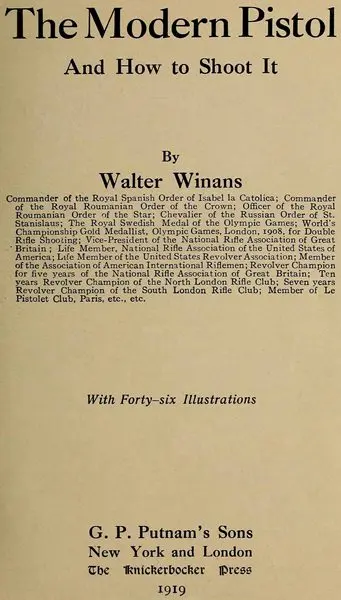
"The Modern Pistol and How to Shoot It" by Walter Winans is a practical guide on modern pistol shooting techniques, written in the early 20th century. The book focuses on the transition from revolver shooting to the more contemporary automatic pistol, providing instruction and safety guidance for aspiring shooters. Winans, an experienced marksman and competitive shooter, emphasizes the effectiveness of automatic pistols over revolvers and shares his insights on developing shooting skills. At the start of the work, Winans reflects on the changing landscape of firearm usage, noting that revolvers are now considered obsolete except for certain niche applications. He stresses the importance of proper training and safety measures, warning against the dangers of mishandling firearms by novices. Additionally, he critiques the existing approaches to teaching pistol shooting, advocating for more engaging and practical methods that enhance skill development. Winans sets the stage for a comprehensive exploration of automatic pistol shooting, addressing both the mechanics of the firearm and the vital responsibilities of the shooter.
Introduction adapted from the source catalogue; source summaries may be automatically generated.
Free to read · English · 77,057 words · No account needed
MAKE TIME FOR A GOOD BOOK
On by default. Untick to stop anonymous reading totals. Each page counts after 10 seconds in view. How this works.
Anonymous counting is on unless you have switched it off.
All the recoil is not made use of, some is wasted and diverts the aim by jumping the pistol about.
The noise of the discharge is an evil, it ought to be made to do work, not
deafen.
To invent a sound-deadener to put on the pistol is working on wrong lines; it is not simplification but it is complication.
Instead of first making a noise and then inventing something to destroy that noise, why not avoid making that noise?
The idea that ugliness does not matter is also a fallacy.
I was objecting to a pistol a man was shooting (and of which he asked my opinion), on the ground that it was so ugly. “What has ugliness to do with a pistol?” he said. “In my opinion, everything,” I answered.
Nothing correct mechanically is ugly, that is the Law of Nature.
The early, impractical, automatic pistols were extremely ugly; the best at present, the U. S. Army Colt, has graceful lines, and the perfect one will be beautiful.
The essence of architecture is beauty in utility.
Look at a first class hand made gun built by an Artist; it has the graceful lines of a classical piece of sculpture.
An automatic pistol should be as simple as possible, the simpler the less
likely to go wrong.
The supposed antagonism between Art and Mechanics, between Science and
Religion are imaginary.
If we simplify Art to its essential essence and perfection as the Ancient Greeks did--what do we find?
Sculpture is proportion and the essential planes.
What else is mechanics?
Science reduces all to the ONE UNIVERSAL FIRST CAUSE, and this is also the foundation of all religion.
In pistol shooting, all resolves itself into aligning the pistol and
discharging the bullet.
The shortest distance from one point to another is the straight line.
Therefore do not “flourish” or “brandish” the pistol up and down before
discharging it.
Merely bring it to alignment and discharge it in so doing.
Time is wasted if the trigger is pressed after alignment. Therefore begin pressing the trigger as the pistol is coming to the level.
This is the whole art of pistol shooting.
The way to advance any art, however humble, is for each to help the other
with his experience.
Nothing is so inimical to success as convention.
All progress is made on the lines of pruning off all not absolutely essential, in other words by simplification.
I think it advisable to give the following World’s Records made by myself with revolvers and black powder as they are now unbeatable, the weapons and cartridges being obsolete.
They stand in the same category as the “high wheel” trotting records.
Your reading position is saved on this browser. Take it to another device with a library code. Reading pages adapt to text, rather than matching a printed edition.
BEHIND THE BOOK
This eBook is for the use of anyone anywhere in the United States and most other parts of the world at no cost and with almost no restrictions whatsoever. You may copy it, give it away or re-use it under the terms of the Project Gutenberg License included with this eBook or online at www.gutenberg.org. If you are not located in the United States, you will have to check the laws of the country where you are located before using this eBook. Read the source licence.
The original source file, including credits and licence, is retained by this library. Request an original-format copy at no charge. Please include the book title and Project Gutenberg identifier #41610.
KEEP YOUR CURIOSITY GOING

Charles G. (Charles Griffith) Ross
Hannah Webster Foster

Emily Lawless
Edwin Hamlin Carr

Charles De Lano Hine
Andrew Ure