THE CLASSIC COLLECTION✦Anthropology and modern lifeCLASSIC FREE BOOKS
Anthropology and modern life
Franz Boas
THE CLASSIC COLLECTION · 1911
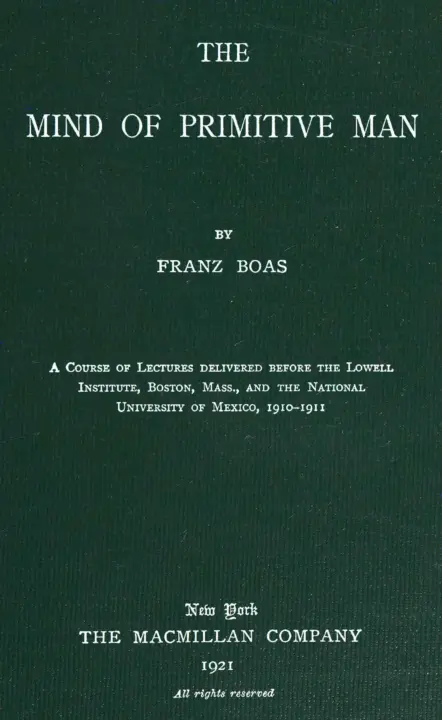
"The Mind of Primitive Man: A Course of Lectures Delivered Before the Lowell..." by Franz Boas is a book published in 1911. This groundbreaking anthropological work challenges racist and eugenic theories about race and intelligence that dominated early twentieth-century thought. Boas examines claims linking physical characteristics to mental capacity, explores the role of environment versus heredity, and compares languages and cultures across civilizations. His analysis dismantles the concept of racial hierarchies and argues that cultural development depends on historical causes rather than biological race.
Introduction adapted from the source catalogue; source summaries may be automatically generated.
Free to read · English · 62,395 words · No account needed
MAKE TIME FOR A GOOD BOOK
On by default. Untick to stop anonymous reading totals. Each page counts after 10 seconds in view. How this works.
Anonymous counting is on unless you have switched it off.
2. OTTO STOLL, Suggestion und Hypnotismus in der
Völkerpsychologie (Leipzig, 1894).
Page 176.
E. B. TYLOR, Primitive Culture (3d ed., 1891), p. 16.
Page 177.
E. B. TYLOR, “On a Method of Investigating the Development of Institutions” (Journal of the Anthropological Institute of Great Britain and Ireland, vol. xviii [1889], pp. 245 et seq.).
Page 179.
1. OTIS T. MASON, The Origins of Invention (London, 1895), pp.
315 et seq.
2. W J MCGEE, “The Beginning of Zooculture” (American Anthropologist, vol. x [1897], pp. 215 et seq.).
3. ED. HAHN, Die Haustiere und ihre Beziehungen zur Wirtschaft
des Menschen; Die Entstehung der Pflugkultur (Heidelberg,
1909).
Page 180.
1. H. COLLEY MARCH, in Transactions of the Lancashire and Cheshire Antiquarian Society, 1886, “Polynesian Ornament a Mythology” (Journal of the Anthropological Institute of Great Britain and Ireland, vol. xxii [1893], pp. 307 et seq.). HJALMAR STOLPE, “Entwicklungserscheinungen in der Ornamentik der Naturvölker” (Mittheilungen der Anthropologischen Gesellschaft in Wien, vol. xxii [1892], pp. 19 et seq.). CHARLES H. READ, “On the Origin and Sacred Character of Certain Ornaments of the S. E. Pacific” (Journ. Anthr. Inst., vol. xxi [1892], pp. 139 et seq.).
2. A. C. HADDON, “The Decorative Art of British New Guinea” (Cunningham Memoirs, No. X [Dublin, 1894]).
3. KARL VON DEN STEINEN, Unter den Naturvölkern
Zentral-Brasiliens (Berlin, 1894).
4. W. H. HOLMES, “Ancient Art of the Province of Chiriqui, Colombia” (Sixth Annual Report of the Bureau of Ethnology [Washington, 1888], pp. 3 et seq.); F. W. PUTNAM, “Conventionalism in Ancient American Art” (Bulletin Essex Institute, vol. xviii [1886], pp. 155-167); GEORGE GRANT MCCURDY, “The Armadillo in the Ancient Art of Chiriqui” (Fifteenth International Congress of Americanists [Quebec, 1907], vol. ii, pp. 147-163).
5. VON DEN STEINEN, “Prähistorische Zeichen und Ornamente” (Bastian Festschrift [Berlin, 1896], pp. 247-288). The general theory of ornament has been treated from this point of view by H. COLLEY MARCH, “The Meaning of Ornament, or its Archæology and its Psychology” (Transactions of the Lancaster and Cheshire Antiquarian Society, 1889). A. C. HADDON, Evolution in Art (1895). ERNST GROSSE, Die Anfänge der Kunst (1894).
Page 186.
VON DEN STEINEN, “Die Bedeutung der Textilmuster für den geometrischen Stil der Naturvölker” (Correspondenz-Blatt der deutschen Gesellschaft für Anthropologie, Ethnologie und Urgeschichte, vol. xxxv [1904], p. 126); MAX SCHMIDT, Indianerstudien in Zentral-Brasilien (Berlin, 1905), pp. 330 et seq.; FRANZ BOAS, “The Decorative Art of the North American Indians” (Popular Science Monthly, 1903, pp. 481-498); HEINRICH SCHURTZ, Urgeschichte der Kultur (1900), p. 540; A. S. F. HAMLIN, in The American Architect and Building News (1898).
Page 187.
1. RICHARD ANDREE, Ethnographische Parallelen und Vergleiche (Neue Folge, 1889), pp. 107 et seq.
2. WASHINGTON MATTHEWS, “The Gentile System of the Navajo Indians” (Journal of American Folk-Lore, vol. iii [1890], pp. 89-110).
Page 188.
1. JOHN G. BOURKE, “Notes upon the Gentile Organization of the Apaches of Arizona” (Ibid., pp. 111-126).
2. J. WALTER FEWKES, “The Kinship of a Tanoan-speaking Community in Tusayan” (American Anthropologist, vol. vii [1894], pp. 162 et seq.).
Your reading position is saved on this browser. Take it to another device with a library code. Reading pages adapt to text, rather than matching a printed edition.
Franz Boas
Franz Boas
Franz Boas
BEHIND THE BOOK
This eBook is for the use of anyone anywhere in the United States and most other parts of the world at no cost and with almost no restrictions whatsoever. You may copy it, give it away or re-use it under the terms of the Project Gutenberg License included with this eBook or online at www.gutenberg.org. If you are not located in the United States, you will have to check the laws of the country where you are located before using this eBook. Read the source licence.
The original source file, including credits and licence, is retained by this library. Request an original-format copy at no charge. Please include the book title and Project Gutenberg identifier #71630.
KEEP YOUR CURIOSITY GOING

Charles G. (Charles Griffith) Ross
Hannah Webster Foster

Emily Lawless
Edwin Hamlin Carr

Charles De Lano Hine
Andrew Ure