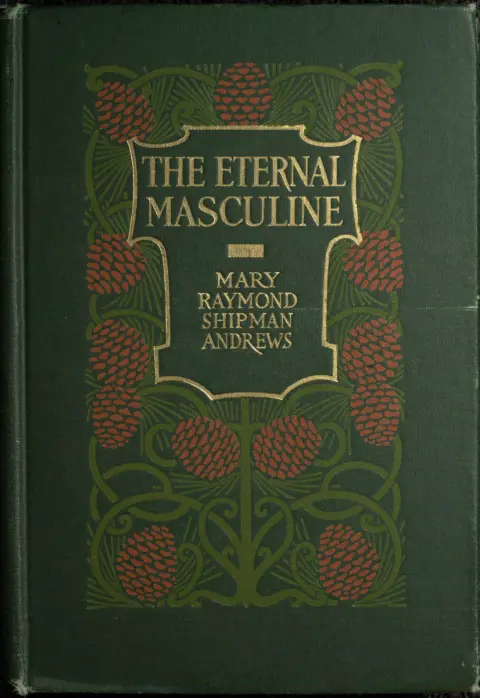
The eternal masculine
Mary Raymond Shipman Andrews
THE CLASSIC COLLECTION · 1907
"The Militants" by Mary Raymond Shipman Andrews is a collection of stories told through the lens of clergymen, soldiers, and other fighters, presumably written in the early 20th century. The work dives into themes of faith, struggle, and the heroism of everyday lives as they intersect during tumultuous times. The opening portion introduces key characters, particularly focusing on a Bishop and a young girl named Eleanor, hinting at their intertwined futures and the impact of their respective journeys. The opening of "The Militants" sets the stage by presenting a quiet July day where the Bishop walks to church and encounters a lively young girl named Eleanor. Their playful exchange reveals her innocence and curiosity, as well as a deeper, reflective side from the Bishop, who finds himself drawn to Eleanor’s resemblance to her deceased mother. The dialogue captures a rich sense of character development and thematic foreshadowing, hinting at loss, kinship, and the trials faced by both characters. In this first interaction, Andrews establishes an emotional bond that will likely influence the unfolding narrative, weaving together themes of spirituality and the trials of love and duty against a backdrop of historical struggles.
Introduction adapted from the source catalogue; source summaries may be automatically generated.
Free to read · English · 68,266 words · No account needed
MAKE TIME FOR A GOOD BOOK
On by default. Untick to stop anonymous reading totals. Each page counts after 10 seconds in view. How this works.
Anonymous counting is on unless you have switched it off.
"That was one impression the clergyman's sermon made, and the other was simply his beautiful goodness. It shone from him at every syllable, uninspired and uninteresting as they were. You couldn't help knowing that his soul was white as an angel's. Such sincerity, devotion, purity as his couldn't be mistaken. As I realized it, it transfigured the whole place. It made me feel that if that quality--just goodness--could so glorify all the defects of his look and mind and manner, it must be worth while, and I would like to have it. So I knew what was right in my heart--I think you can always know what's right if you want to know--and I just chucked my pride and my stubbornness into the street, and--and I caught the 7:35 train."
The light of renunciation, the exhaustion of wrenching effort, the trembling triumph of hard-won victory, were in the boy's face, and the thought, as he looked at it, dear and familiar in every shadow, that he had never seen spirit shine through clay more transparently. Never in their lives had the two been as close, never had the son so unveiled his soul before. And, as he had said, in all probability never would it be again. To the depth where they stood words could not reach, and again for minutes, only the friendly undertone of the crackling fire stirred the silence of the great room. The sound brought steadiness to the two who sat there, the old hand on the young shoulder yet. After a time, the older man's low and strong tones, a little uneven, a little hard with the effort to be commonplace, which is the first readjustment from deep feeling, seemed to catch the music of the homely accompaniment of the fire.
"It is a queer thing, Ted," he said, "but once, when I was not much older than you, just such an unexpected chance influence made a crisis in my life. I was crossing to England with the deliberate intention of doing something which I knew was wrong. I thought it meant happiness, but I know now it would have meant misery. On the boat was a young clergyman of about my own age making his first, very likely his only, trip abroad. I was thrown with him--we sat next each other at table, and our cabins faced--and something in the man attracted me, a quality such as you speak of in this other, of pure and uncommon goodness. He was much the same sort as your old man, I fancy, not particularly winning, rather narrow, rather limited in brains and in advantages, with a natural distrust of progress and breadth. We talked together often, and one day, I saw, by accident, into the depths of his soul, and knew what he had sacrificed to become a clergyman--it was what meant to him happiness and advancement in life. It had been a desperate effort, that was plain, but it was plain, too, that from the moment he saw what he thought was the right, there had been no hesitation in his mind. And I, with all my wider mental training, my greater breadth--as I looked at it--was going, with my eyes open, to do a wrong because I wished to do it. You and I must be built something alike, Ted, for a touch in the right spot seems to penetrate to the core of us--the one and the other. This man's simple and intense flame of right living, right doing, all unconsciously to himself, burned into me, and all that I had planned to do seemed scorched in that fire--turned to ashes and bitterness. Of course it was not so simple as it sounds. I went through a great deal. But the steady influence for good was beside me through that long passage--we were two weeks--the stronger because it was unconscious, the stronger, I think, too, that it rested on no intellectual basis, but was wholly and purely spiritual--as the confidence of a child might hold a man to his duty where the arguments of a sophist would have no effect. As I say, I went through a great deal. My mind was a battle-field for the powers of good and evil during those two weeks, but the man who was leading the forces of the right never knew it. The outcome was that as soon as I landed I took my passage back on the next boat, which sailed at once. Within a year, within a month almost, I knew that the decision I made then was a turning-point, that to have done otherwise would have meant ruin in more than one way. I tremble now to think how close I was to shipwreck. All that I am, all that I have, I owe more or less directly to that man's unknown influence. The measure of a life is its service. Much opportunity for that, much power has been in my hands, and I have tried to hold it humbly and reverently, remembering that time. I have thought of myself many times us merely the instrument, fitted to its special use, of that consecrated soul."
Your reading position is saved on this browser. Take it to another device with a library code. Reading pages adapt to text, rather than matching a printed edition.
Mary Raymond Shipman Andrews
Mary Raymond Shipman Andrews

Mary Raymond Shipman Andrews
Mary Raymond Shipman Andrews
BEHIND THE BOOK
This eBook is for the use of anyone anywhere in the United States and most other parts of the world at no cost and with almost no restrictions whatsoever. You may copy it, give it away or re-use it under the terms of the Project Gutenberg License included with this eBook or online at www.gutenberg.org. If you are not located in the United States, you will have to check the laws of the country where you are located before using this eBook. Read the source licence.
The original source file, including credits and licence, is retained by this library. Request an original-format copy at no charge. Please include the book title and Project Gutenberg identifier #15496.
KEEP YOUR CURIOSITY GOING
Cécile Tormay

Moritz Busch
Coulson Kernahan
John L. Ransom

Maurice Baring
Frances Wright