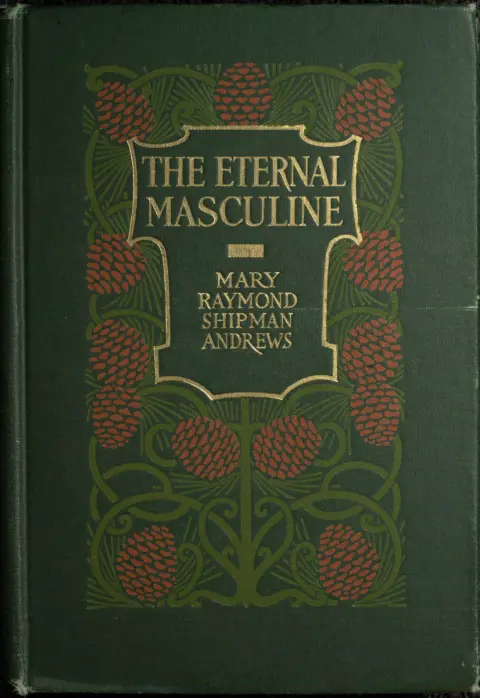
The eternal masculine
Mary Raymond Shipman Andrews
THE CLASSIC COLLECTION · 1907
"The Militants" by Mary Raymond Shipman Andrews is a collection of stories told through the lens of clergymen, soldiers, and other fighters, presumably written in the early 20th century. The work dives into themes of faith, struggle, and the heroism of everyday lives as they intersect during tumultuous times. The opening portion introduces key characters, particularly focusing on a Bishop and a young girl named Eleanor, hinting at their intertwined futures and the impact of their respective journeys. The opening of "The Militants" sets the stage by presenting a quiet July day where the Bishop walks to church and encounters a lively young girl named Eleanor. Their playful exchange reveals her innocence and curiosity, as well as a deeper, reflective side from the Bishop, who finds himself drawn to Eleanor’s resemblance to her deceased mother. The dialogue captures a rich sense of character development and thematic foreshadowing, hinting at loss, kinship, and the trials faced by both characters. In this first interaction, Andrews establishes an emotional bond that will likely influence the unfolding narrative, weaving together themes of spirituality and the trials of love and duty against a backdrop of historical struggles.
Introduction adapted from the source catalogue; source summaries may be automatically generated.
Free to read · English · 68,266 words · No account needed
MAKE TIME FOR A GOOD BOOK
On by default. Untick to stop anonymous reading totals. Each page counts after 10 seconds in view. How this works.
Anonymous counting is on unless you have switched it off.
The boy, reddening, insisted. "But, mother, really, don't you think it was queer? I saw him as plainly as I do now--and I've never seen this picture before."
"Oh, yes, you have--you must have seen it," his mother threw back lightly. "You've forgotten, but the image of it was tucked away in some dark corner of your mind, and when you were asleep it stole out and played tricks on you. That's the way forgotten ideas do: they get even with you in dreams for having forgotten them."
"Mother, only listen--" But Mrs. Beckwith, her eyes lighting with a swift turn of thought, interrupted him--laid her finger on his lips.
"No--you listen, boy dear--quick, before I forget it! I've never told you about this, and it's very interesting."
And the youngster, used to these wilful ways of his sister-mother, laughed and put his fair head against her shoulder and listened.
"It's quite a romance," she began, "only there isn't any end to it; it's all unfinished and disappointing. It's about this little Philip here, whose name you have--my brother. He died when he was five, as I said, but even then he had a bit of dramatic history in his life. He was born just before war-time in 1859, and he was a beautiful and wonderful baby; I can remember all about it, for I was six years older. He was incarnate sunshine, the happiest child that ever lived, but far too quick and clever for his years. The servants used to ask him, 'Who is you, Marse Philip, sah?' to hear him answer, before he could speak it plainly, 'I'm Philip Fairfield of Fairfield'; he seemed to realize that, and his responsibility to them and to the place, as soon as he could breathe. He wouldn't have a darky scolded in his presence, and every morning my father put him in front of him in the saddle, and they rode together about the plantation. My father adored him, and little Philip's sunshiny way of taking possession of the slaves and the property pleased him more deeply, I think, than anything in his life. But the war came before this time, when the child was about a year old, and my father went off, of course, as every Southern man went who could walk, and for a year we did not see him. Then he was badly wounded at the battle of Malvern Hill; and came home to get well. However, it was more serious than he knew, and he did not get well. Twice he went off again to join our army, and each time he was sent back within a month, too ill to be of any use. He chafed constantly, of course, because he must stay at home and farm, when his whole soul ached to be fighting for his flag; but finally in December, 1863, he thought he was well enough at last for service. He was to join General John Morgan, who had just made his wonderful escape from prison at Columbus, and it was planned that my mother should take little Philip and me to England to live there till the war was over and we could all be together at Fairfield again. With that in view my father drew all of his ready money--it was ten thousand dollars in gold--from the banks in Lexington, for my mother's use in the years they might be separated. When suddenly, the day before he was to have gone, the old wound broke out again, and he was helplessly ill in bed at the hour when he should have been on his horse riding toward Tennessee. We were fifteen miles out from Lexington, yet it might be rumored that father had drawn a large sum of money, and, of course, he was well known as a Southern officer. Because of the Northern soldiers, who held the city, he feared very much to have the money in the house, yet he hoped still to join Morgan a little later, and then it would be needed as he had planned. Christmas morning my father was so much better that my mother went to church, taking me, and leaving little Philip, then four years old, to amuse him. What happened that morning was the point of all this rambling; so now listen hard, my precious thing."
Your reading position is saved on this browser. Take it to another device with a library code. Reading pages adapt to text, rather than matching a printed edition.
Mary Raymond Shipman Andrews
Mary Raymond Shipman Andrews
Mary Raymond Shipman Andrews
Mary Raymond Shipman Andrews
BEHIND THE BOOK
This eBook is for the use of anyone anywhere in the United States and most other parts of the world at no cost and with almost no restrictions whatsoever. You may copy it, give it away or re-use it under the terms of the Project Gutenberg License included with this eBook or online at www.gutenberg.org. If you are not located in the United States, you will have to check the laws of the country where you are located before using this eBook. Read the source licence.
The original source file, including credits and licence, is retained by this library. Request an original-format copy at no charge. Please include the book title and Project Gutenberg identifier #15496.
KEEP YOUR CURIOSITY GOING
Cécile Tormay

Moritz Busch
Coulson Kernahan
John L. Ransom

Maurice Baring
Frances Wright