
The Residuary Legatee; Or, The Posthumous Jest of the Late John Austin
Frederic Jesup Stimson
THE CLASSIC COLLECTION · 1896
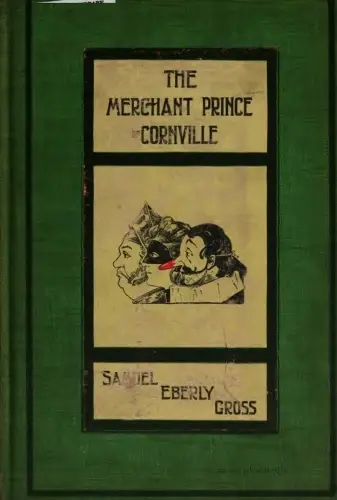
"The Merchant Prince of Cornville: A Comedy" by Samuel Eberly Gross is a theatrical comedy written in the late 19th century. This engaging play offers a mix of romance, idealism, and commentary on materialism, focusing on the character of Hercules Whetstone, a wealthy merchant and mayor who seeks to win the heart of the refined Violet. The narrative juxtaposes lofty ideals with the mundane realities of wealth and love in a whimsical manner that characterizes the comedic style of its time. At the start of the play, the audience is introduced to the idyllic setting of an orchard by the sea, where the poet Ideal and the charming Violet engage in playful and flirtatious banter, hinting at deeper themes of romantic aspiration and poetic fancy. As the scene unfolds, it becomes clear that Violet is not only charming but also weary of proposals related solely to wealth, as she is introduced to her suitor, Whetstone. The characters provide a lively commentary on the values of their society, including discussions of love entwined with commerce and the pursuit of happiness amidst material concerns, setting the stage for a tale rich in humor and romantic entanglements.
Introduction adapted from the source catalogue; source summaries may be automatically generated.
Free to read · English · 26,217 words · No account needed
MAKE TIME FOR A GOOD BOOK
On by default. Untick to stop anonymous reading totals. Each page counts after 10 seconds in view. How this works.
Anonymous counting is on unless you have switched it off.
The tree ’neath which thou standest is cedrine, and its laced boughs, filtering the moonlight, cast an interlacing shadow on the lawn; upon this plot, now, in part, a deeper shadow rests, like shadow upon shadow.
BLUEGRASS [sings in recitative, and WHETSTONE accompanies with
pantomime].
’Tis but a shadow, ’tis but a shadow cast from me by the moonlight.
I hear ze voice of ze shadow, ze pretty shadow. Oh, zat I had ze shadow up on ze balcony! Charmant!
Fie, Ninon, what wouldst thou with the fleeting shadow of this Merchant Prince? Thou hadst not even the shadow of sentiment.
Dear mistress, I see ze rainbow in ze shadow. Superbe!
BLUEGRASS [aside].
I’ve been too long a shadow.
WHETSTONE [aside].
You rascal, make yourself shorter!
Black slave that I am, thus to serve this merchant prince of
merchandise!
I’m a solid man, and my shadow lies solid.
Poor shadow, come off ze cold, cold ground!
BLUEGRASS [sings in recitative, and WHETSTONE accompanies with
pantomime].
The shadow is slave to the substance. Who can separate them? None. Who can separate them? None,--none but Ninon.
Ninon, ’tis marvellously good,--but we must go. [Slowly going.] Good-night alike to substance and shadow. Yet, stay! [Advancing.] Didst ever study arithmetic?
BLUEGRASS [sings in recitative, and WHETSTONE accompanies with
pantomime].
Addition I have at my finger-tips. [Counting notes upon his guitar.] One, two, three, four, five. Multiplication I have by heart.
WHETSTONE [aside].
Throw in all the multiplication-table.
BLUEGRASS [sings in recitative, and WHETSTONE accompanies with
pantomime].
Come, come, let us learn, let us sing. Come, come, let us learn the multiplication-table. Come, let us sing the multiplication-table.
Thou art too multitudinous, and wert born for the opera; yet I will give thee a problem that thou shalt solve, not with thy digits, but with thy pedals. I will teach thee subtraction, and separate thy shadow from thy substance by plane trigonometry.
WHETSTONE [aside].
Major, steady! Listen for the click of the trigger.
A triangle is a sweet instrument in the mathematics of love; for oft, about the first of April nights, I’ve watched the merry wild geese in the sky flying northward in musical and far-sounding triangles.
I know them well. I have one in my brass band in Cornville.
And yet triangulation by moonlight were a pleasant death, betwixt substance and shadow. Ninon, girl, quick! bring me my bronze-covered trigonometry.
[Exit NINON.
Hold on! There must be some mistake here. Please don’t pull any trigger
on us!
BLUEGRASS [aside].
And make angels of us!
Your reading position is saved on this browser. Take it to another device with a library code. Reading pages adapt to text, rather than matching a printed edition.
BEHIND THE BOOK
This eBook is for the use of anyone anywhere in the United States and most other parts of the world at no cost and with almost no restrictions whatsoever. You may copy it, give it away or re-use it under the terms of the Project Gutenberg License included with this eBook or online at www.gutenberg.org. If you are not located in the United States, you will have to check the laws of the country where you are located before using this eBook. Read the source licence.
The original source file, including credits and licence, is retained by this library. Request an original-format copy at no charge. Please include the book title and Project Gutenberg identifier #54014.
KEEP YOUR CURIOSITY GOING
Frederic Jesup Stimson

Laurence Sterne
Maurice Baring

Isabel Anderson

Eric Mackay
King of England Henry VIII