
Recollections The Reminiscences of the Busy Life of One Who Has Played the Varied Parts of Sailor, Author & Lecturer
Frank Thomas Bullen
THE CLASSIC COLLECTION · 1900
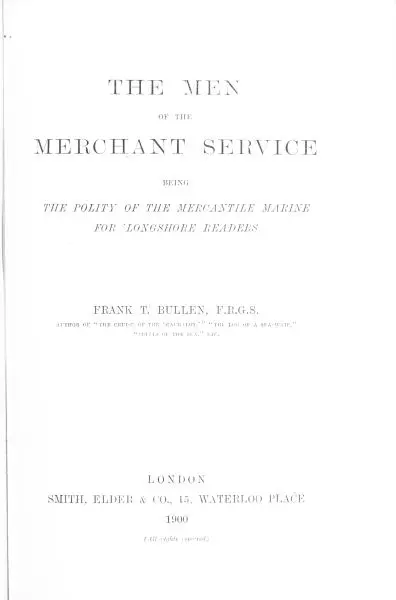
"The Men of the Merchant Service" by Frank Thomas Bullen is a detailed account of life and conditions in the British mercantile marine, written in the late 19th century. This work aims to provide a comprehensive guide for both parents and young men considering a career at sea, exploring the roles, responsibilities, and challenges encountered by those in the Merchant Service. It promises to shed light on various shipboard positions, particularly the intricacies of a shipmaster's duties, and the contrasts between sailing ships and steamers. At the start of the book, the author expresses his recognition of the ignorance surrounding the mercantile marine among the general public, despite its critical importance to British commerce. Bullen outlines his motivation for writing, as there are few reliable resources on the subject, especially for youth aspiring to become seamen. The opening chapters introduce the progression from cadet training to achieving the status of a shipmaster, detailing the numerous qualifications and competencies necessary for each stage. Bullen emphasizes the personal qualities required to succeed in maritime roles, setting the stage for an exploration of the intricate world of seafaring and the dedicated individuals who navigate it.
Introduction adapted from the source catalogue; source summaries may be automatically generated.
Free to read · English · 95,808 words · No account needed
MAKE TIME FOR A GOOD BOOK
On by default. Untick to stop anonymous reading totals. Each page counts after 10 seconds in view. How this works.
Anonymous counting is on unless you have switched it off.
And now we approach the discussion of the A.B., the man of the rank and file, the "common sailor," as he is sometimes contemptuously termed by those who, God forgive them, know absolutely nothing of his uncommon trials, virtues, and temptations. It is most probable, nay, almost certain, that for what I have written in the preceding pages the A.B. will bear me little good-will. He will most likely set me down in his own mind as another mercenary scoundrel, paid by the owners to vilify the fo'c'sle man. When you come to look at the matter you will see that it must be so. Such a one-sided view of themselves is not confined to the sailor. It is rampant among men who should be able to weigh questions impartially--intelligent workmen ashore of all kinds. As a general rule, they lay themselves open to the charge of grossest unfairness, because they will not abide the truth about themselves. One need not use any names, because they will occur to all who keep in touch with current events--names of men who have been chosen from among their fellows for their exceptional abilities, and empowered to represent them in various councils. As long as such representatives could see in capital no white and in labour no black they were popular, cheered to the echo; but as soon as they learned the fundamental fact that there are two sides to every question, and wisely endeavoured to use that knowledge, they were subjected to much abuse, gross misrepresentation, and perhaps the mildest suggestion made about them was that they had been "got at."
But although the foremast hand finds it impossible to be fair; although he, taken collectively, regards all owners as blood-suckers, and all officers as traitors or tyrants, every one of his well-wishers--of whom I claim to be one of the warmest--can, and do, find many excuses for him. Please to consider his position. For the great majority of his days he lives in the utmost ignorance of what is going on in the world. He is like the inhabitants of some undiscovered country where-into none of the latter-day adjuncts of civilization had penetrated. From year's end to year's end he never reads a newspaper, at least not until it is long out of date. During his quiet voyaging from one side of the world to the other, the whole political aspect of the planet may be changed, but he knows nor recks nothing of it. Speak to him of the rise and fall of governments, the strife of parties, the hubbub of a general election, and he will look upon you as one that talks in an unknown tongue. To those of his class who read, supposing that they possess the right books, this aloofness from the world-movement is all to the good: they can enter into the spirit of those giants of literature as no other men can. Bringing to the consideration of immense topics minds unfettered and undisturbed by the petty squabbling and sordid tricks of politics, whether Imperial or local, they enjoy their reading as few other men do. One of my chief delights when I was before the mast was to sit on deck in the brilliant tropical moonlight, or on a lotus-eating evening before the dark had arrived, and read aloud to the assembled watch. I had no inattentive listeners. Hardly breathing, except to keep their pipes aglow, they drank in every syllable, their long acquaintance with all sorts of hybrid variants of English enabling them to catch the sense, even if they were unable to grasp the full meaning of the sonorous sentences. For I never would read them rubbish, or what I considered rubbish. I carried with me for years three volumes of the Chandos Classics, the "Odyssey," the "Æneid," and Longfellow. Shakespeare I always had, and I should be puzzled indeed to say which of the two, the "Odyssey" or Shakespeare, they relished most. They did not favour discussion of the books read very much; they were content to enjoy. I grieve to say that their discussions were usually most trivial and unprofitable. They would start an argument upon some question about which none of them knew anything, and carry it on with the utmost fierceness and heat, even unto blows. Once I used to intervene with some reliable information, but I found that when, in reply to the query, "Who told you that?" I admitted that I had learned it from books, I was thenceforward scouted as a purveyor of second-hand information, and I desisted.
Your reading position is saved on this browser. Take it to another device with a library code. Reading pages adapt to text, rather than matching a printed edition.
Frank Thomas Bullen

Frank Thomas Bullen

Frank Thomas Bullen

Frank Thomas Bullen
BEHIND THE BOOK
This eBook is for the use of anyone anywhere in the United States and most other parts of the world at no cost and with almost no restrictions whatsoever. You may copy it, give it away or re-use it under the terms of the Project Gutenberg License included with this eBook or online at www.gutenberg.org. If you are not located in the United States, you will have to check the laws of the country where you are located before using this eBook. Read the source licence.
The original source file, including credits and licence, is retained by this library. Request an original-format copy at no charge. Please include the book title and Project Gutenberg identifier #64896.
KEEP YOUR CURIOSITY GOING
Cécile Tormay

Moritz Busch
John L. Ransom
Frances Wright
Cécile Tormay

Mabel Potter Daggett