
Recollections The Reminiscences of the Busy Life of One Who Has Played the Varied Parts of Sailor, Author & Lecturer
Frank Thomas Bullen
THE CLASSIC COLLECTION · 1900
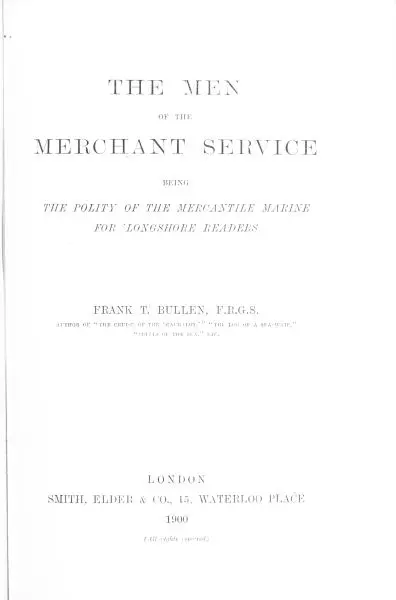
"The Men of the Merchant Service" by Frank Thomas Bullen is a detailed account of life and conditions in the British mercantile marine, written in the late 19th century. This work aims to provide a comprehensive guide for both parents and young men considering a career at sea, exploring the roles, responsibilities, and challenges encountered by those in the Merchant Service. It promises to shed light on various shipboard positions, particularly the intricacies of a shipmaster's duties, and the contrasts between sailing ships and steamers. At the start of the book, the author expresses his recognition of the ignorance surrounding the mercantile marine among the general public, despite its critical importance to British commerce. Bullen outlines his motivation for writing, as there are few reliable resources on the subject, especially for youth aspiring to become seamen. The opening chapters introduce the progression from cadet training to achieving the status of a shipmaster, detailing the numerous qualifications and competencies necessary for each stage. Bullen emphasizes the personal qualities required to succeed in maritime roles, setting the stage for an exploration of the intricate world of seafaring and the dedicated individuals who navigate it.
Introduction adapted from the source catalogue; source summaries may be automatically generated.
Free to read · English · 95,808 words · No account needed
MAKE TIME FOR A GOOD BOOK
On by default. Untick to stop anonymous reading totals. Each page counts after 10 seconds in view. How this works.
Anonymous counting is on unless you have switched it off.
There is, of course, another side to the question, and it applies almost exclusively to the fine seamen that are reared in America and the British North American colonies. Strangely enough, these splendid men do not profit as they might be expected to do by the facilities for education provided in their go-ahead country. It would seem as if they thought that it was necessary for a man of action to coarsen himself; to become--I say it without any intention of giving offence--more or less of a ruffian. The quiet, firm authority which marks the native-born gentleman does not appeal to them. The ideal Yankee or "Blue-nose" mate is a splendid seaman, with a voice of brass and a fist of iron. When work is afoot he may be heard all over the ship, and it is impossible to conceive of him being a silent, reserved, and thoughtful man. In the practice of seamanship this plan seems to work well. I shall never forget while lying in Hong Kong harbour a fine American ship, the Colorado, coming in one evening. We had done work for the day, and were smoking the after-supper pipe on the forecastle head. Therefore we were keenly observant of the doings of the newcomer, and with that minute admiration of smartness possessed by all seamen, even the laziest, we watched her. She came grandly up to her moorings close to us, amidst a very hurricane of roaring orders, and presently was securely moored. Then, instead of furling sails and coiling up ropes, as would have been the case with an English ship, the crew began to strip the yards of the sails and stop up the running-gear. The mate was ubiquitous. His tremendous tones reverberated over the quiet harbour incessantly, weighted by the weird profanity affected by American seamen. The men flew from spar to spar, sails descended magically, were seized, stopped up, and stowed away immediately. Before it was quite dark the ship was in as complete harbour trim as if she had been anchored a week, and even the few sea-marks upon her outside had been carefully removed. Then, and not till then, were the hard-driven crew permitted to seek the forecastle and rest from their labours. And although every one of our crew were loud in their condemnation of the "infernal nigger-drivin'," as they called it, they did not withhold their admiration of the consummate smartness of the whole business, and added in chorus: "Yes, but y' sh'd see th' grub them fellows hev got ter go below ter. When a man gits 'nough t' eat 'ee don' mind workin'." It is conceivable that the splendid officer who thus made things fly could hardly write his own name, since it is the good sailor-man an American skipper looks for, not a gentleman. More than that, I'm afraid the more "bucko" he is the better, from the skipper's point of view. To be quiet and reserved is decidedly against him. I was once in an American ship where the skipper was old--too old to go to sea really, although he had no doubt been a smart man in his day. He shipped a mate in London who was an Englishman, and had commanded some first-rate English ships. As far as I can remember, he was a good seaman, although a little rusty from having been long in command. But he certainly was a gentleman, and he had not been on board a week before the "old man" hated him with an intensity of fervour that was almost comical to see, simply because he could not roar, neither could he kick. I heard the "old man" say to him one day, "See here, Mr. Small, I hain't no use fer a man as mate of my ship that creeps aroun' 's if he wuz dum 'n paralytic. For God's sake, try an' hustle them squarheds some, 'r we shain't get t' Melbun this fall." Yet the ship was well handled; no thanks, I am bound to say, to the mate's quietness, but to the traditions of the American Merchant Service, which have been followed and improved upon by the Blue-nose, and may be summed up in the following words of the Yankee mate to his crew: "W'en I say 'walk,' I want ye t' run; w'en I say 'run,' I want ye t' fly." And also the typical words of the mate of the lumber-carrying ship to his crew: "Here, knock off work and carry deals." To their prayer for a little rest he says, in tones of bitterest scorn, "Rest! Rest when you're dead."
Your reading position is saved on this browser. Take it to another device with a library code. Reading pages adapt to text, rather than matching a printed edition.
Frank Thomas Bullen

Frank Thomas Bullen

Frank Thomas Bullen

Frank Thomas Bullen
BEHIND THE BOOK
This eBook is for the use of anyone anywhere in the United States and most other parts of the world at no cost and with almost no restrictions whatsoever. You may copy it, give it away or re-use it under the terms of the Project Gutenberg License included with this eBook or online at www.gutenberg.org. If you are not located in the United States, you will have to check the laws of the country where you are located before using this eBook. Read the source licence.
The original source file, including credits and licence, is retained by this library. Request an original-format copy at no charge. Please include the book title and Project Gutenberg identifier #64896.
KEEP YOUR CURIOSITY GOING
Cécile Tormay

Moritz Busch
John L. Ransom
Frances Wright
Cécile Tormay

Mabel Potter Daggett