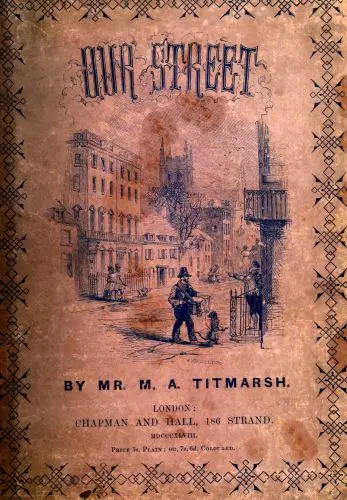
“Our Street”
William Makepeace Thackeray
THE CLASSIC COLLECTION · 1856
"The Memoirs of Mr. Charles J. Yellowplush" by William Makepeace Thackeray is a novel written in the early 19th century, characterized by satirical humor and social commentary. The narrative is presented through the voice of the protagonist, Mr. Charles James Harrington Fitzroy Yellowplush, a former footman who offers an irreverent view of society and its class distinctions, reflecting Thackeray's ingenuity in critiquing the social structures of his time. At the start of the story, readers are introduced to the life and origins of Charles Yellowplush, who recounts his childhood and early experiences with his eccentric mother and a series of jobs as a servant. He shares various anecdotes, revealing the chaotic and often absurd circumstances of his upbringing. As he describes his first position working for Mr. Bago and later for the flamboyant master, Mr. Frederic Altamont, the stage is set for a blend of humor and social observation as Yellowplush navigates the complexities of servant-master dynamics and the world of fashion and money. His reflections provide insight into the lives of both lower and upper classes, making for an engaging exploration into Victorian society.
Introduction adapted from the source catalogue; source summaries may be automatically generated.
Free to read · English · 58,223 words · No account needed
MAKE TIME FOR A GOOD BOOK
On by default. Untick to stop anonymous reading totals. Each page counts after 10 seconds in view. How this works.
Anonymous counting is on unless you have switched it off.
Pore Dawkins left our rooms as happy as a prins. “Here, Charles,” says he, and flung me a sovring. Pore fellow! pore fellow! I knew what was a-comin!
But the best of it was, that these 13 sovrings which Dawkins won, MASTER HAD BORROWED THEM FROM MR. BLEWITT! I brought 'em, with 7 more, from that young genlmn's chambers that very morning: for, since his interview with master, Blewitt had nothing to refuse him.
Well, shall I continue the tail? If Mr. Dawkins had been the least bit wiser, it would have taken him six months befoar he lost his money; as it was, he was such a confunded ninny, that it took him a very short time to part with it.
Nex day (it was Thursday, and master's acquaintance with Mr. Dawkins had only commenced on Tuesday), Mr. Dawkins, as I said, gev his party,--dinner at 7. Mr. Blewitt and the two Mr. D.'s as befoar. Play begins at 11. This time I knew the bisness was pretty serious, for we suvvants was packed off to bed at 2 o'clock. On Friday, I went to chambers--no master--he kem in for 5 minutes at about 12, made a little toilit, ordered more devvles and soda-water, and back again he went to Mr. Dawkins's.
They had dinner there at 7 again, but nobody seamed to eat, for all the vittles came out to us genlmn: they had in more wine though, and must have drunk at least two dozen in the 36 hours.
At ten o'clock, however, on Friday night, back my master came to his chambers. I saw him as I never saw him before, namly reglar drunk. He staggered about the room, he danced, he hickipd, he swoar, he flung me a heap of silver, and, finely, he sunk down exosted on his bed; I pullin off his boots and close, and making him comfrabble.
When I had removed his garmints, I did what it's the duty of every servant to do--I emtied his pockits, and looked at his pockit-book and all his letters: a number of axdents have been prevented that way.
I found there, among a heap of things, the following pretty dockyment--
I. O. U.
L 4700.
THOMAS SMITH DAWKINS.
Friday, 16th January.
There was another bit of paper of the same kind--“I. 0. U. four hundred pounds: Richard Blewitt:” but this, in corse, ment nothink.
Nex mornin, at nine, master was up, and as sober as a judg. He drest, and was off to Mr. Dawkins. At ten, he ordered a cab, and the two gentlmn went together.
“Where shall he drive, sir?” says I.
“Oh, tell him to drive to THE BANK.”
Your reading position is saved on this browser. Take it to another device with a library code. Reading pages adapt to text, rather than matching a printed edition.
William Makepeace Thackeray
William Makepeace Thackeray
Charles Dickens & William Makepeace Thackeray
William Makepeace Thackeray
BEHIND THE BOOK
This eBook is for the use of anyone anywhere in the United States and most other parts of the world at no cost and with almost no restrictions whatsoever. You may copy it, give it away or re-use it under the terms of the Project Gutenberg License included with this eBook or online at www.gutenberg.org. If you are not located in the United States, you will have to check the laws of the country where you are located before using this eBook. Read the source licence.
The original source file, including credits and licence, is retained by this library. Request an original-format copy at no charge. Please include the book title and Project Gutenberg identifier #2796.
KEEP YOUR CURIOSITY GOING
Coulson Kernahan

Maurice Baring
Frances Wright
Cécile Tormay

Frederic Jesup Stimson

W. H. P. (William Henry Pope) Jarvis