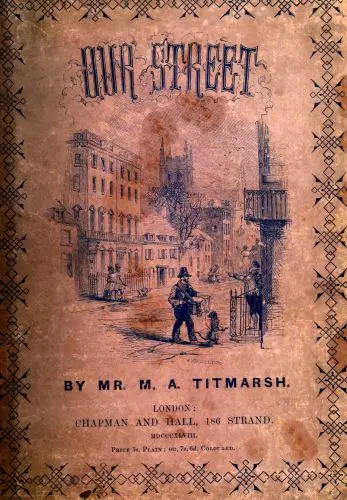
“Our Street”
William Makepeace Thackeray
THE CLASSIC COLLECTION · 1856
"The Memoirs of Mr. Charles J. Yellowplush" by William Makepeace Thackeray is a novel written in the early 19th century, characterized by satirical humor and social commentary. The narrative is presented through the voice of the protagonist, Mr. Charles James Harrington Fitzroy Yellowplush, a former footman who offers an irreverent view of society and its class distinctions, reflecting Thackeray's ingenuity in critiquing the social structures of his time. At the start of the story, readers are introduced to the life and origins of Charles Yellowplush, who recounts his childhood and early experiences with his eccentric mother and a series of jobs as a servant. He shares various anecdotes, revealing the chaotic and often absurd circumstances of his upbringing. As he describes his first position working for Mr. Bago and later for the flamboyant master, Mr. Frederic Altamont, the stage is set for a blend of humor and social observation as Yellowplush navigates the complexities of servant-master dynamics and the world of fashion and money. His reflections provide insight into the lives of both lower and upper classes, making for an engaging exploration into Victorian society.
Introduction adapted from the source catalogue; source summaries may be automatically generated.
Free to read · English · 58,223 words · No account needed
MAKE TIME FOR A GOOD BOOK
On by default. Untick to stop anonymous reading totals. Each page counts after 10 seconds in view. How this works.
Anonymous counting is on unless you have switched it off.
Fust, they playd crown pints, and a pound the bett. At this game they were wonderful equill; and about supper-time (when grilled am, more shampang, devld biskits, and other things, was brot in) the play stood thus: Mr. Dawkins had won 2 pounds; Mr. Blewitt 30 shillings; the Honrabble Mr. Deuceace having lost 3L. l0s. After the devvle and the shampang the play was a little higher. Now it was pound pints, and five pound the bet. I thought, to be sure, after hearing the complymints between Blewitt and master in the morning, that now poor Dawkins's time was come.
Not so: Dawkins won always, Mr. B. betting on his play, and giving him the very best of advice. At the end of the evening (which was abowt five o'clock the nex morning) they stopt. Master was counting up the skore on a card.
“Blewitt,” says he, “I've been unlucky. I owe you, let me see--yes, five-and-forty pounds?”
“Five-and-forty,” says Blewitt, “and no mistake!”
“I will give you a cheque,” says the honrabble genlmn.
“Oh! don't mention it, my dear sir!” But master got a grate sheet of paper, and drew him a check on Messeers. Pump, Algit and Co., his bankers.
“Now,” says master, “I've got to settle with you, my dear Mr. Dawkins. If you had backd your luck, I should have owed you a very handsome sum of money. Voyons, thirteen points at a pound--it is easy to calculate;” and drawin out his puss, he clinked over the table 13 goolden suverings, which shon till they made my eyes wink.
So did pore Dawkinses, as he put out his hand, all trembling, and drew
them in.
“Let me say,” added master, “let me say (and I've had some little experience), that you are the very best ecarte player with whom I ever sat down.”
Dawkinses eyes glissened as he put the money up, and said, “Law,
Deuceace, you flatter me.”
FLATTER him! I should think he did. It was the very think which master
ment.
“But mind you, Dawkins,” continyoud he, “I must have my revenge; for I'm ruined--positively ruined by your luck.”
“Well, well,” says Mr. Thomas Smith Dawkins, as pleased as if he had gained a millium, “shall it be to-morrow? Blewitt, what say you?”
Mr. Blewitt agreed, in course. My master, after a little demurring, consented too. “We'll meet,” says he, “at your chambers. But mind, my dear fello, not too much wine: I can't stand it at any time, especially when I have to play ecarte with YOU.”
Your reading position is saved on this browser. Take it to another device with a library code. Reading pages adapt to text, rather than matching a printed edition.
William Makepeace Thackeray
William Makepeace Thackeray
Charles Dickens & William Makepeace Thackeray
William Makepeace Thackeray
BEHIND THE BOOK
This eBook is for the use of anyone anywhere in the United States and most other parts of the world at no cost and with almost no restrictions whatsoever. You may copy it, give it away or re-use it under the terms of the Project Gutenberg License included with this eBook or online at www.gutenberg.org. If you are not located in the United States, you will have to check the laws of the country where you are located before using this eBook. Read the source licence.
The original source file, including credits and licence, is retained by this library. Request an original-format copy at no charge. Please include the book title and Project Gutenberg identifier #2796.
KEEP YOUR CURIOSITY GOING
Coulson Kernahan

Maurice Baring
Frances Wright
Cécile Tormay

Frederic Jesup Stimson

W. H. P. (William Henry Pope) Jarvis