READ · DISCOVER · ENJOYClassic literature · Always free
The Maya Indians of Southern Yucatan and Northern British Honduras — digital edition cover

THE CLASSIC COLLECTION · 1900

The Maya Indians of Southern Yucatan and Northern British Honduras

"The Maya Indians of Southern Yucatan and Northern British Honduras" by Thomas W. F. Gann is a scientific publication written in the early 20th century. This work provides an in-depth analysis of the customs, ceremonies, and way of life of the Maya Indians residing in the southern Yucatan and northern British Honduras regions. Gann explores various aspects of their culture, including social practices, agriculture, crafts, and traditional beliefs, aiming to document and preserve the knowledge of these indigenous communities. At the start of the book, Gann introduces the contemporary state of two Maya tribes—the Santa Cruz and the Icaichè—highlighting their declining populations due to historical pressures and government policies. He describes the geographical setting of these tribes, noting the environmental features that shape their daily lives. The opening also touches on the physical characteristics of the Maya people, their dresses, and introduces key aspects of their daily activities, such as agriculture and social behaviors, setting the stage for a comprehensive exploration of their culture. Ultimately, Gann's detailed observations and descriptions aim to provide a richer understanding of the Maya Indians and the challenges they face in preserving their traditions amidst external influences.

Introduction adapted from the source catalogue; source summaries may be automatically generated.

Start reading ↓

Free to read · English · 58,216 words · No account needed

MAKE TIME FOR A GOOD BOOK

The Maya Indians of Southern Yucatan and Northern British Honduras

On by default. Untick to stop anonymous reading totals. Each page counts after 10 seconds in view. How this works.

Anonymous counting is on unless you have switched it off.

The Maya Indians of Southern Yucatan and Northern British Honduras

MOUND NO. 23

Mound No. 23 was situated near the northern end of Chetumal Bay, on the east coast of Yucatan. The mound was 12 feet in height, roughly circular in shape, and 12 yards in diameter at the base. The top was flattened, and near its center a circular space 10 feet in diameter was inclosed by a low, roughly built stone wall. On digging within this space there were brought to light, immediately beneath the surface, the following objects:

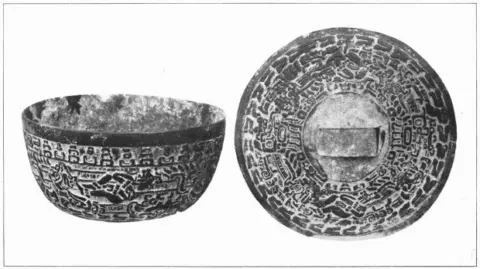
(a) Part of a large hourglass-shaped incense burner in rough pottery, decorated with a human figure in high relief, 20 inches high. Unfortunately the left arm and leg and part of the chest are missing from this figure, which, judging by the headdress, curved nose, and tusk-like teeth, is probably intended to represent the God Cuculcan. The left foot is sandaled, and on the left wrist is a loop-fastened string of beads, while over the front of the chest hangs a breastplate of quilted cotton, decorated with flaps and fastened over the shoulders.[47] Round the neck is a flat gorget, decorated with round bosses, and in the ears are large circular ear plugs with tassels dependent from their centers. Over the upper part of the nose is a curious curved, snake-like ornament. The lofty headdress, with broad flaps extending over each ear almost to the shoulders, has in front the head and upper jaw of some mythological animal, the latter projecting well over the face of the god, as if in the act of swallowing him. Pointing downward from the plumed ornament on the right side of the figure (the corresponding one on the left has been broken away) is a crotalus head, which so often accompanies representations of this god. The figure still exhibits traces of blue and white paint on that part of the face protected by the broad flap of the headdress, and originally doubtless the whole was painted in various colors, which first exposure to rain and afterward burial in moist earth, have almost completely obliterated. (b) An earthenware figure, 26 inches in height, which doubtless at one time ornamented the outer surface of a large incense burner. The left foot and leg are gone; the right foot is covered with a sandal held on by a curved heelpiece rising above the back of the ankle, and fastened in a bow in front of the instep, while a leather thong passing between the great and second toe is attached to this, holding the front part of the sandal in place. Round the leg is a broad band, with a row of semilunar ornaments projecting downward from it. The maxtli has been broken away, but the quilted cotton chest covering is still in position. This is held in place by bands passing over the shoulders, and is ornamented by a row of five circular studs passing down its center, with long tassels below, which must have hung on each side of the maxtli, and tassels above, attached near the shoulder, which hang down on each side of it. The throat is covered by a broad band, decorated along its lower edge with four pairs of small circular studs. Round the left wrist is a bracelet composed of six flat oval beads, fastened in front by an ornamental loop. The left arm is extended, and in the hand, held palm upward, is grasped an acorn-shaped object from which project nine spikes. From each side of the mouth project long curved tusks. The nose is of unusual shape, being long, straight, and slender; the bridge is covered by a curved snake-like object. The headdress rises 6 inches above the superciliary ridges; its lower part consists of the head and upper mandible of the bill of some bird, probably a hawk or eagle. Above this rises a hollow cylindrical erection, with the upper border scalloped, supported on each side by objects which suggest broad stone blades, hafted in club-shaped handles, and ornamented in front with a plume of feathers. There can be little doubt that this figure is meant to represent the God Itzamna, as the sunken cheeks, the single large tooth on each side of the mouth, and the prominent, though well-formed nose, are all characteristics of this god. (c) An earthenware figure, closely similar in size and appearance to those just described. Of the face only the left eye, the left side of the mouth, and the nose are left; the last named is short, rounded, and well formed, and is ornamented at its root with a small round stud. (d) Fragments of a rough bowl of yellowish pottery, which must have been of considerable size. Unfortunately only four fragments were found; these exhibit on their outer surfaces parts of a hieroglyphic inscription, roughly incised in the clay while it was soft, with some sharp-pointed instrument. Of the many glyphic inscriptions which have been found at different times in British Honduras, painted on pottery and stucco and incised on pottery, stone, and other material, none has proved to be an initial series, which would fix the period in the Maya long count when the mounds, temples, burial places, and other monuments scattered throughout this colony, were constructed. According to recent researches the latest date recorded by an initial series on the monoliths of Quirigua, in Guatemala, is within about 70 years of the earliest date recorded by any of the initial series found up to the present among the ruins of Yucatan.[48] As the tide of Maya migration was undoubtedly from south to north, and as British Honduras stands midway between Guatemala and Yucatan, it is only reasonable to suppose that the colonization of the greater part of it by the Maya took place at some period between the abandonment of the cities of Quirigua and Coban, and the rise of Chichen Itza, Uxmal, and other Yucatan cities. This theory is borne out by the fact that the hieroglyphic inscriptions and pictographs found in the colony are closely allied to those found both in the northern and southern cities; moreover, the painted stucco and wooden lintels so common in Yucatan, but not found in the south, are present here, while the sculptured stelæ found in the south, but of extreme rarity in northern Yucatan, are (though not very numerous and poorly executed) found in British Honduras. (e) Large quantities of fragments of rough pottery vases and bowls; some of these evidently belonged to hourglass-shaped incense burners, 2 to 3 feet high, decorated with incised lines and glyphs, raised bands, and studs, but without human figures on their exterior surfaces. A number of these fragments were taken down to the camp of some chicle bleeders in the vicinity; unfortunately in the night the palm-leaf shelters caught fire and the whole camp was burned to the ground, most of the potsherds being lost or destroyed. Among these were probably the missing parts of the clay figures and of the hieroglyphic-covered pot. The whole of the mound was dug down, but with the exception of traces of a wall built of squared stones on the ground level, nothing worthy of note was found in it. It is almost certain that this mound had never been visited from the time of its erection till its discovery last year by chicle bleeders looking for sapodilla trees in this very remote corner of Yucatan. The clay images were lying on the top of the mound, partially uncovered, and had anyone, even an Indian, visited the place, they would almost certainly have removed these, as there is always a ready market for ídolos, as the Indians call every relic of their ancestors, among curio collectors who visit Belize.

Your reading position is saved on this browser. Take it to another device with a library code. Reading pages adapt to text, rather than matching a printed edition.

BEHIND THE WORDS

About Thomas William Francis Gann

Thomas William Francis Gann (1867–1938). Explore The Maya Indians of Southern Yucatan and Northern British Honduras in this collection. These books span history.

Explore this author’s books →

THE READERS’ VERDICT

How did this story stay with you?

Not rated yet
Your rating for The Maya Indians of Southern Yucatan and Northern British Honduras

Be the first to share your verdict.

One rating per browser, which you can change or remove. A necessary browser identifier remembers your vote. How ratings work

A GOOD STORY DESERVES COMPANY

Pass this book along.

A great read is even better when it’s shared.

SEND A LITTLE INSPIRATION

Share this book

BEHIND THE BOOK

Edition & source details.

Title
The Maya Indians of Southern Yucatan and Northern British Honduras
Author
Thomas William Francis Gann
First publication (Open Library catalogue match)
1900
Digital edition publisher
Project Gutenberg
Gutenberg release date
2014-09-26
Language
English
Source edition imprint
Not stated in source catalogue
Source identifier
Project Gutenberg #46973
Contributors
No additional named contributors in source metadata

Public-domain source & licence

This eBook is for the use of anyone anywhere in the United States and most other parts of the world at no cost and with almost no restrictions whatsoever. You may copy it, give it away or re-use it under the terms of the Project Gutenberg License included with this eBook or online at www.gutenberg.org. If you are not located in the United States, you will have to check the laws of the country where you are located before using this eBook. Read the source licence.

Full source licence and obtaining an original copy

The original source file, including credits and licence, is retained by this library. Request an original-format copy at no charge. Please include the book title and Project Gutenberg identifier #46973.

the full Project Gutenberg License must appear
prominently whenever any copy of a Project Gutenberg work (any work
on which the phrase “Project Gutenberg” appears, or with which the
phrase “Project Gutenberg” is associated) is accessed, displayed,
performed, viewed, copied or distributed:

This eBook is for the use of anyone anywhere in the United States and most
other parts of the world at no cost and with almost no restrictions
whatsoever. You may copy it, give it away or re-use it under the terms
of the Project Gutenberg™ License included with this eBook or online
at www.gutenberg.org. If you
are not located in the United States, you will have to check the laws
of the country where you are located before using this eBook.

1.E.2. If an individual Project Gutenberg electronic work is
derived from texts not protected by U.S. copyright law (does not
contain a notice indicating that it is posted with permission of the
copyright holder), the work can be copied and distributed to anyone in
the United States without paying any fees or charges. If you are
redistributing or providing access to a work with the phrase “Project
Gutenberg” associated with or appearing on the work, you must comply
either with the requirements of paragraphs 1.E.1 through 1.E.7 or
obtain permission for the use of the work and the Project Gutenberg
trademark as set forth in paragraphs 1.E.8 or 1.E.9.

1.E.3. If an individual Project Gutenberg electronic work is posted
with the permission of the copyright holder, your use and distribution
must comply with both paragraphs 1.E.1 through 1.E.7 and any
additional terms imposed by the copyright holder. Additional terms
will be linked to the Project Gutenberg License for all works
posted with the permission of the copyright holder found at the
beginning of this work.

1.E.4. Do not unlink or detach or remove the full Project Gutenberg
License terms from this work, or any files containing a part of this
work or any other work associated with Project Gutenberg.

1.E.5. Do not copy, display, perform, distribute or redistribute this
electronic work, or any part of this electronic work, without
prominently displaying the sentence set forth in paragraph 1.E.1 with
active links or immediate access to the full terms of the Project
Gutenberg License.

1.E.6. You may convert to and distribute this work in any binary,
compressed, marked up, nonproprietary or proprietary form, including
any word processing or hypertext form. However, if you provide access
to or distribute copies of a Project Gutenberg work in a format
other than “Plain Vanilla ASCII” or other format used in the official
version posted on the official Project Gutenberg website
(www.gutenberg.org), you must, at no additional cost, fee or expense
to the user, provide a copy, a means of exporting a copy, or a means
of obtaining a copy upon request, of the work in its original “Plain
Vanilla ASCII” or other form. Any alternate format must include the
full Project Gutenberg License as specified in paragraph 1.E.1.

1.E.7. Do not charge a fee for access to, viewing, displaying,
performing, copying or distributing any Project Gutenberg works
unless you comply with paragraph 1.E.8 or 1.E.9.

1.E.8. You may charge a reasonable fee for copies of or providing
access to or distributing Project Gutenberg electronic works
provided that:

• You pay a royalty fee of 20% of the gross profits you derive from
the use of Project Gutenberg works calculated using the method
you already use to calculate your applicable taxes. The fee is owed
to the owner of the Project Gutenberg trademark, but he has
agreed to donate royalties under this paragraph to the Project
Gutenberg Literary Archive Foundation. Royalty payments must be paid
within 60 days following each date on which you prepare (or are
legally required to prepare) your periodic tax returns. Royalty
payments should be clearly marked as such and sent to the Project
Gutenberg Literary Archive Foundation at the address specified in
Section 4, “Information about donations to the Project Gutenberg
Literary Archive Foundation.”

• You provide a full refund of any money paid by a user who notifies
you in writing (or by e-mail) within 30 days of receipt that s/he
does not agree to the terms of the full Project Gutenberg™
License. You must require such a user to return or destroy all
copies of the works possessed in a physical medium and discontinue
all use of and all access to other copies of Project Gutenberg™
works.

• You provide, in accordance with paragraph 1.F.3, a full refund of
any money paid for a work or a replacement copy, if a defect in the
electronic work is discovered and reported to you within 90 days of
receipt of the work.

• You comply with all other terms of this agreement for free
distribution of Project Gutenberg™ works.


1.E.9. If you wish to charge a fee or distribute a Project
Gutenberg™ electronic work or group of works on different terms than
are set forth in this agreement, you must obtain permission in writing
from the Project Gutenberg Literary Archive Foundation, the manager of
the Project Gutenberg™ trademark. Contact the Foundation as set
forth in Section 3 below.

1.F.

1.F.1. Project Gutenberg volunteers and employees expend considerable
effort to identify, do copyright research on, transcribe and proofread
works not protected by U.S. copyright law in creating the Project
Gutenberg™ collection. Despite these efforts, Project Gutenberg™
electronic works, and the medium on which they may be stored, may
contain “Defects,” such as, but not limited to, incomplete, inaccurate
or corrupt data, transcription errors, a copyright or other
intellectual property infringement, a defective or damaged disk or
other medium, a computer virus, or computer codes that damage or
cannot be read by your equipment.

1.F.2. LIMITED WARRANTY, DISCLAIMER OF DAMAGES - Except for the “Right
of Replacement or Refund” described in paragraph 1.F.3, the Project
Gutenberg Literary Archive Foundation, the owner of the Project
Gutenberg™ trademark, and any other party distributing a Project
Gutenberg™ electronic work under this agreement, disclaim all
liability to you for damages, costs and expenses, including legal
fees. YOU AGREE THAT YOU HAVE NO REMEDIES FOR NEGLIGENCE, STRICT
LIABILITY, BREACH OF WARRANTY OR BREACH OF CONTRACT EXCEPT THOSE
PROVIDED IN PARAGRAPH 1.F.3. YOU AGREE THAT THE FOUNDATION, THE
TRADEMARK OWNER, AND ANY DISTRIBUTOR UNDER THIS AGREEMENT WILL NOT BE
LIABLE TO YOU FOR ACTUAL, DIRECT, INDIRECT, CONSEQUENTIAL, PUNITIVE OR
INCIDENTAL DAMAGES EVEN IF YOU GIVE NOTICE OF THE POSSIBILITY OF SUCH
DAMAGE.

1.F.3. LIMITED RIGHT OF REPLACEMENT OR REFUND - If you discover a
defect in this electronic work within 90 days of receiving it, you can
receive a refund of the money (if any) you paid for it by sending a
written explanation to the person you received the work from. If you
received the work on a physical medium, you must return the medium
with your written explanation. The person or entity that provided you
with the defective work may elect to provide a replacement copy in
lieu of a refund. If you received the work electronically, the person
or entity providing it to you may choose to give you a second
opportunity to receive the work electronically in lieu of a refund. If
the second copy is also defective, you may demand a refund in writing
without further opportunities to fix the problem.

1.F.4. Except for the limited right of replacement or refund set forth
in paragraph 1.F.3, this work is provided to you ‘AS-IS’, WITH NO
OTHER WARRANTIES OF ANY KIND, EXPRESS OR IMPLIED, INCLUDING BUT NOT
LIMITED TO WARRANTIES OF MERCHANTABILITY OR FITNESS FOR ANY PURPOSE.

1.F.5. Some states do not allow disclaimers of certain implied
warranties or the exclusion or limitation of certain types of
damages. If any disclaimer or limitation set forth in this agreement
violates the law of the state applicable to this agreement, the
agreement shall be interpreted to make the maximum disclaimer or
limitation permitted by the applicable state law. The invalidity or
unenforceability of any provision of this agreement shall not void the
remaining provisions.

1.F.6. INDEMNITY - You agree to indemnify and hold the Foundation, the
trademark owner, any agent or employee of the Foundation, anyone
providing copies of Project Gutenberg™ electronic works in
accordance with this agreement, and any volunteers associated with the
production, promotion and distribution of Project Gutenberg™
electronic works, harmless from all liability, costs and expenses,
including legal fees, that arise directly or indirectly from any of
the following which you do or cause to occur: (a) distribution of this
or any Project Gutenberg work, (b) alteration, modification, or
additions or deletions to any Project Gutenberg work, and (c) any
Defect you cause.

Section 2. Information about the Mission of Project Gutenberg

Project Gutenberg is synonymous with the free distribution of
electronic works in formats readable by the widest variety of
computers including obsolete, old, middle-aged and new computers. It
exists because of the efforts of hundreds of volunteers and donations
from people in all walks of life.

Volunteers and financial support to provide volunteers with the
assistance they need are critical to reaching Project Gutenberg’s
goals and ensuring that the Project Gutenberg collection will
remain freely available for generations to come. In 2001, the Project
Gutenberg Literary Archive Foundation was created to provide a secure
and permanent future for Project Gutenberg and future
generations. To learn more about the Project Gutenberg Literary
Archive Foundation and how your efforts and donations can help, see
Sections 3 and 4 and the Foundation information page at www.gutenberg.org.

Section 3. Information about the Project Gutenberg Literary Archive Foundation

The Project Gutenberg Literary Archive Foundation is a non-profit
501(c)(3) educational corporation organized under the laws of the
state of Mississippi and granted tax exempt status by the Internal
Revenue Service. The Foundation’s EIN or federal tax identification
number is 64-6221541. Contributions to the Project Gutenberg Literary
Archive Foundation are tax deductible to the full extent permitted by
U.S. federal laws and your state’s laws.

The Foundation’s business office is located at 41 Watchung Plaza #516,
Montclair NJ 07042, USA, +1 (862) 621-9288. Email contact links and up
to date contact information can be found at the Foundation’s website
and official page at www.gutenberg.org/contact

Section 4. Information about Donations to the Project Gutenberg
Literary Archive Foundation

Project Gutenberg™ depends upon and cannot survive without widespread
public support and donations to carry out its mission of
increasing the number of public domain and licensed works that can be
freely distributed in machine-readable form accessible by the widest
array of equipment including outdated equipment. Many small donations
($1 to $5,000) are particularly important to maintaining tax exempt
status with the IRS.

The Foundation is committed to complying with the laws regulating
charities and charitable donations in all 50 states of the United
States. Compliance requirements are not uniform and it takes a
considerable effort, much paperwork and many fees to meet and keep up
with these requirements. We do not solicit donations in locations
where we have not received written confirmation of compliance. To SEND
DONATIONS or determine the status of compliance for any particular state
visit www.gutenberg.org/donate.

While we cannot and do not solicit contributions from states where we
have not met the solicitation requirements, we know of no prohibition
against accepting unsolicited donations from donors in such states who
approach us with offers to donate.

International donations are gratefully accepted, but we cannot make
any statements concerning tax treatment of donations received from
outside the United States. U.S. laws alone swamp our small staff.

Please check the Project Gutenberg web pages for current donation
methods and addresses. Donations are accepted in a number of other
ways including checks, online payments and credit card donations. To
donate, please visit: www.gutenberg.org/donate.

Section 5. General Information About Project Gutenberg electronic works

Professor Michael S. Hart was the originator of the Project
Gutenberg concept of a library of electronic works that could be
freely shared with anyone. For forty years, he produced and
distributed Project Gutenberg eBooks with only a loose network of
volunteer support.

Project Gutenberg eBooks are often created from several printed
editions, all of which are confirmed as not protected by copyright in
the U.S. unless a copyright notice is included. Thus, we do not
necessarily keep eBooks in compliance with any particular paper
edition.

Most people start at our website which has the main PG search
facility: www.gutenberg.org.

This website includes information about Project Gutenberg,
including how to make donations to the Project Gutenberg Literary
Archive Foundation, how to help produce our new eBooks, and how to
subscribe to our email newsletter to hear about new eBooks.


KEEP YOUR CURIOSITY GOING

Your next chapter awaits.

Your privacy choices

Reading is always free. You can change these settings at any time.

Book banners link to our books on simonward.net. They do not use advertising cookies or tracking.

Privacy & cookie policy · Reading data and privacy controls